

The current state of Japanese Macaque that used to live on the monkey mountain.
June 25, 2026
About the monkey mountain
In November 2024, the exhibit at Monkey Hill—which had been beloved by many for 92 years—came to an end. Monkey Hill at Ueno Zoo has remained virtually unchanged since its completion and served as a pioneer for monkey hill exhibits in Japanese zoos.
Following the closure of the Monkey Hill exhibit, a series of events—including a panel exhibition, video streams, and the “guided tour”—were held in 2025, and the demolition work proceeded amid much public regret.
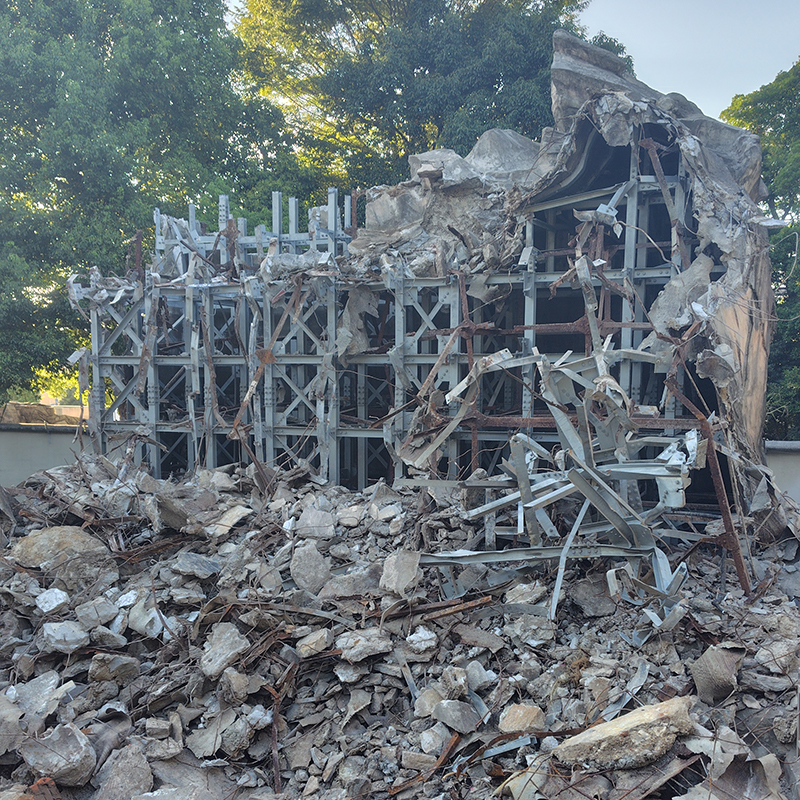
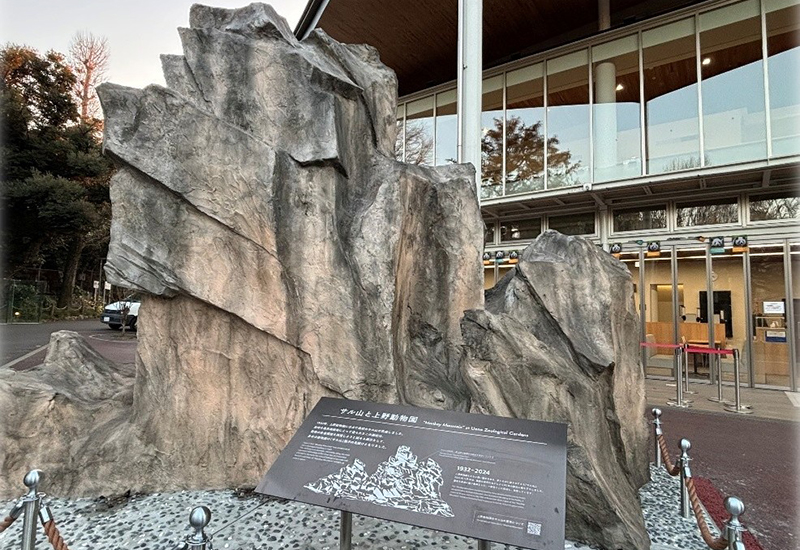
The upper part of the artificial rock has been relocated and is on display in front of "Saruyama Kitchen" as a symbol that connects the history of the monkey mountain, which has watched over Ueno Ueno Zoo for a long time, into the future. Come and see the monkey mountain up close, which has remained almost unchanged for 92 years.
About Japanese Macaque groups
Here's an update on Japanese Macaque that used to live on Monkey Mountain. This group came to Ueno Zoo in 2010 from the Shimokita Peninsula in Aomori Prefecture. The monkeys that inhabit the Shimokita Peninsula are the northernmost monkeys in the world, excluding humans, and have attracted attention from around the globe. They are also designated as a national natural monument.
However, in Aomori Prefecture, the increasing damage to agricultural crops and injuries to people became a problem, leading to the culling of the groups causing the damage. As a result, Ueno Zoo decided to welcome the group that was targeted for culling into its monkey enclosure. The group, which initially consisted of 23 monkeys, now numbers 35 and is being cared for in a temporary animal enclosure in a non-exhibition area.
Japanese Macaque breeding
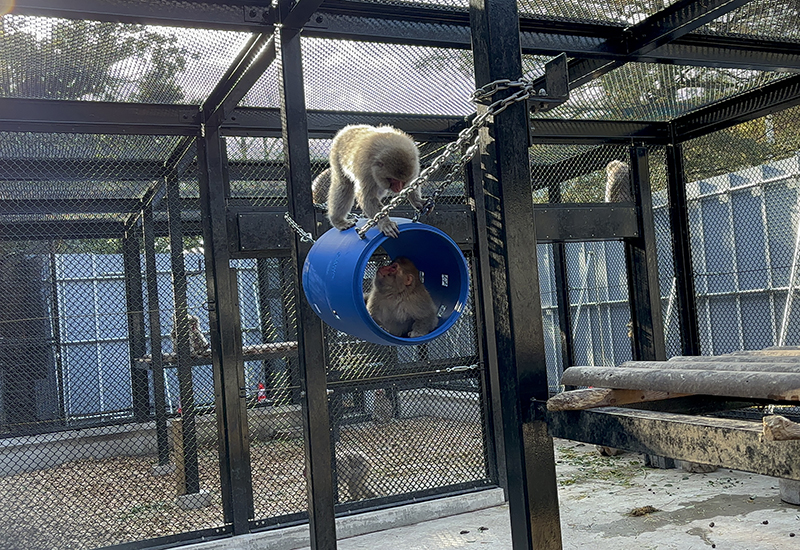
The temporary animal enclosure was built to temporarily house the monkeys between the demolition of the monkey mountain and the construction of the new facility. Because Japanese Macaque are classified as "specified animals" under the Animal Welfare and Management Act (animals that may endanger human life, body, or property), they are being managed in a sturdy facility that meets the breeding standards, even if it is only temporary.
At the zoo, the monkeys are fed green grass, branches and leaves of Japanese evergreen oak and privet, seasonal vegetables, and solid feed for monkeys. Wild Japanese Macaque eat a lot of food in the spring and fall to prepare for the summer and winter when food is scarce. Therefore, in the spring and fall, they are also given high-calorie foods such as sunflower seeds.
When feeding time, just like when they lived in the monkey enclosure, stronger individuals tend to stay on the ground, while weaker individuals tend to stay in relatively higher places. Feeding is done 4 to 5 times a day, with the type of food changing each time—vegetables the first time, green grass the second time, branches and leaves the third time—and a substantial amount of each type is given. This is because if small amounts of various types of food are given each time, the stronger individuals will monopolize their favorite foods.
Environmental enrichment
Although the temporary animal enclosure is not a facility with exhibits, it is where Japanese Macaque will spend several years. Because the enclosure is smaller than the monkey mountain, maintaining animal welfare is a challenge. Therefore, the temporary animal enclosure employs various methods to encourage diverse behaviors in the monkeys and ensure they live healthy lives. This time, we will introduce some of these "environmental enrichment" measures.
First, when it comes to feeding, we use feeders that require some ingenuity to retrieve the food, extending the feeding time, and we stimulate them by offering bamboo shoots, cherry branches and leaves, and walnuts in their shells that are collected within the park. Also, simply placing food on the wire mesh ceiling of the cage allows us to observe them skillfully hanging up to the ceiling and taking the food.
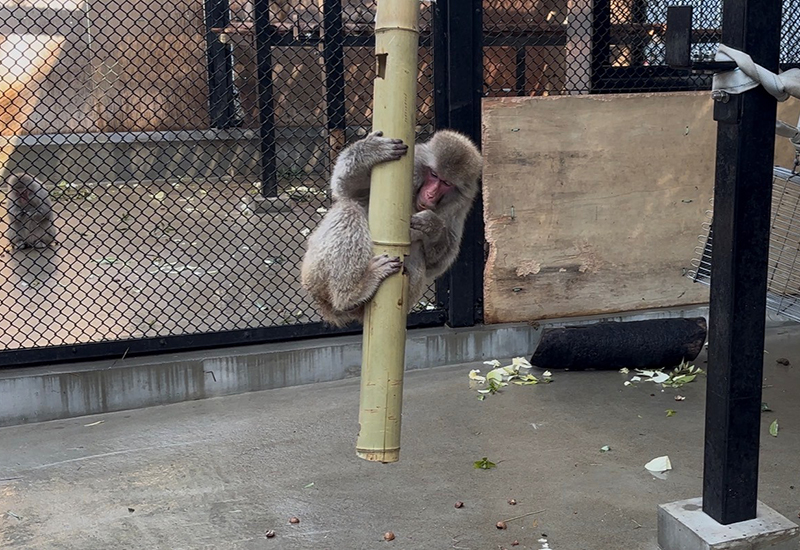
We also tried to increase the area where he could move around by stringing fire hoses around the room and hanging hammocks and plastic barrels. He was able to expand his repertoire of actions by cautiously moving across the fire hoses and jumping onto the hammocks.
In undertaking these environmental enrichment initiatives, we utilize supporter funds to provide items such as food not normally given to the animals, feeder containers, and fire hoses. Thanks to your support, the animals at the zoo are able to live more vibrant lives.
Heat countermeasures
As mentioned earlier, Japanese Macaque in Shimokita are the northernmost inhabitants of the Earth, so they have dense fur and are highly resistant to cold. On the other hand, they are not very tolerant of heat, so heat countermeasures are being implemented in their temporary enclosure.
First, we provide shade. We cover about half of the top of the cage with shade cloth. However, simply hanging the shade cloth could cause the monkeys to pull it in, so we've raised it with a wooden frame to prevent them from touching it.
Next up are the sprinklers. These are the same ones that were used in the monkey enclosure, and we're reusing them here in the temporary enclosure. Some monkeys come to get soaked in the water, while others run away looking displeased, but even just wetting the ground makes things a little cooler.
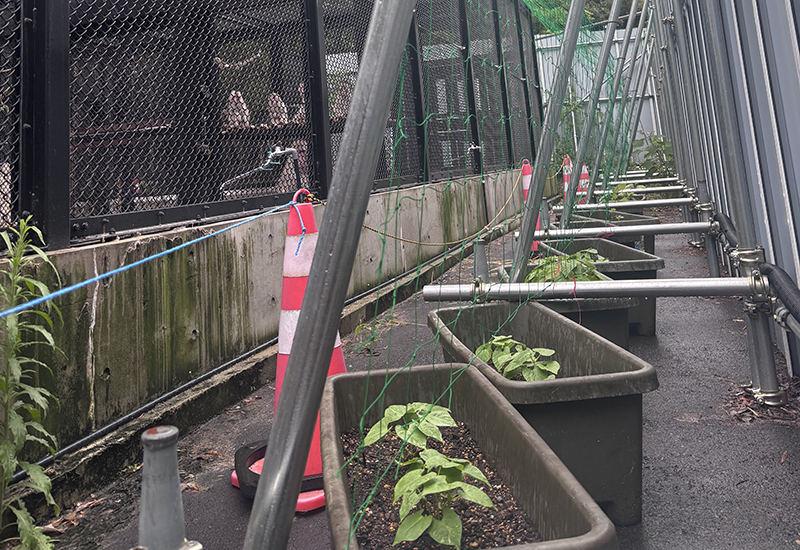
Also, although it didn't work out last year, this year, with the cooperation of the facilities staff, we tried installing a green curtain. We are hoping that the vines will grow and provide more shade during the summer.
Although the animal enclosure is not currently on display, we will continue to strive to create a comfortable environment for the monkeys. Please keep an eye on the future of Japanese Macaque, along with the new Japanese Macaque facility.
[Ueno Zoo East Garden Animal Care and Exhibition Staff]