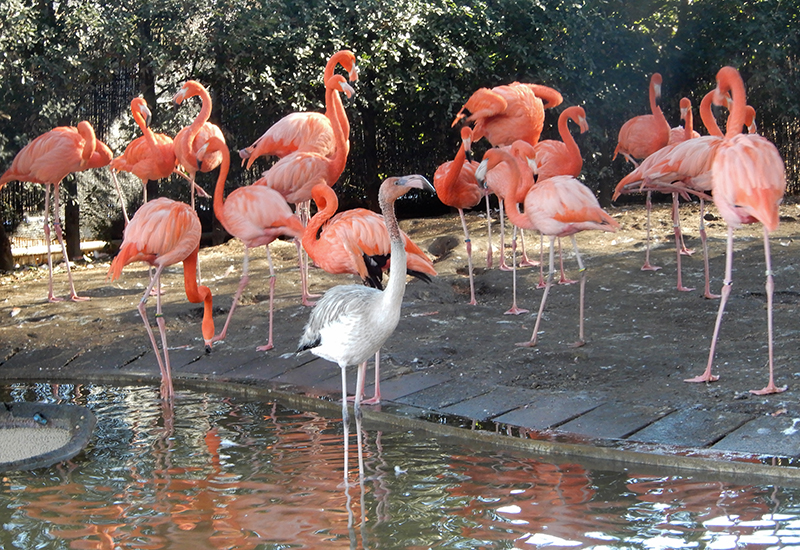

American Flamingo- the grey newcomer
December 27, 2025
Have you heard of the "gray bird" that suddenly appeared in the flamingo enclosure in West Garden of Ueno Zoo? This gray bird is actually a "juvenile American Flamingo." In this article, we will introduce how this young bird appeared and how it is growing.
The young bird hatched at the end of July this year, 2025, and was raised by animal keeper. Raising baby birds by humans in this way is called "artificial raising." In the flamingo house at our zoo, many chicks have been raised by their parents up until now, and one chick was raised last year as well. However, this time, artificial raising was carried out. The reason for this was to avoid "damage caused by wild animals" which has been a problem for previous keepers.
Damage to eggs and chicks by wild snakes and rats has long been a problem, and measures have been taken to address this. One such measure was to have animal keeper take care of all eggs laid in the nests (with the parents incubating fake eggs) and return them to their parents just before they hatch. However, this did not prevent wild animals from attacking chicks shortly after they hatched.
Under these circumstances, last year, as a measure against avian influenza, the netting covering the flamingo enclosure was replaced with a finer mesh of 15mm squares. At the same time, rat traps were installed around the flamingo enclosure to prevent predation. This was expected to reduce predation, but although it prevented rats from entering, it was unable to prevent damage from snakes. Further measures were needed, but as the flock was already in the middle of the breeding season at the time, it was difficult to take additional measures, so this time we decided to switch to artificial rearing of one surviving chick.
![[2 days after hatching] The egg tooth (whitish part) remains in the beak to crack the egg.](/image/29471_01.jpg)
On July 31st, the day the chick was confirmed to have hatched, we took it from its parents and moved it to an incubator. The chick weighed about 100g and was covered in white feathers, which was unusual for a flamingo. However, its pink legs and beak, and long, large legs compared to its body, already gave it the appearance of a flamingo.
Flamingo chicks normally grow by drinking "flamingo milk," a liquid secreted from the back of their parents' throats, but in this artificial rearing experiment, cat milk, which has a relatively similar composition, was used instead. The milk was placed in a needleless syringe and given to the chicks by dripping it onto their beaks, just like a parent bird would do to a chick. When the chicks were given milk the day after being moved to the incubator, they stood up strong and drank up the milk, making it hard to believe they had been born just yesterday.
After three days, they began walking around the incubator and pecking at anything that caught their eye. I had heard that they would leave the nest about five days after hatching, but I was surprised at how quickly they grew.
![[3rd day after hatching] Feeding](/image/29471_02.jpg)
About three weeks after hatching, the beak began to curve downward, and the wing feathers that began to grow around this time were almost fully grown within another month, and the chick had developed into a strange sight: a grey body with pink wings. What's even more interesting is that when we provided a water source, the chick, without having been taught or seen by anyone, began to bathe in the water and stamp its feet like an adult bird does when eating. It was an impressive sight to see that this chick was born with the instincts of a flamingo.
About three months after hatching, the chicks weighed over 2kg, and once we confirmed that they could eat the solid food (pellets) that adult birds eat on their own, we began training them to join the flock.
On October 25th, they were moved to the flamingo enclosure and allowed to get used to their new living environment. After a few days, they joined the flock, but for the first few weeks, both the young bird and the flock kept their distance from each other. After that, they gradually began to get used to each other and began spending more time together in the flock.
Recently, it seems to be learning how to live in a group by threatening the adults and then being intimidated and having to give up its place. If you have a chance to visit Ueno Zoo, be sure to take the time to observe the young birds growing up.
Being able to observe the chicks' growth up close through artificial rearing was a very valuable experience for us animal keeper. However, we also feel regretful that we were unable to allow them to breed naturally within the flock. We will improve the environment and rearing methods so that the flamingos can raise their young in peace for the next breeding season.