

Zoo Stock Species and the Red List
Zoo Stock Species and the Red List
Zoo Stock
This indicates that the species is included in the Second Zoo Stock Plan, which was formulated by the Tokyo Metropolitan Government in 2018. The plan sets goals for the next 10 years in three areas: "species conservation," "contribution to wildlife conservation," and "environmental education and conservation awareness." 124 animal species are included.
What is the Red List?
Based on scientific research, this is a list of wildlife classified by rank (category) indicating the degree of risk of extinction.
Livng Things Encyclopedia shows the categories (mainland and islands) assessed by the IUCN (International Union for Conservation of Nature) at the global level, the Ministry of the Environment for Japan, and the Tokyo Metropolitan Government for Tokyo.
The higher the category in each table, the higher the risk of extinction, and CR, EN, and VU are the three categories known as "endangered species." In Tokyo, species that are not at the NT (near threatened) level but are relatively rare are considered "species of concern."
|
IUCN categories |
|
|---|---|
|
EX |
extinction |
|
EW |
Extinction in the wild |
|
CR+EN |
— |
|
CR |
Serious crisis |
|
EN |
crisis |
|
VU |
emergency |
|
NT |
Near Threatened |
|
LC・○ |
Low Concern |
|
DD |
Data shortage |
|
LP |
— |
|
Japan (Ministry of the Environment) Category |
|
|---|---|
|
EX |
extinction |
|
EW |
Extinction in the wild |
|
CR+EN |
Endangered species |
|
CR |
Critically Endangered |
|
EN |
Endangered species |
|
VU |
Endangered species |
|
NT |
Near Threatened |
|
LC・○ |
— |
|
DD |
Lack of information |
|
LP |
Endangered |
|
Tokyo Category |
|
|---|---|
|
EX |
extinction |
|
EW |
Extinction in the wild |
|
CR+EN |
Endangered species |
|
CR |
Critically Endangered |
|
EN |
Endangered species |
|
VU |
Endangered species |
|
NT |
Near Threatened |
|
LC・○ |
Unranked |
|
DD |
Lack of information |
|
LP |
Endangered |
Creatures at Tokyo Sea Life Park
Creatures at Tokyo Sea Life Park
Yellow and Blueback Fusilier
Yellow and Blueback Fusilier
Caesio teres
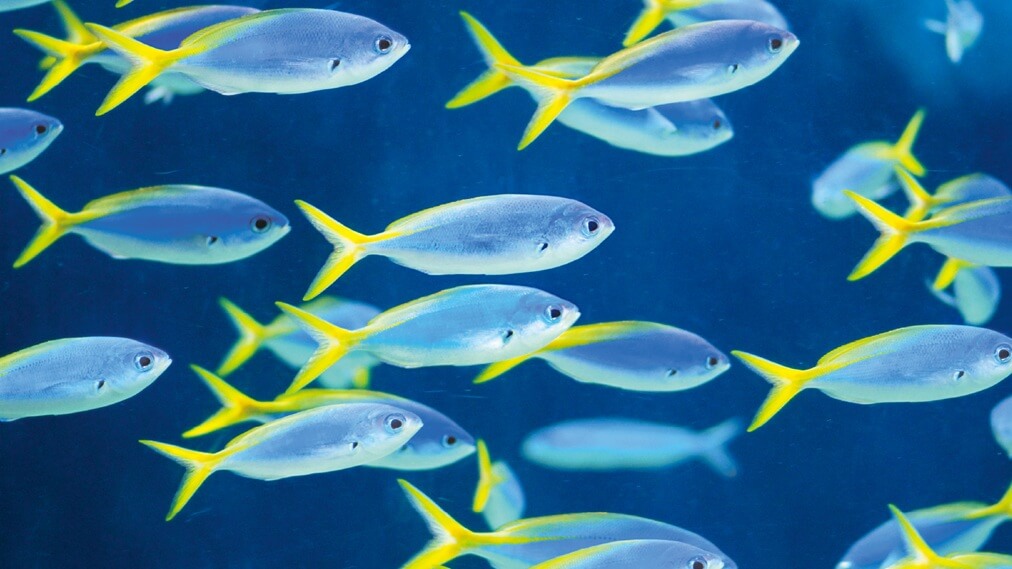
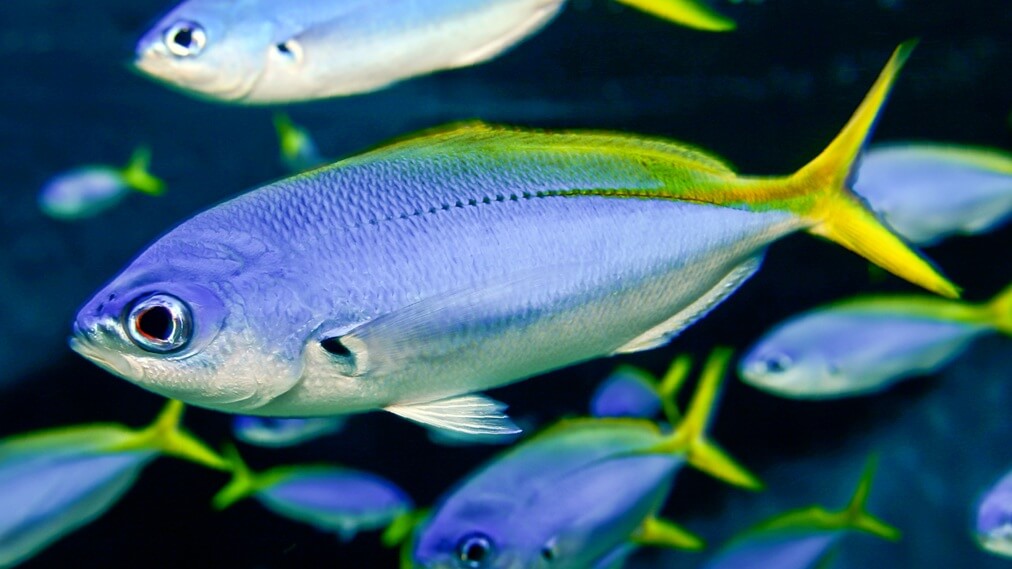
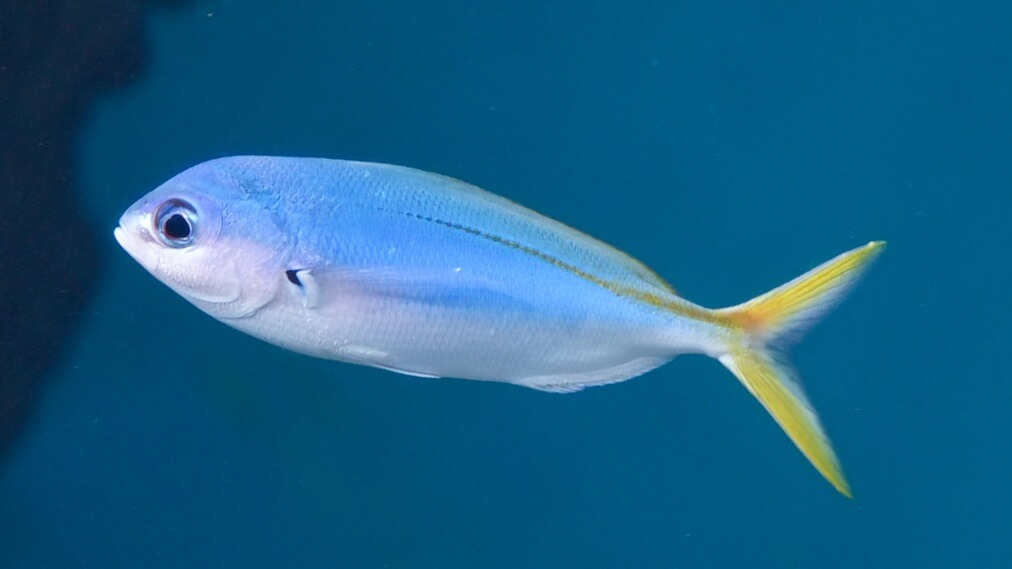
In the ocean where light shines in, the blue color of their body contrasts with the yellow from their back to their tail fin, making them look even more beautiful. They usually swim in large schools around coastal rocks and coral reefs. They are omnivorous and eat plankton as well. Fish such as Yellow and Blueback Fusilier and fusiliers are called "gurukun" in the Okinawa region and are caught in large quantities using drive nets, making them one of the most popular fish for food.
| classification | Actinopterygii, Perciformes, Fusiliidae |
|---|---|
| English name | Yellow and Blueback Fusilier |
| distribution | From central Honshu south to the Western Pacific |
| Residence | Flowing mid-level |
| Size |
Total length: 35cm
|
| food | Small plankton |
| Red List |
IUCN: LC (Least Concern)
|
Feeding time for Yellow and Blueback Fusilier shrike
The "Ogasawara Sea 4" aquarium displays many fish, including a school of Yellow and Blueback Fusilier. When feeding the fish, the fish are given food by scattering it over a wide area at once, so that the best swimmers don't end up monopolizing it, and the fish are devised so that the food is right in front of all the fish. If you happen to be there at feeding time, please check to make sure that all the fish have had access to the food.
Different appearances during the day and at night
The false Yellow and Blueback Fusilier has a vibrant blue body and a yellow line from its back to its tail fin, but at night or when it is caught, its entire body turns reddish or purplish. Some butterflyfish are known to turn black at night to make them less visible to predators, and Yellow and Blueback Fusilier 's color change may also be a way of protecting itself from predators.