

Zoo Stock Species and the Red List
Zoo Stock Species and the Red List
Zoo Stock
This indicates that the species is included in the Second Zoo Stock Plan, which was formulated by the Tokyo Metropolitan Government in 2018. The plan sets goals for the next 10 years in three areas: "species conservation," "contribution to wildlife conservation," and "environmental education and conservation awareness." 124 animal species are included.
What is the Red List?
Based on scientific research, this is a list of wildlife classified by rank (category) indicating the degree of risk of extinction.
Livng Things Encyclopedia shows the categories (mainland and islands) assessed by the IUCN (International Union for Conservation of Nature) at the global level, the Ministry of the Environment for Japan, and the Tokyo Metropolitan Government for Tokyo.
The higher the category in each table, the higher the risk of extinction, and CR, EN, and VU are the three categories known as "endangered species." In Tokyo, species that are not at the NT (near threatened) level but are relatively rare are considered "species of concern."
|
IUCN categories |
|
|---|---|
|
EX |
extinction |
|
EW |
Extinction in the wild |
|
CR+EN |
— |
|
CR |
Serious crisis |
|
EN |
crisis |
|
VU |
emergency |
|
NT |
Near Threatened |
|
LC・○ |
Low Concern |
|
DD |
Data shortage |
|
LP |
— |
|
Japan (Ministry of the Environment) Category |
|
|---|---|
|
EX |
extinction |
|
EW |
Extinction in the wild |
|
CR+EN |
Endangered species |
|
CR |
Critically Endangered |
|
EN |
Endangered species |
|
VU |
Endangered species |
|
NT |
Near Threatened |
|
LC・○ |
— |
|
DD |
Lack of information |
|
LP |
Endangered |
|
Tokyo Category |
|
|---|---|
|
EX |
extinction |
|
EW |
Extinction in the wild |
|
CR+EN |
Endangered species |
|
CR |
Critically Endangered |
|
EN |
Endangered species |
|
VU |
Endangered species |
|
NT |
Near Threatened |
|
LC・○ |
Unranked |
|
DD |
Lack of information |
|
LP |
Endangered |
Creatures at Tokyo Sea Life Park
Creatures at Tokyo Sea Life Park
Spiny Red Gurnard
Spiny Red Gurnard
Chelidonichthys spinosus
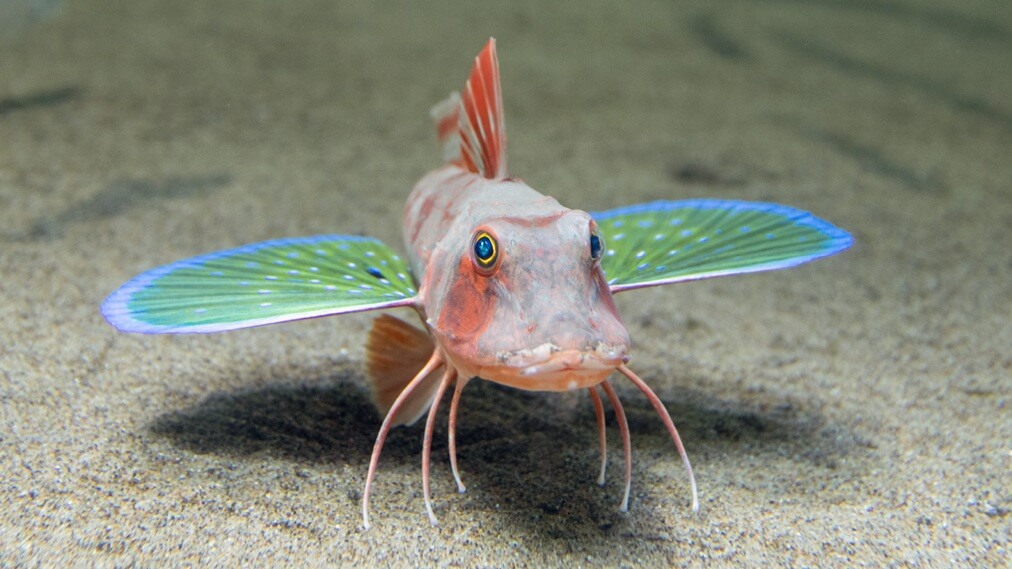
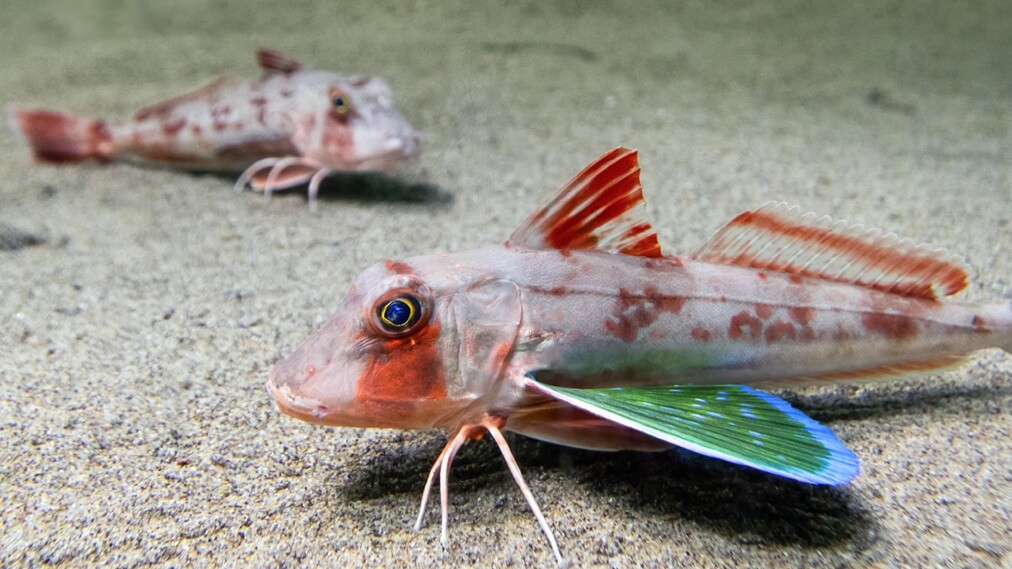
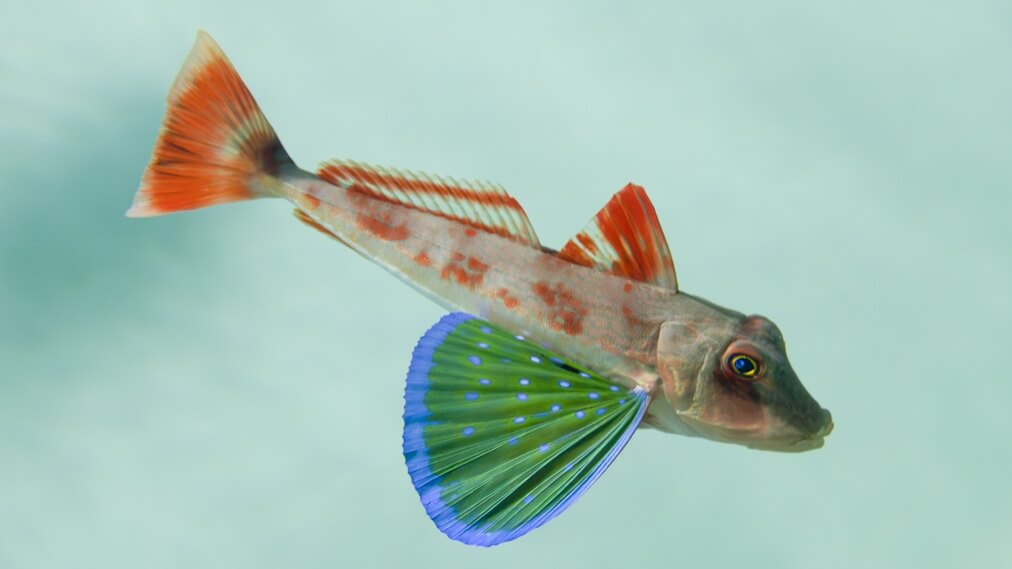
It lives in relatively deep sandy or muddy seabeds. It is characterized by its large, brightly colored pectoral fins and the way it uses the "veins" that are modified parts of its pectoral fins to probe the sand. It is a tasty fish and has become a common sight in fish markets in recent years.
| classification | Actinopterygii, Perciformes, Spiny Red Gurnard |
|---|---|
| English name | Spiny Red Gurnard |
| distribution | South of southern Hokkaido, East China Sea, South China Sea |
| Residence | A slightly deep sandbank along the coast |
| Size |
Total length: 40cm
|
| food | Creatures in the sand |
| Red List |
Unrated
|
Large pectoral fins
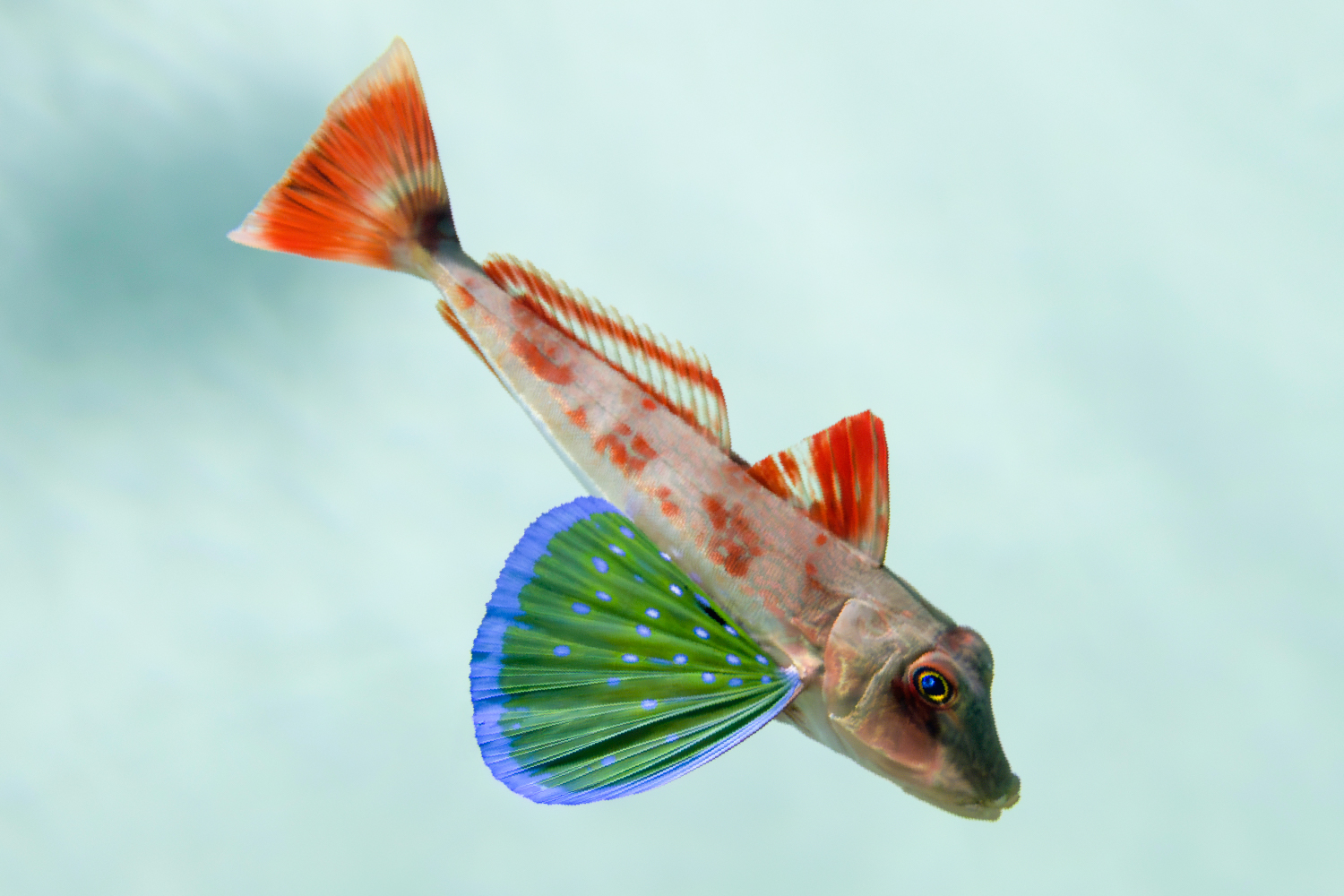
The large, fan-shaped pectoral fins are metallic blue-green, adorned with vivid blue edges and spots, making them very conspicuous. Normally, these fins are folded, but when swimming, they are spread wide, allowing the fish to glide slowly through the water. There is a theory that the fish uses these conspicuous fins to startle predators, but this is not fully understood.
Tools for finding bait
Let's look for the veins on the sides of the pectoral fins. There are three on each side of the pectoral fin, for a total of six. These veins are called "soft rays," which are branches of the pectoral fin, and they function as sensory organs. They move like fingers, and the fish uses them to search for and eat creatures in the sand.
Origin of the name
Where does the name Spiny Red Gurnard come from? It is said that the name comes from the "bo-bo" sound that the males make using their swim bladder. Another theory is that it comes from the fact that their heads are angular and square-shaped. It might be interesting to research the origins of fish names.