

Zoo Stock Species and the Red List
Zoo Stock Species and the Red List
Zoo Stock
This indicates that the species is included in the Second Zoo Stock Plan, which was formulated by the Tokyo Metropolitan Government in 2018. The plan sets goals for the next 10 years in three areas: "species conservation," "contribution to wildlife conservation," and "environmental education and conservation awareness." 124 animal species are included.
What is the Red List?
Based on scientific research, this is a list of wildlife classified by rank (category) indicating the degree of risk of extinction.
Livng Things Encyclopedia shows the categories (mainland and islands) assessed by the IUCN (International Union for Conservation of Nature) at the global level, the Ministry of the Environment for Japan, and the Tokyo Metropolitan Government for Tokyo.
The higher the category in each table, the higher the risk of extinction, and CR, EN, and VU are the three categories known as "endangered species." In Tokyo, species that are not at the NT (near threatened) level but are relatively rare are considered "species of concern."
|
IUCN categories |
|
|---|---|
|
EX |
extinction |
|
EW |
Extinction in the wild |
|
CR+EN |
— |
|
CR |
Serious crisis |
|
EN |
crisis |
|
VU |
emergency |
|
NT |
Near Threatened |
|
LC・○ |
Low Concern |
|
DD |
Data shortage |
|
LP |
— |
|
Japan (Ministry of the Environment) Category |
|
|---|---|
|
EX |
extinction |
|
EW |
Extinction in the wild |
|
CR+EN |
Endangered species |
|
CR |
Critically Endangered |
|
EN |
Endangered species |
|
VU |
Endangered species |
|
NT |
Near Threatened |
|
LC・○ |
— |
|
DD |
Lack of information |
|
LP |
Endangered |
|
Tokyo Category |
|
|---|---|
|
EX |
extinction |
|
EW |
Extinction in the wild |
|
CR+EN |
Endangered species |
|
CR |
Critically Endangered |
|
EN |
Endangered species |
|
VU |
Endangered species |
|
NT |
Near Threatened |
|
LC・○ |
Unranked |
|
DD |
Lack of information |
|
LP |
Endangered |
Creatures at Tokyo Sea Life Park
Creatures at Tokyo Sea Life Park
Luna Lion Fish
Luna Lion Fish
Pterois lunulata
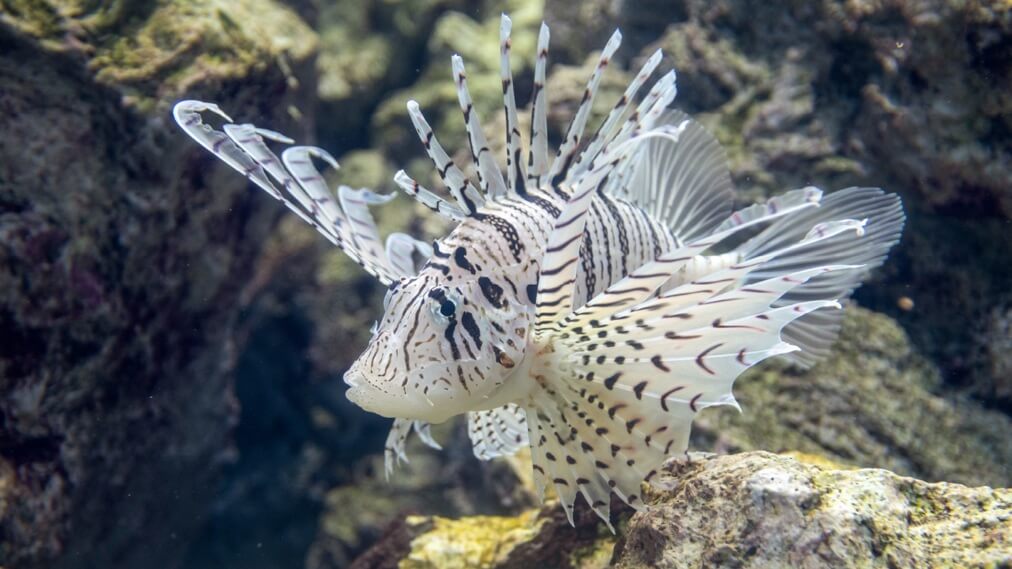
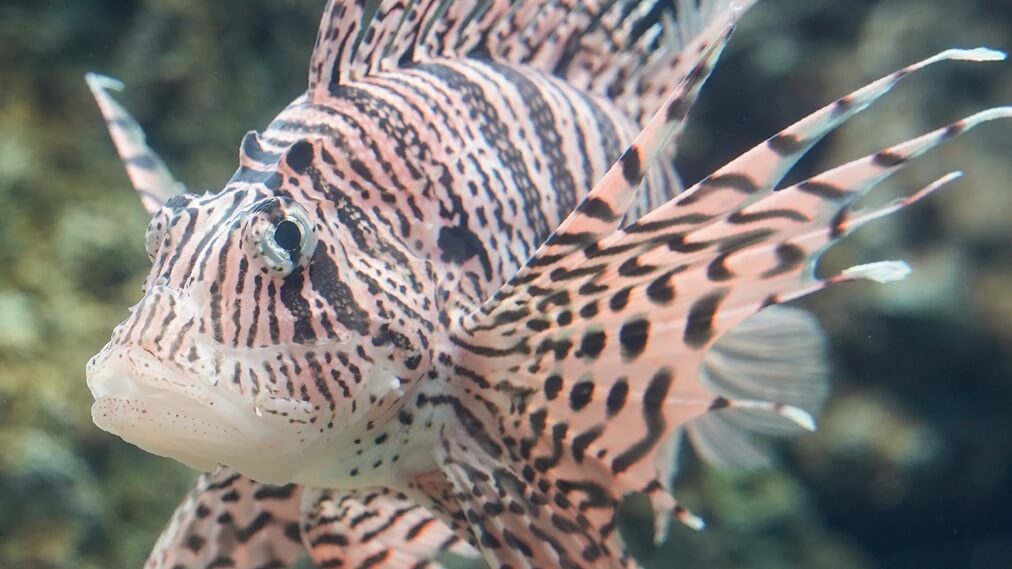
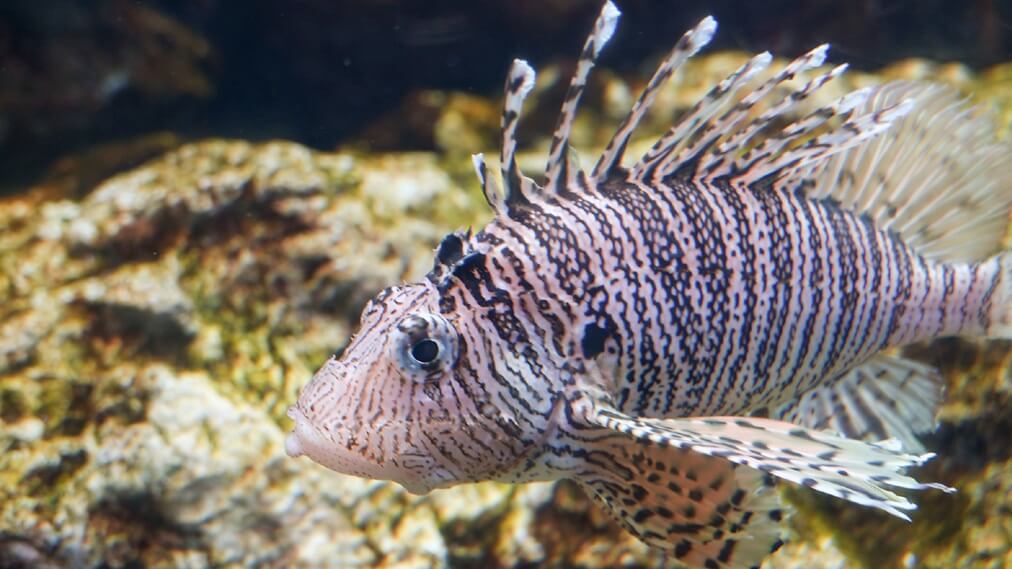
It has a flashy appearance, almost as if it's wearing a dress. The spines on its fins are venomous, and being stung is extremely painful. Its conspicuous appearance serves to signal to others that it is dangerous, thus preventing attacks. It usually moves slowly, but when a small fish comes close to its mouth, it will gobble it up in the blink of an eye. In an aquarium, it's best to feed the other fast-moving fish first, and then bring the food to Luna Lion Fish 's mouth for it to eat.
| classification | Actinopterygii, Scorpaeniformes, Scorpaenidae |
|---|---|
| English name | Luna Lionfish |
| distribution | The coast of Japan south of southern Hokkaido, and the warm waters from the Indian Ocean to the Pacific Ocean |
| Residence | Coastal rocky areas, coral reefs, sandy and muddy bottoms, etc. |
| Size |
Total length: 30cm
|
| food | Small fish and crustaceans such as shrimp |
| Red List |
IUCN: LC (Least Concern)
|
What's the purpose of the flashy appearance?
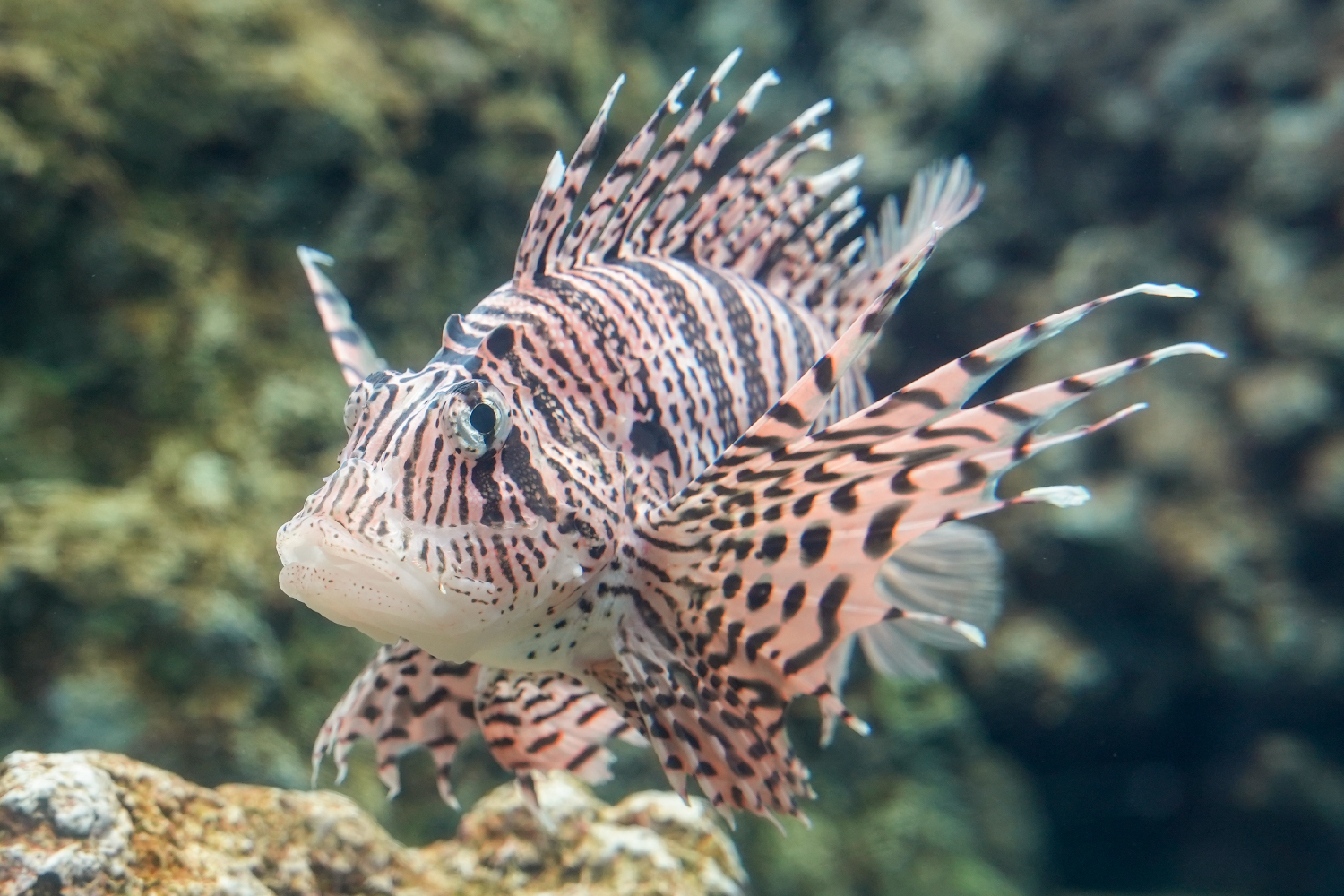
It is characterized by its vivid reddish-brown or brown vertical stripes, large, cloak-like pectoral fins, and long, extended dorsal fin. This flashy appearance is thought to serve to warn predators that it is a dangerous creature. It is also popular as an ornamental fish. Other Luna Lion Fish species have similarly flashy appearances, so try looking for them in other aquariums as well.
If I get stabbed...
The fish has 13 venomous spines on its dorsal fin, one on each pelvic fin, and three on its anal fin. A sting causes intense pain, and the affected area swells significantly. Because the venom is protein-based, immersing the affected area in water at 40-50°C will inactivate the venom and alleviate the pain.