

Zoo Stock Species and the Red List
Zoo Stock Species and the Red List
Zoo Stock

This indicates that the species is included in the Second Zoo Stock Plan, which was formulated by the Tokyo Metropolitan Government in 2018. The plan sets goals for the next 10 years in three areas: "species conservation," "contribution to wildlife conservation," and "environmental education and conservation awareness." 124 animal species are included.
What is the Red List?
Based on scientific research, this is a list of wildlife classified by rank (category) indicating the degree of risk of extinction.
Livng Things Encyclopedia shows the categories (mainland and islands) assessed by the IUCN (International Union for Conservation of Nature) at the global level, the Ministry of the Environment for Japan, and the Tokyo Metropolitan Government for Tokyo.
The higher the category in each table, the higher the risk of extinction, and CR, EN, and VU are the three categories known as "endangered species." In Tokyo, species that are not at the NT (near threatened) level but are relatively rare are considered "species of concern."
|
IUCN categories |
|
|---|---|
|
EX |
extinction |
|
EW |
Extinction in the wild |
|
CR+EN |
— |
|
CR |
Serious crisis |
|
EN |
crisis |
|
VU |
emergency |
|
NT |
Near Threatened |
|
LC・○ |
Low Concern |
|
DD |
Data shortage |
|
LP |
— |
|
Japan (Ministry of the Environment) Category |
|
|---|---|
|
EX |
extinction |
|
EW |
Extinction in the wild |
|
CR+EN |
Endangered species |
|
CR |
Critically Endangered |
|
EN |
Endangered species |
|
VU |
Endangered species |
|
NT |
Near Threatened |
|
LC・○ |
— |
|
DD |
Lack of information |
|
LP |
Endangered |
|
Tokyo Category |
|
|---|---|
|
EX |
extinction |
|
EW |
Extinction in the wild |
|
CR+EN |
Endangered species |
|
CR |
Critically Endangered |
|
EN |
Endangered species |
|
VU |
Endangered species |
|
NT |
Near Threatened |
|
LC・○ |
Unranked |
|
DD |
Lack of information |
|
LP |
Endangered |
Creatures at Tokyo Sea Life Park
Creatures at Tokyo Sea Life Park
Painted Comber
Painted Comber
Serranus scriba
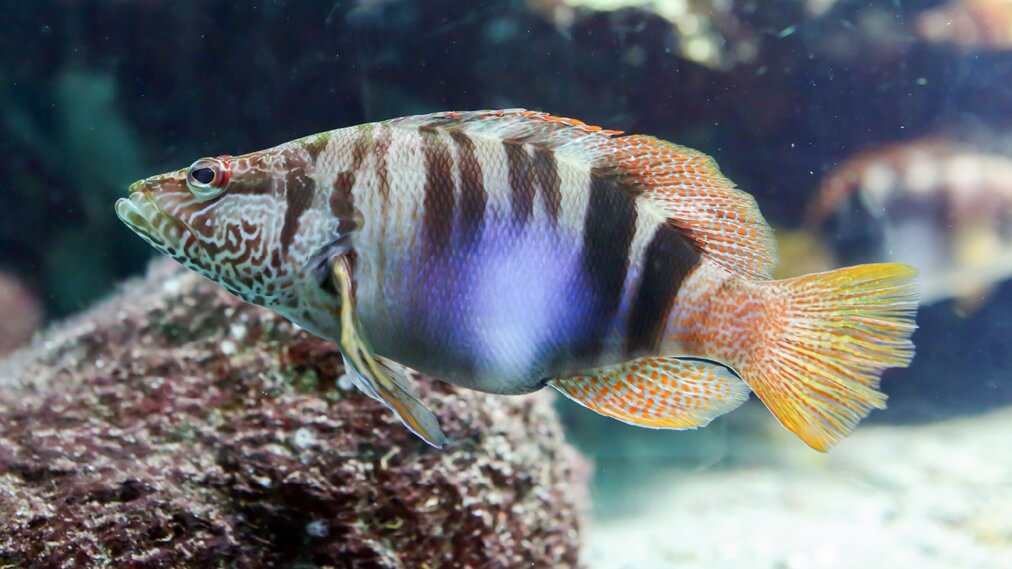
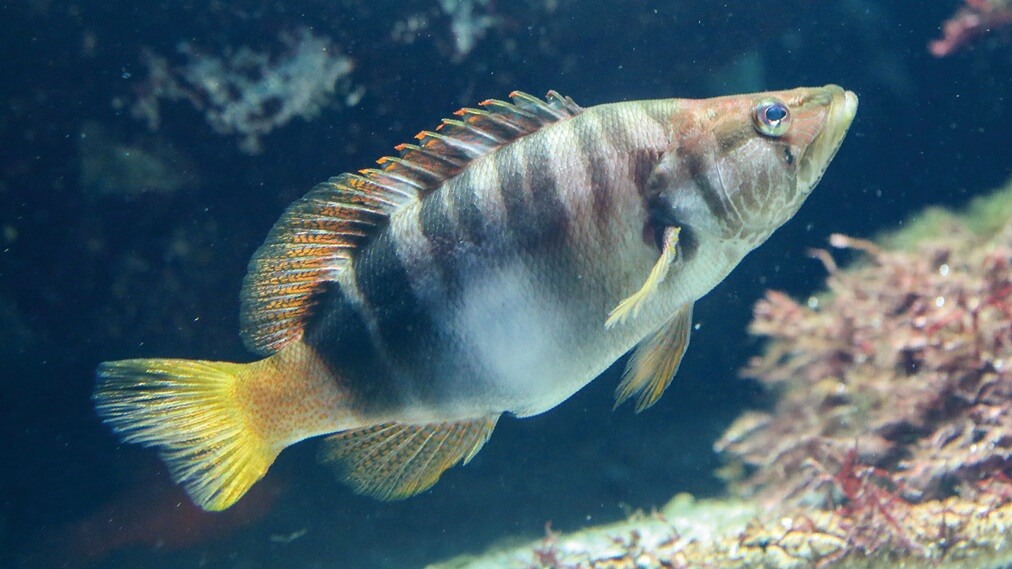
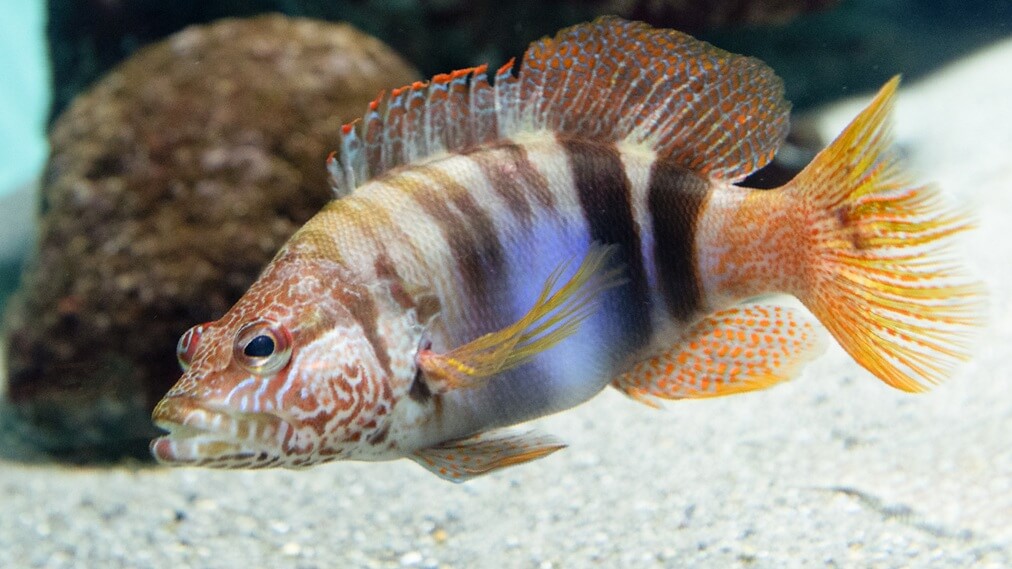
This grouper lives in seaweed beds and the surrounding rocky reefs. While many fish change sexes during their lifetime, this fish is unique in that its ovaries and testes mature simultaneously, meaning it can be both male and female. In an aquarium, you can observe its courtship behavior, where it displays its vivid blue-purple belly to attract a mate, as its name "painted" suggests.
| classification | Actinopterygii, Perciformes, Grouper family |
|---|---|
| English name | Painted Comber |
| distribution | Eastern Atlantic coast from the Canary Islands to the Bay of Biscay, Mediterranean Sea, and Black Sea |
| Residence | Areas where seagrass grows abundantly and surrounding reef areas |
| Size |
Total length: 30cm
|
| food | Benthic organisms, etc. |
| Red List |
IUCN: LC (Least Concern)
|
Mysterious Reproduction Methods
How exactly do Painted Comber, which can be either male or female, reproduce? Normally, each individual has its own territory and lives alone. During the breeding season, before sunset when spawning takes place, they leave their territories to search for a mate. Then, the two individuals take turns playing the male and female roles throughout the night, spawning multiple times. This method of reproduction is well known among deep-sea fish where opportunities to meet mates are rare.