

Zoo Stock Species and the Red List
Zoo Stock Species and the Red List
Zoo Stock

This indicates that the species is included in the Second Zoo Stock Plan, which was formulated by the Tokyo Metropolitan Government in 2018. The plan sets goals for the next 10 years in three areas: "species conservation," "contribution to wildlife conservation," and "environmental education and conservation awareness." 124 animal species are included.
What is the Red List?
Based on scientific research, this is a list of wildlife classified by rank (category) indicating the degree of risk of extinction.
Livng Things Encyclopedia shows the categories (mainland and islands) assessed by the IUCN (International Union for Conservation of Nature) at the global level, the Ministry of the Environment for Japan, and the Tokyo Metropolitan Government for Tokyo.
The higher the category in each table, the higher the risk of extinction, and CR, EN, and VU are the three categories known as "endangered species." In Tokyo, species that are not at the NT (near threatened) level but are relatively rare are considered "species of concern."
|
IUCN categories |
|
|---|---|
|
EX |
extinction |
|
EW |
Extinction in the wild |
|
CR+EN |
— |
|
CR |
Serious crisis |
|
EN |
crisis |
|
VU |
emergency |
|
NT |
Near Threatened |
|
LC・○ |
Low Concern |
|
DD |
Data shortage |
|
LP |
— |
|
Japan (Ministry of the Environment) Category |
|
|---|---|
|
EX |
extinction |
|
EW |
Extinction in the wild |
|
CR+EN |
Endangered species |
|
CR |
Critically Endangered |
|
EN |
Endangered species |
|
VU |
Endangered species |
|
NT |
Near Threatened |
|
LC・○ |
— |
|
DD |
Lack of information |
|
LP |
Endangered |
|
Tokyo Category |
|
|---|---|
|
EX |
extinction |
|
EW |
Extinction in the wild |
|
CR+EN |
Endangered species |
|
CR |
Critically Endangered |
|
EN |
Endangered species |
|
VU |
Endangered species |
|
NT |
Near Threatened |
|
LC・○ |
Unranked |
|
DD |
Lack of information |
|
LP |
Endangered |
Creatures at Tokyo Sea Life Park
Creatures at Tokyo Sea Life Park
King Penguin
King Penguin
Aptenodytes patagonicus
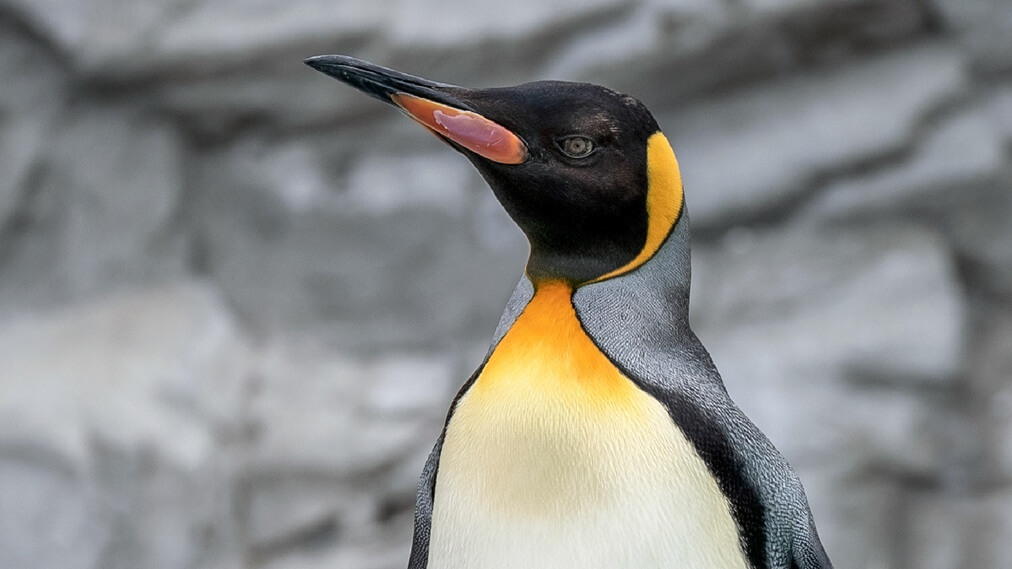
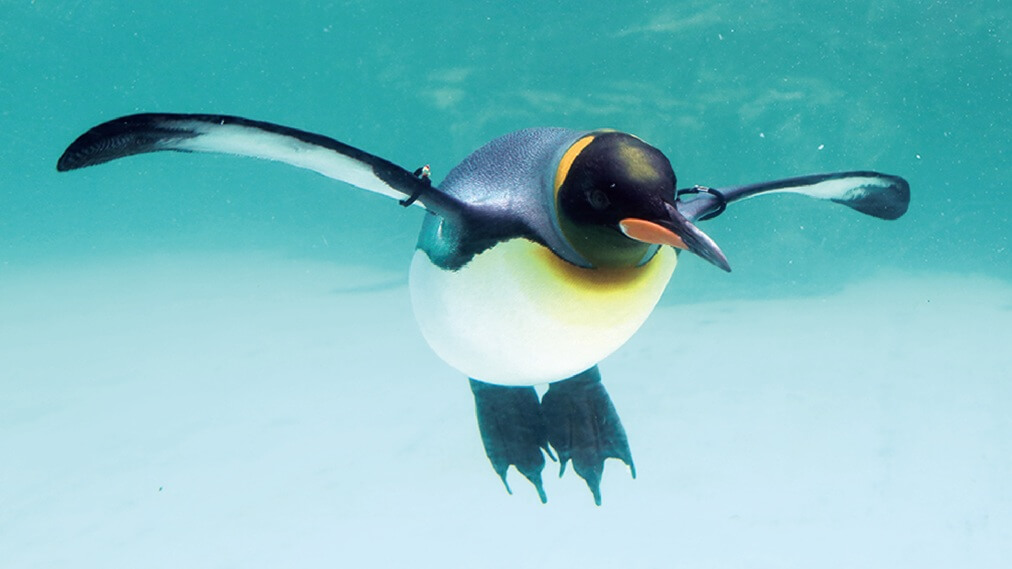
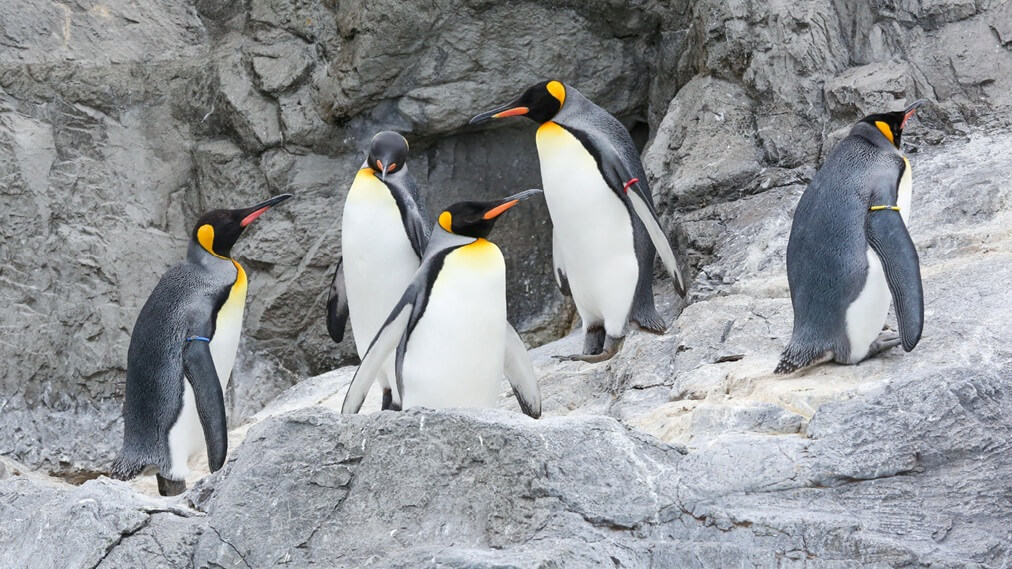
King penguins are the second largest penguins after emperor penguins. Like other penguins, they swim quickly in the sea to catch and eat fish, but King Penguin are especially good at diving. During the breeding season, they gather in large numbers and breed in groups. They do not build nests, but lay one egg, which the male and female take turns incubating on their feet. Once the chicks grow to a certain size, they gather together to form a group called a "creche" and live together. Meanwhile, the parent penguins go out to find food.
*On Thursday, May 7, 2026 (a day the zoo is closed), King Penguin and Southern Rockhopper Penguin will be moved to an air-conditioned room for summer refuge and breeding purposes. They will not be in the main enclosure, but can be observed on monitor screens. They are scheduled to be put back on display outdoors around autumn (they may be temporarily moved to the outdoor enclosure for health management purposes).
| classification | Aves, Sphenisciformes, Penguinidae |
|---|---|
| English name | King Penguin |
| distribution | Islands around the Southern Ocean |
| Residence | Non-breeding season: At sea Breeding season: Open areas |
| Size |
Length from tip of beak to tip of tail: approx. 95cm
Weight: 12-15kg |
| food | Mainly fish and squid |
| Red List |
IUCN: LC (Least Concern)
|
How deep can King Penguin dive?
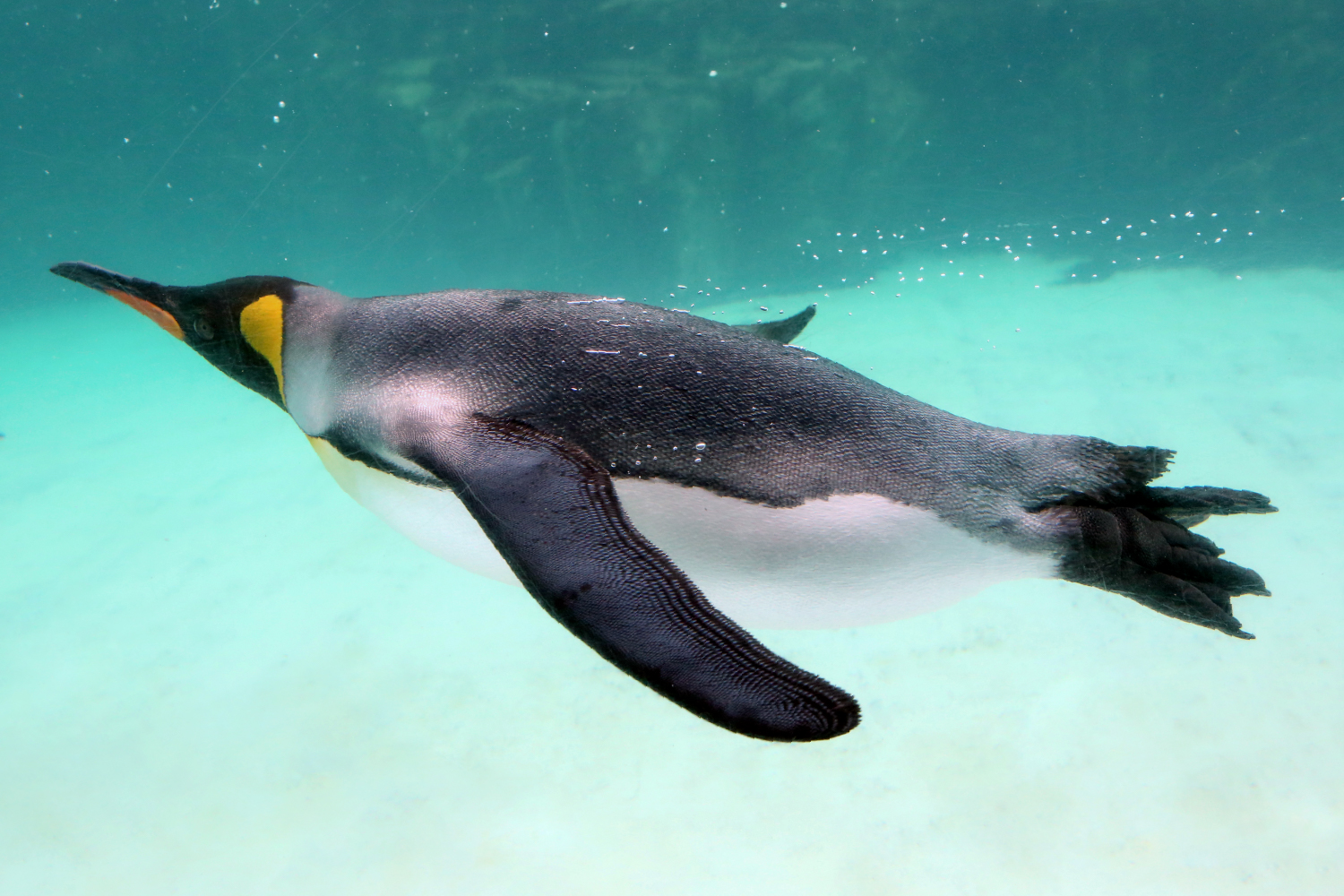
The mycanthropes that King Penguin feed on mainly live at depths of over 100m. King Penguin are very good at diving, and can even dive to depths of over 360m! In other words, they can dive to depths known as the deep sea. With their large wings (flippers), King Penguin swim very dynamically. You can imagine them diving rapidly into the ocean.
King Penguin chick: even better than its parents?
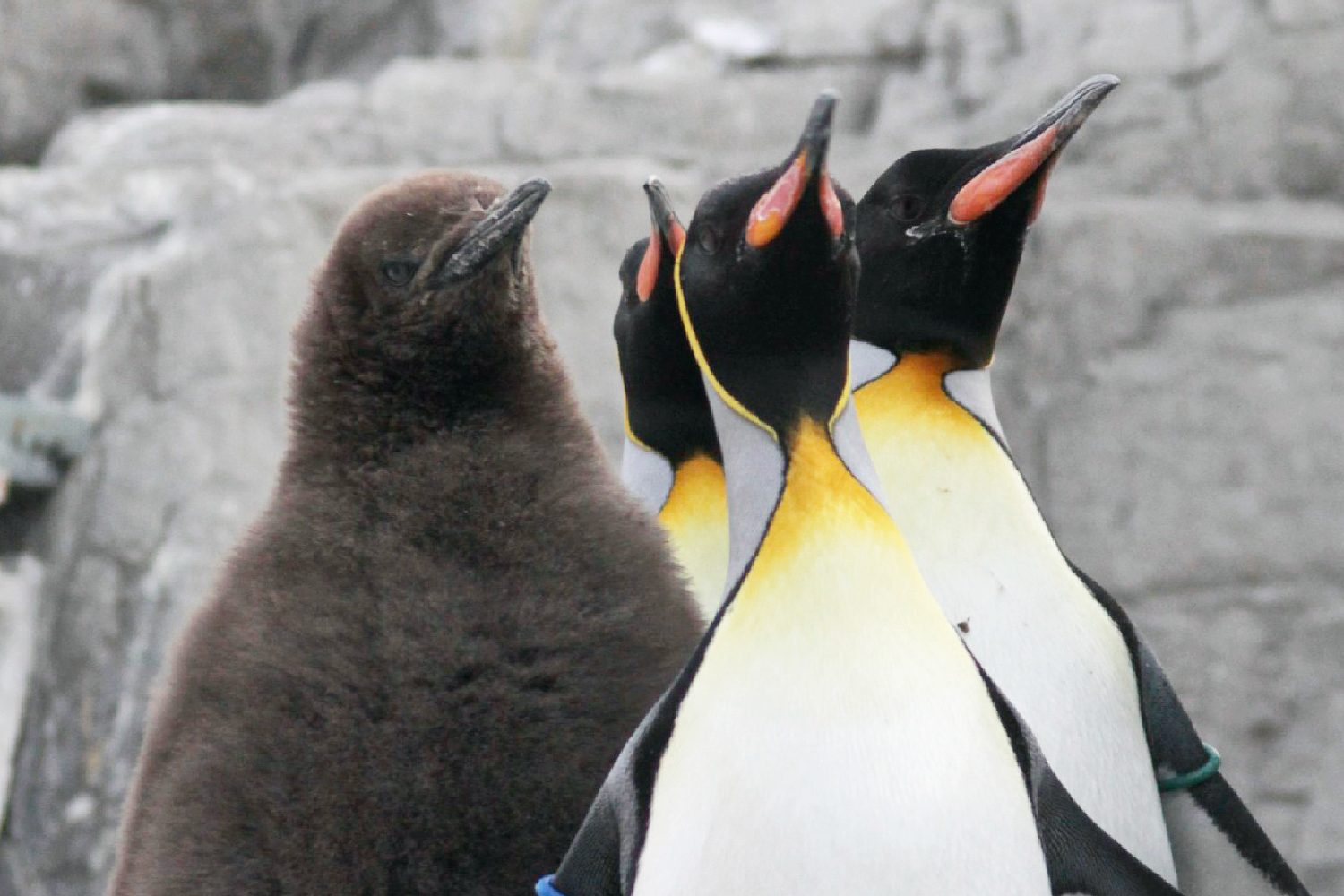
When King Penguin return to the exhibit in autumn after being kept indoors in the cool weather during the summer, in years when breeding has been successful, you can see young birds covered in fluffy down. Their dark brown appearance can make them look a size larger and more impressive than their parents. King Penguin have the longest parenting period of any penguin species, taking more than a year from the time they lay their eggs until they are able to stand on their own.
What is the orange color of the beak?
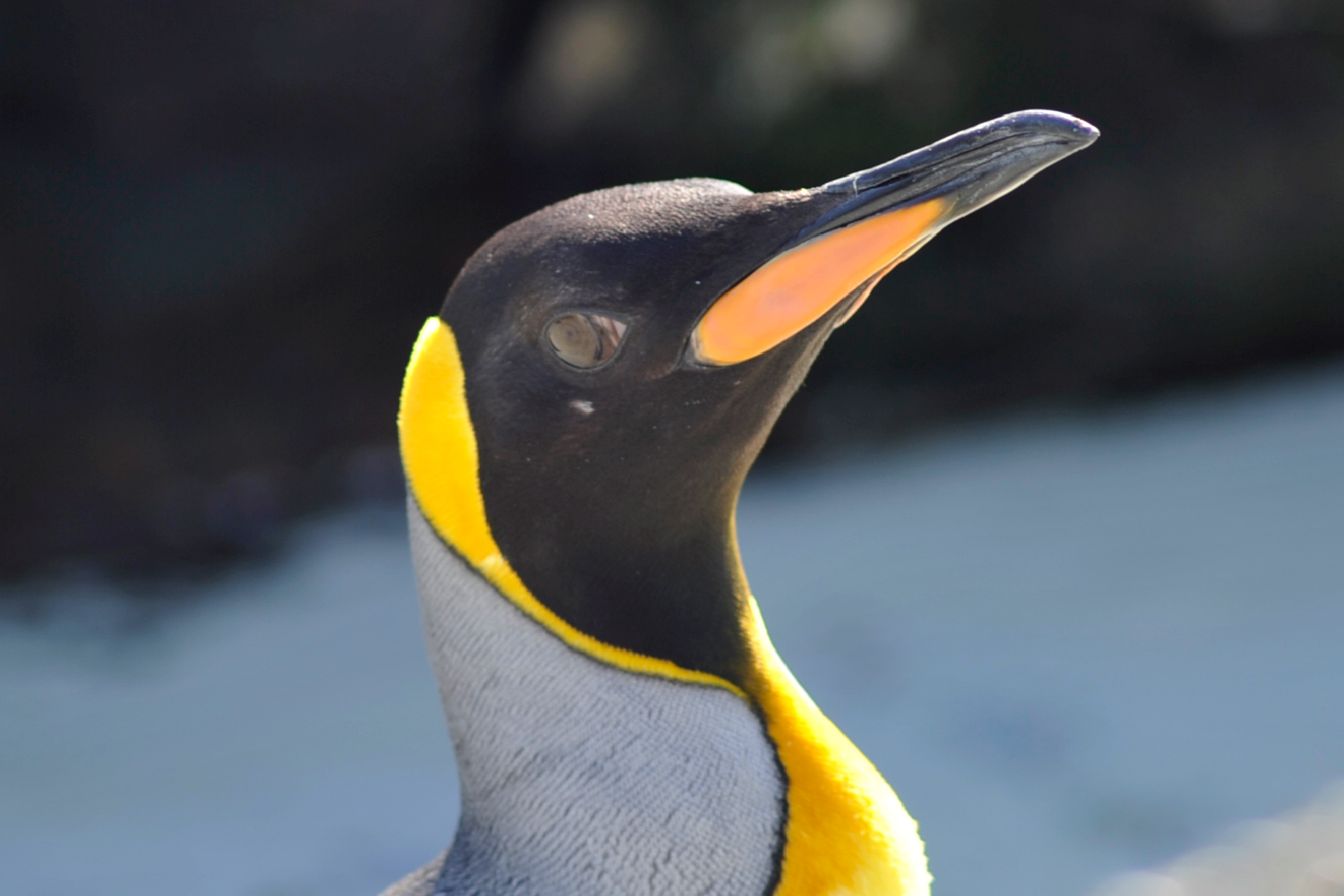
The orange color on the underside of King Penguin 's beak is very noticeable. This part is called the mandible plate. As the name "plate" suggests, the surface of this part peels off and is replaced once a year. According to the zookeepers, it's more like a thick layer of skin peeling off than a "plate."