

An attempt to select silkworms that produce yellow cocoons.
July 3, 2026
The "Creatures of village forest" corner in Insectarium at Tama Zoo features silkworms being raised and displayed.
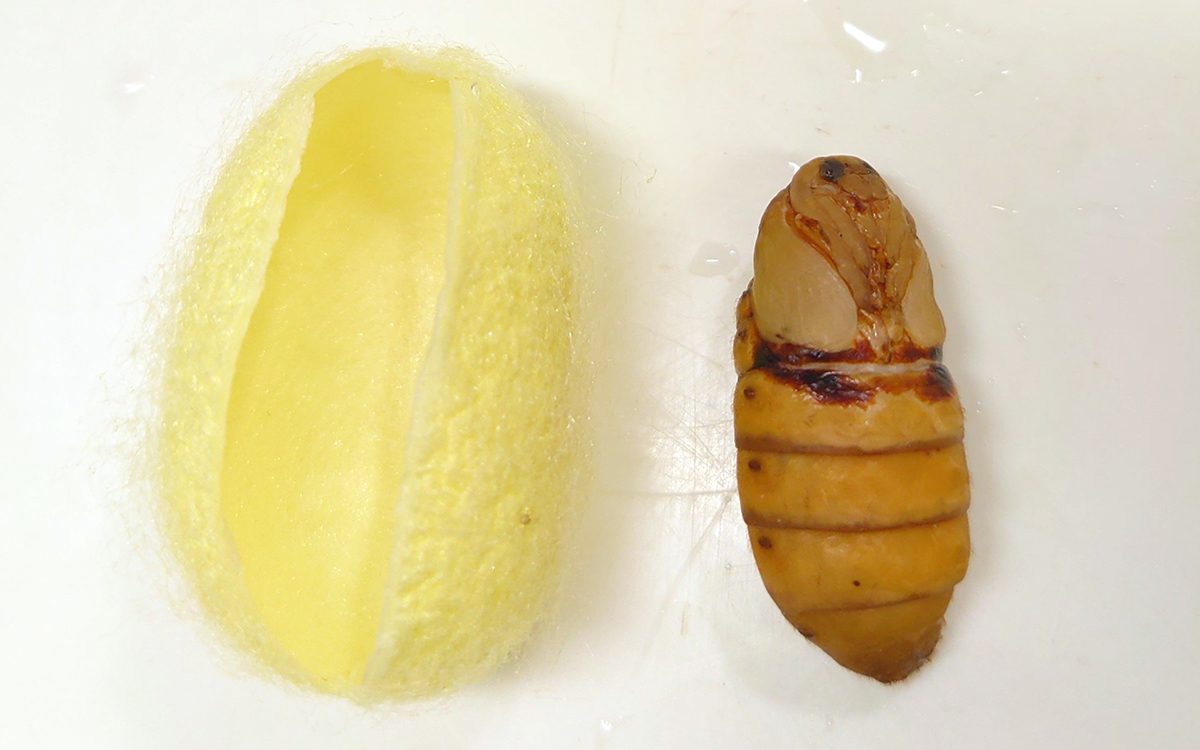
Silkworms, which are "domesticated" for producing silk, are known to have several varieties, each originating from individuals whose cocoon color has changed due to a mutation in a single gene. In 2024, we raised larvae of a variety that produces yellow cocoons and bred them after they emerged as adults. As a result, the offspring generation produced not only yellow cocoons, but also two types of cocoons: yellow and white.
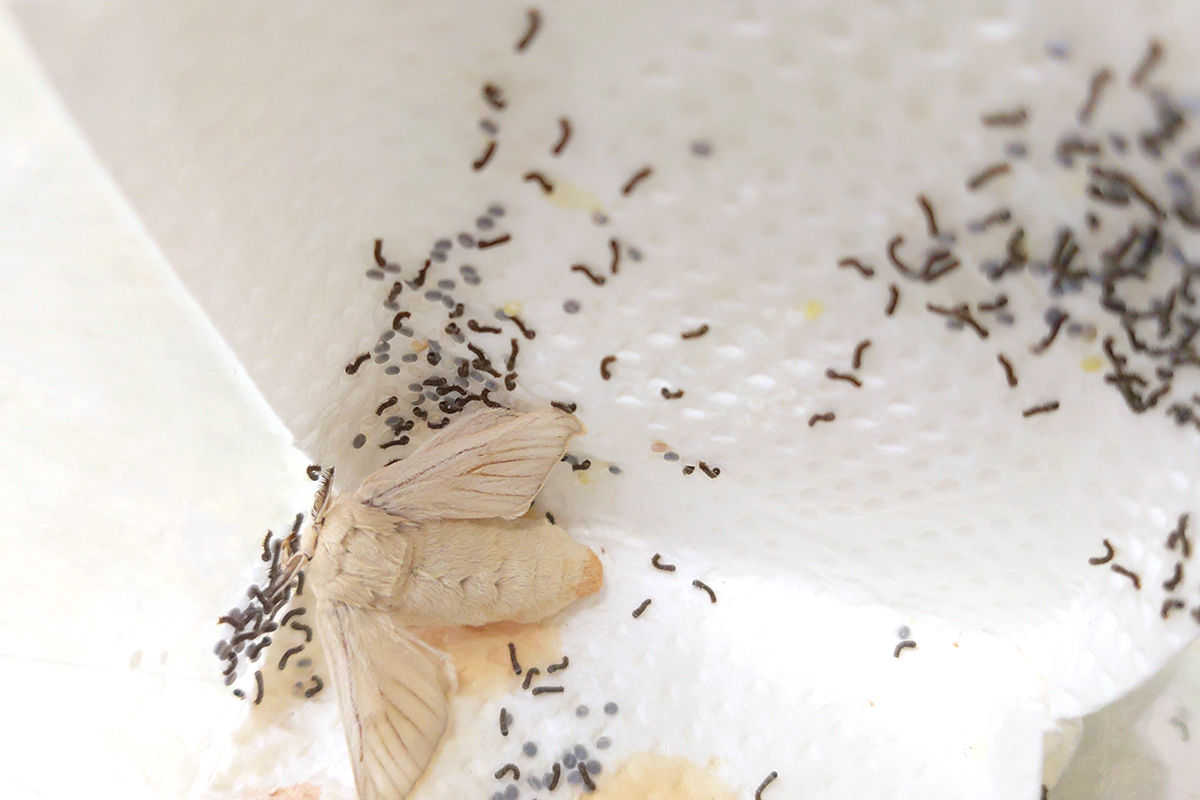
The silkworms obtained were likely hybrids, a cross between a variety that produces yellow cocoons and a variety that produces white cocoons. One reason for producing such hybrids is to utilize "hybrid vigor."
Hybrid vigor is a phenomenon in which, when different varieties are crossbred, the offspring exhibit traits superior to those of both parents. It is widely used in the improvement of livestock and crop varieties to achieve robustness and increase yields. Indeed, the larvae of the variety I obtained were larger, and the cocoons they produced were clearly larger than those of other varieties I had been raising.
In this case, a parent that produced yellow cocoons gave birth to multiple offspring that produced two types of cocoons: yellow and white. Therefore, we hypothesized that there are two types of genes related to cocoon color: a dominant yellow "A" and a recessive white "a". Furthermore, applying Mendel's law of segregation, which we learned in 9th grade science, we can expect that the genotype of the parent that produced only yellow cocoons is Aa, and that among the offspring that produced yellow cocoons, 25% were AA and 50% were Aa, while the genotype of the offspring that produced white cocoons was aa and 25% were aa.
While this explanation of pairing based on assumed genotypes may seem complex at first glance, it is useful for planning pairings because it allows us to predict the proportion of offspring with a certain trait. However, it is certainly more convenient for planned exhibitions if the breed has uniform traits. Therefore, in order to continue the stable breeding and exhibition of silkworms that produce yellow cocoons in the future, we have begun an attempt to select silkworms with uniform genotypes over generations.
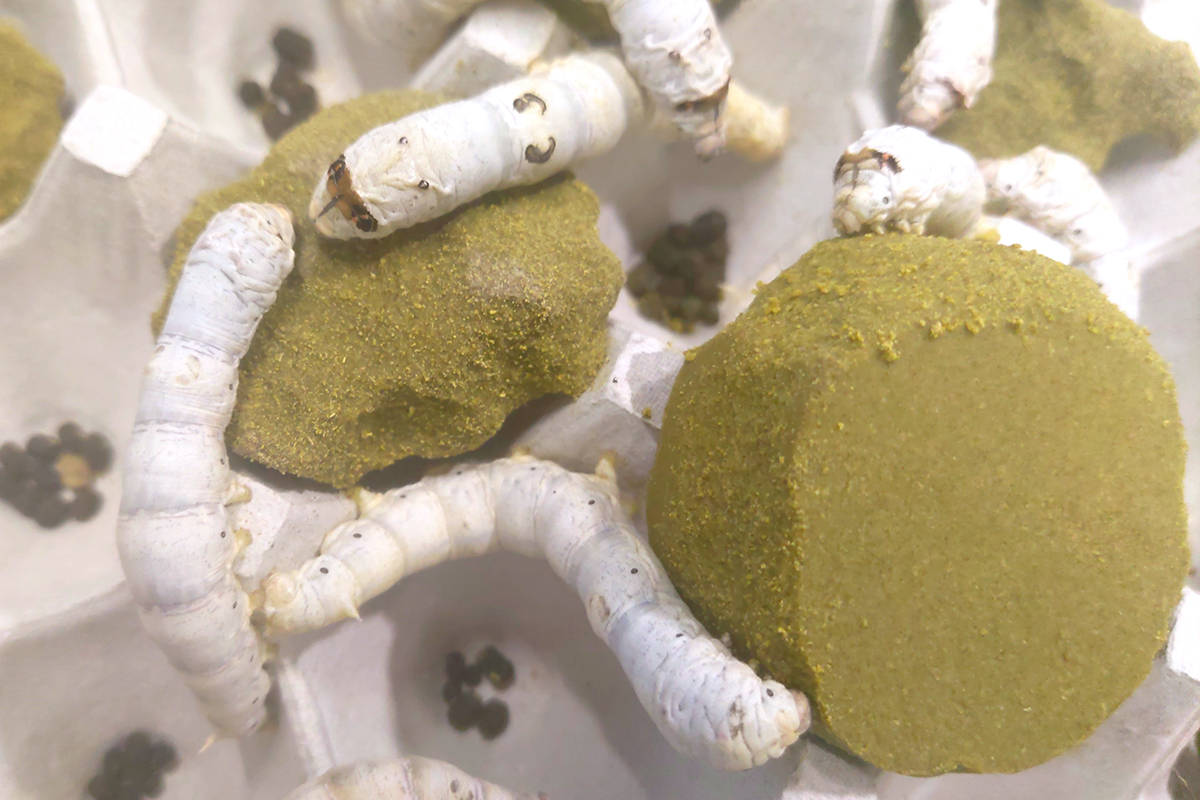
In this experiment, we first selected one male and one female from the offspring generation that had produced yellow cocoons and paired them individually, collecting eggs from a total of 14 pairs to obtain 14 groups of grandchildren. In the grandchildren generation, we raised the larvae in each of these groups, kept the groups from which only yellow cocoons appeared, and performed individual pairing again within those groups to obtain the great-grandchildren generation.
Furthermore, in the grandchild generation, if a white cocoon appears during the "cocoon-making" stage, we created a new group by selecting and pairing only individuals that have produced white cocoons. We intend to use this group of individuals that produce white cocoons (genotype aa) not only for exhibition but also for future test crosses (a pairing method to confirm a hypothetical genotype).
As of May 2026, there is now only one group that has yet to produce white cocoons. We are currently raising the larvae of this great-great-grandchild generation, but will it become a pure group with only yellow cocoons, as we had hoped...?
Furthermore, since we are repeatedly breeding a limited number of individuals within the group, we are also closely monitoring whether there are any negative effects such as a decrease in egg hatching rates or larval growth.
Silkworms have a deep connection with humans, and I hope that everyone will learn about their characteristics and charm, not only because of their appearance, but also as a starting point for thinking about genetics.
[Tama Zoo]