

We successfully paired up Red Kangaroo!
June 26, 2026
We paired up Red Kangaroo between April and May of this year (2026).
At Tama Zoo, male and female Red Kangaroo are kept separately in order to maintain an appropriate number of animals and to promote planned breeding.
Red Kangaroo can breed year-round. The gestation period is approximately 33 days, and the pups immediately enter their mother's pouch after birth, where they grow for about six months. Therefore, we calculated backwards to ensure that the pups would not emerge from the pouch during the coldest part of the year, and paired them in April this time.
The pair chosen for this combination is a male named "Wau" (2 years old) and a female named "Mosco" (3 years old). Both are relatively young and have no prior breeding experience, but they are in good health and the group's bloodline is not biased, making them suitable for breeding.
Since the male and female enclosures are in separate locations, we first placed the female Moscow in a transport box and carefully carried her to the enclosure at the back of the male's exhibit. After that, we brought Wau from the male's exhibit to the enclosure, and they began living together.
When they first met, we made sure to leave enough space around them so that we could separate them immediately if they didn't get along, and we kept a close eye on them. Fortunately, the two quickly became accustomed to each other, and we saw them eating side by side and resting together buried in piles of fallen leaves.
Although mating was not observed, the pairing was concluded after approximately 6 weeks of cohabitation, as Red Kangaroo 's estrus cycle is about 34 days.
If there is no delayed implantation (*) and the pregnancy is progressing smoothly, the baby is expected to be born by June at the latest. Newborn babies are very small, about 2 cm long and weighing about 0.8 g, so it is not possible to confirm the presence of a baby from outside the gestational sac.
However, mothers have a habit of licking the inside of the pouch to clean up their offspring's waste. Therefore, if we see Mosco putting his face into the pouch, it is highly likely that there is a baby inside. So far, Mosco has not shown any such behavior, but we are keeping a close eye on him.
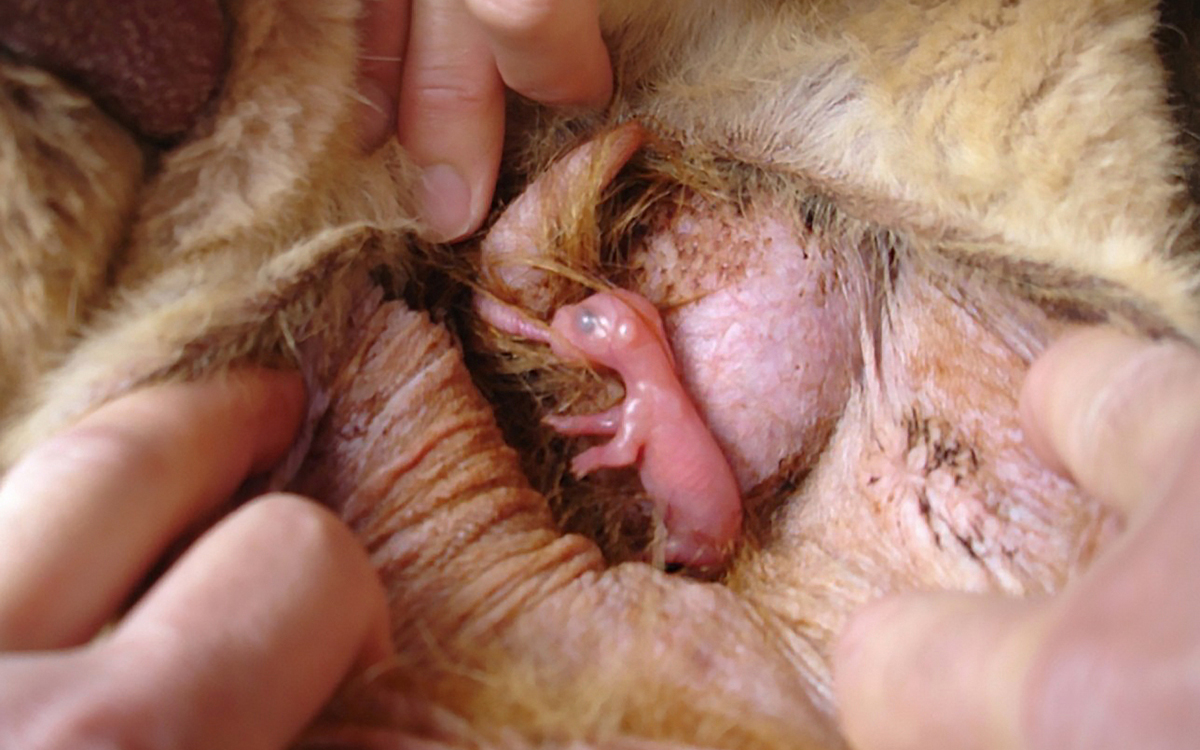
The babies usually start to emerge from the pouch around six months of age, and you'll often see them making "kukukuku" sounds to call their mother. If all goes well, around November or December of this year, you might see the newly emerged babies going in and out of their mother's pouch, or even putting their faces inside to nurse. Please look forward to it!
(*) Delayed implantation is a phenomenon in which the fertilized egg does not immediately implant in the uterus but floats around in the uterus for a while, resulting in an irregular implantation time and an extended period from mating to birth. It is observed in kangaroos, as well as bears, weasels, and pinnipeds.
[Tama Zoo]