

Zoo Stock Species and the Red List
Zoo Stock Species and the Red List
Zoo Stock

This indicates that the species is included in the Second Zoo Stock Plan, which was formulated by the Tokyo Metropolitan Government in 2018. The plan sets goals for the next 10 years in three areas: "species conservation," "contribution to wildlife conservation," and "environmental education and conservation awareness." 124 animal species are included.
What is the Red List?
Based on scientific research, this is a list of wildlife classified by rank (category) indicating the degree of risk of extinction.
Livng Things Encyclopedia shows the categories (mainland and islands) assessed by the IUCN (International Union for Conservation of Nature) at the global level, the Ministry of the Environment for Japan, and the Tokyo Metropolitan Government for Tokyo.
The higher the category in each table, the higher the risk of extinction, and CR, EN, and VU are the three categories known as "endangered species." In Tokyo, species that are not at the NT (near threatened) level but are relatively rare are considered "species of concern."
|
IUCN categories |
|
|---|---|
|
EX |
extinction |
|
EW |
Extinction in the wild |
|
CR+EN |
— |
|
CR |
Serious crisis |
|
EN |
crisis |
|
VU |
emergency |
|
NT |
Near Threatened |
|
LC・○ |
Low Concern |
|
DD |
Data shortage |
|
LP |
— |
|
Japan (Ministry of the Environment) Category |
|
|---|---|
|
EX |
extinction |
|
EW |
Extinction in the wild |
|
CR+EN |
Endangered species |
|
CR |
Critically Endangered |
|
EN |
Endangered species |
|
VU |
Endangered species |
|
NT |
Near Threatened |
|
LC・○ |
— |
|
DD |
Lack of information |
|
LP |
Endangered |
|
Tokyo Category |
|
|---|---|
|
EX |
extinction |
|
EW |
Extinction in the wild |
|
CR+EN |
Endangered species |
|
CR |
Critically Endangered |
|
EN |
Endangered species |
|
VU |
Endangered species |
|
NT |
Near Threatened |
|
LC・○ |
Unranked |
|
DD |
Lack of information |
|
LP |
Endangered |
Creatures at Tama Zoo
Creatures at Tama Zoo

Himalayan Monal
Himalayan Monal
Lophophorus impejanus
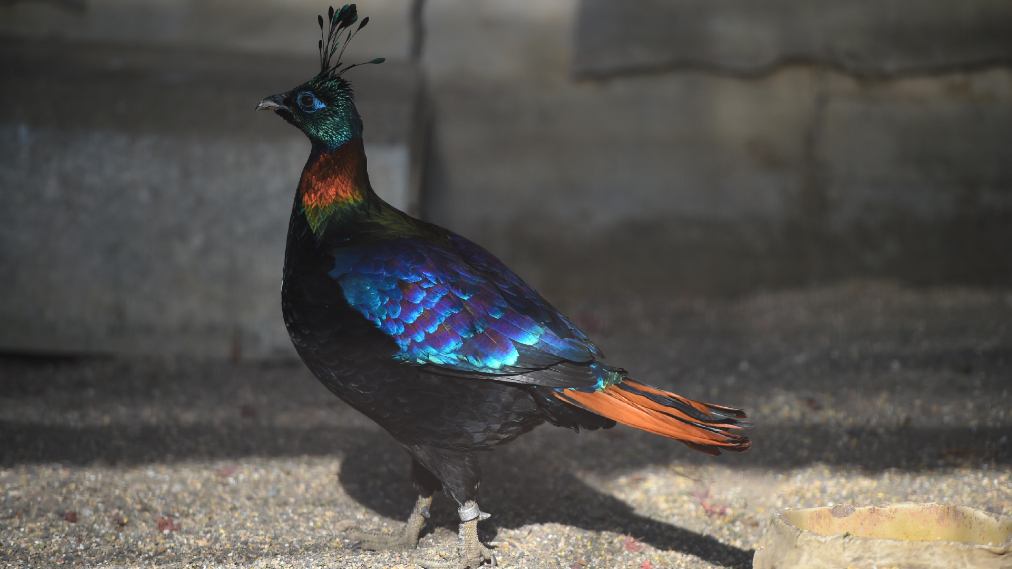
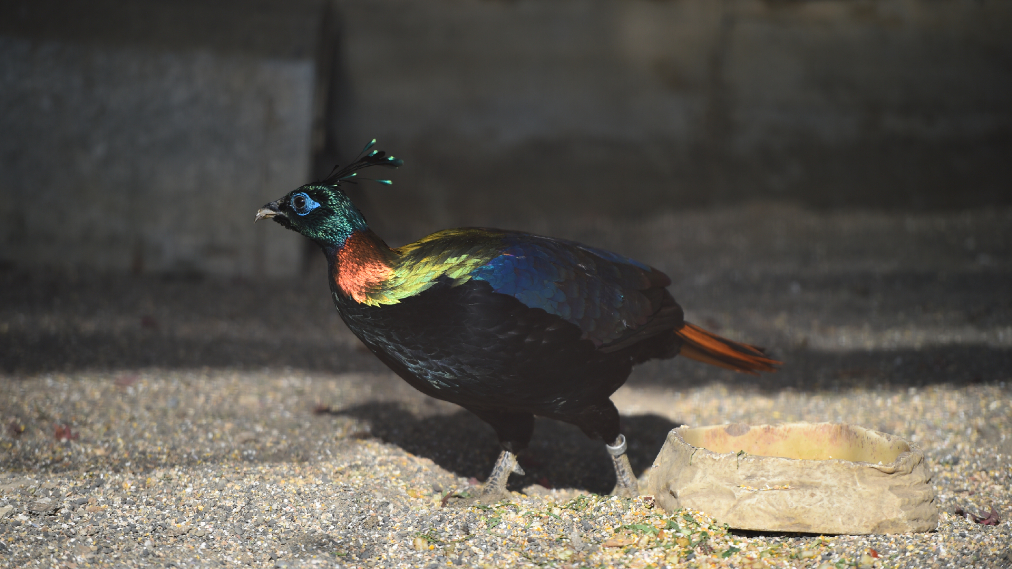
They live in low forests near the tree line at altitudes of 3,000 to 4,400 meters. They search for food by digging up snow-covered soil with their beaks. They are polygamous, and males perform displays by flying over cliffs and forests while making loud calls. Males' bodies are green, blue, purple, etc., with orange tail feathers. Females are brown overall, with white spots from their throats to their cheeks. They lay 4 to 8 eggs in a hollow-shaped nest.
| classification | Aves, Galliformes, Phasianidae |
|---|---|
| English name | Himalayan Monal |
| distribution | Himalayan mountain range stretching from Afghanistan to Bhutan and southern Tibet. *However, it has been introduced to various parts of the world as a hunting bird. |
| Residence | Alpine shrubland |
| Size |
Total length: Males approximately 70cm, females approximately 63cm
Weight: Approximately 2kg |
| food | Plant roots, rhizomes, insects, seeds |
| Red List |
IUCN: LC (Least Concern)
|