

New attempts at raising White-handed Gibbon [Part 2]
April 3, 2026
This is a follow-up to the article "A New Approach to Raising White-handed Gibbon" published on Tokyo Zoo Net on November 15, 2024.
Tama Zoo keeps three White-handed Gibbon: a male named "Tete," a female named "Mitsu," and a male named "Hari" who was born to the two.
In the previous article, I introduced a hanging scale to weigh the gibbons, but it didn't work out.
Initially, we thought that White-handed Gibbon, being arboreal animals, could easily grab onto a rope suspended from a scale, so we installed a rope with a food dispenser attached in their enclosure. However, while their front paws could grasp the rope, their hind paws would grip the metal bars, making accurate measurements impossible. If we placed the rope too far from the bars, we couldn't read their weight, and we couldn't place the food dispenser either.
The orangutans that started weighing themselves this year are no different; they don't seem to like holding onto unstable ropes. The orangutan scales are also the hanging type, but except for the boldest individuals, they tend to grab onto parts other than the scale itself, making accurate measurements impossible. It's expected that they would be more comfortable on a stable platform.
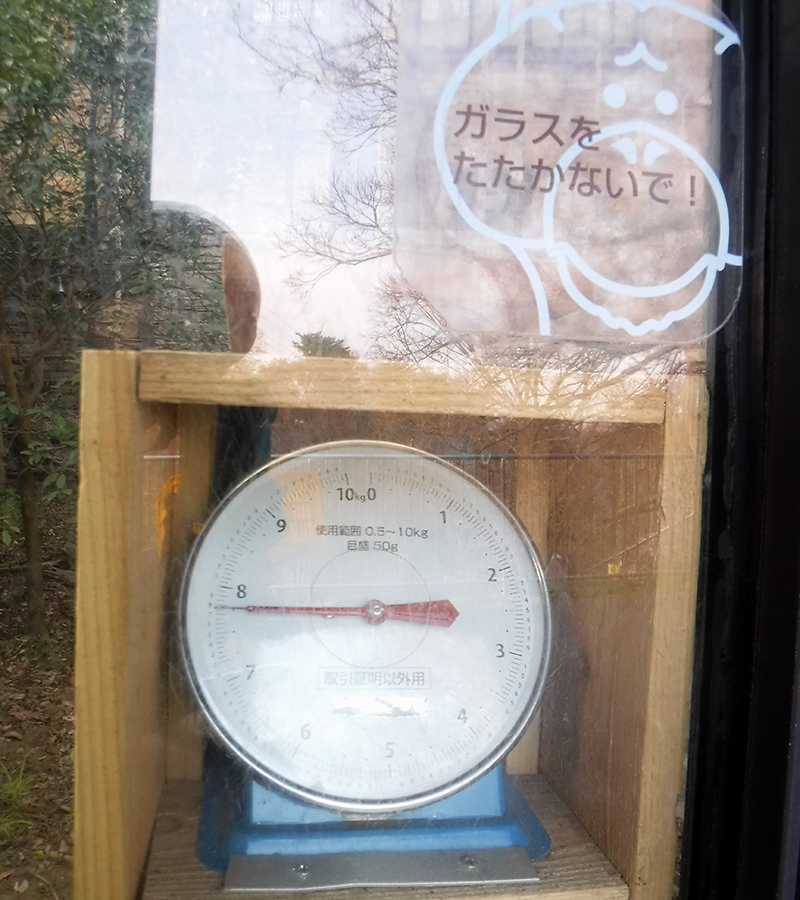
Therefore, we decided to use a "top-loading scale," the kind used to weigh vegetables and other items, to measure the gibbon's weight. We also made sure to cover the scale securely with wood to reduce the gibbon's wariness.
The problem was the placement. All the gibbons would approach when the zookeeper got close to the glass. They also preferred slightly elevated spots. So we placed the scale at a slight height in front of the exhibit glass. The zookeeper would stand in front of the scale and check the reading when the gibbon stepped on it.
As a result, all three dogs stepped onto the scale as planned. Mitsu weighed 6.2 kg, Hari 5.7 kg, and Tete 5.2 kg. All of them were at average weights.
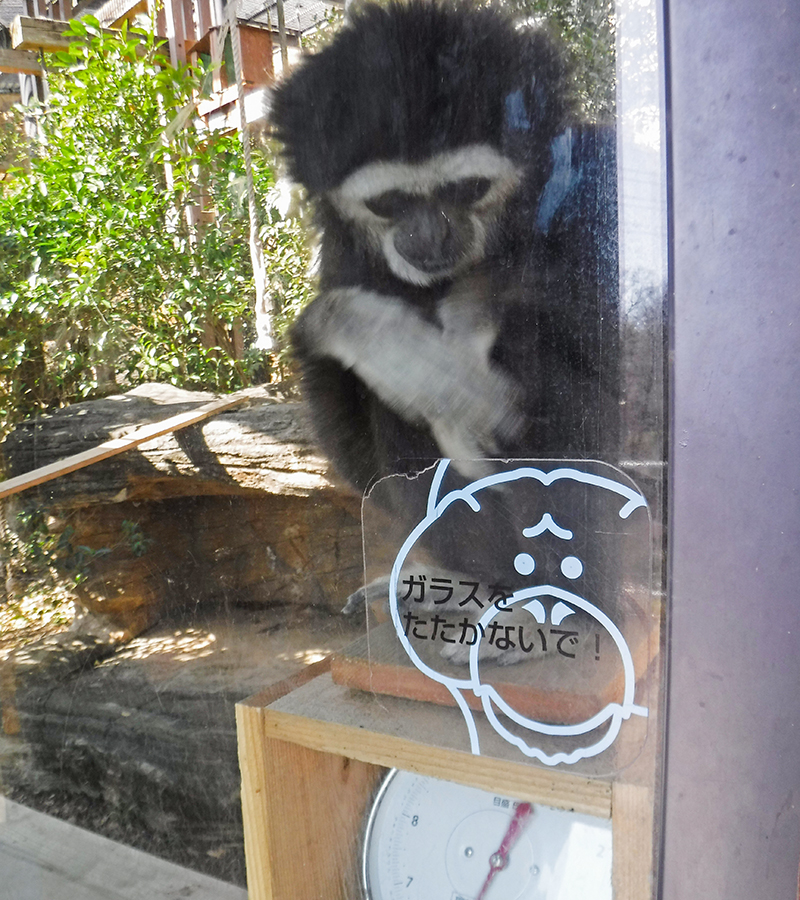
However, one problem arose. The scale's readings started to shift frequently. This is probably due to the gibbons jumping onto it with great force. We tried to fix it, but it would shift again before we knew it. It seems that it cannot withstand the heavy load because it is being used for a purpose other than its intended use.
Going forward, we will utilize the weight data we obtain to improve our animal husbandry management and strive to improve our weighing scales.
[Tama Zoo]
(April 3, 2026)