

Current status of Malayan Tapir "Liza"
February 20, 2026
Tama Zoo currently houses two male and four female Malayan Tapir.
The youngest is "Lin" (female) at 3 years old, while the oldest are "Liza," who is Lin's grandmother, and "Daifuku" (male) at 27 years old.
While it seems rare for Malayan Tapir to live to 24 years old in the wild, their lifespan in captivity is said to be around 25 to 30 years.
Liza and Daifuku, both 27 years old, could be considered elderly.
Liza has been staying in a private back area since last autumn for health management purposes, and we are unable to show her to visitors.
This time, we'll tell you about Liza's condition and the care that animal keeper are providing her with.
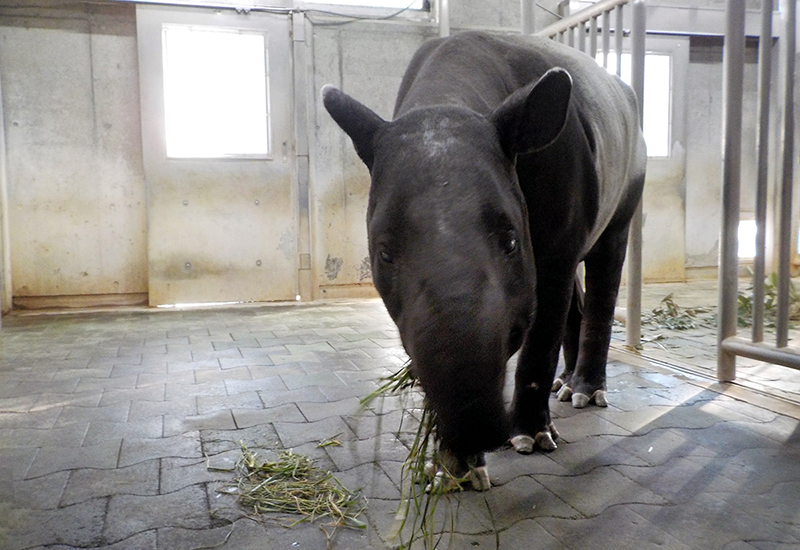
At Tama Zoo, Malayan Tapir are fed root vegetables, branches and leaves, hay, fresh grass, herbivore pellets, and hay cubes, with the contents and quantities adjusted to suit each individual animal.
However, since around last summer, Liza's food intake has become unstable.
My weight has decreased and my physical strength has declined, so my activity time has also decreased.
Although she has an appetite, Liza has become a very picky eater, so I have tried various methods of feeding her to encourage her to eat more.
I suspected that the pellets my bird was leaving uneaten might be difficult to chew because they were too hard, so I tried softening them with various things like water, mango juice, banana smoothie, and soy milk before feeding them to him.
Since it ate the pellets softened with apple juice, I decided to continue feeding them softened pellets with apple juice for a while.
In addition, he started leaving behind sweet potatoes and carrots that he had previously eaten, so I changed how I cut them, and for the carrots he still wouldn't eat, I steamed them before giving them to him.
However, around November, her appetite for pellets became unstable again, and after much trial and error, she started eating a mixture of pellets with bran, okara (soy pulp), and boiled sweet potatoes.
Currently, what Liza is willingly eating is a mixture of boiled sweet potato and softened pellets, formed into balls and wrapped in slices of bread.
Since they also like to eat the branches and leaves of trees such as bayberry and Japanese evergreen oak, we pick some growing in the garden and feed them to Liza according to her preferences at the time.
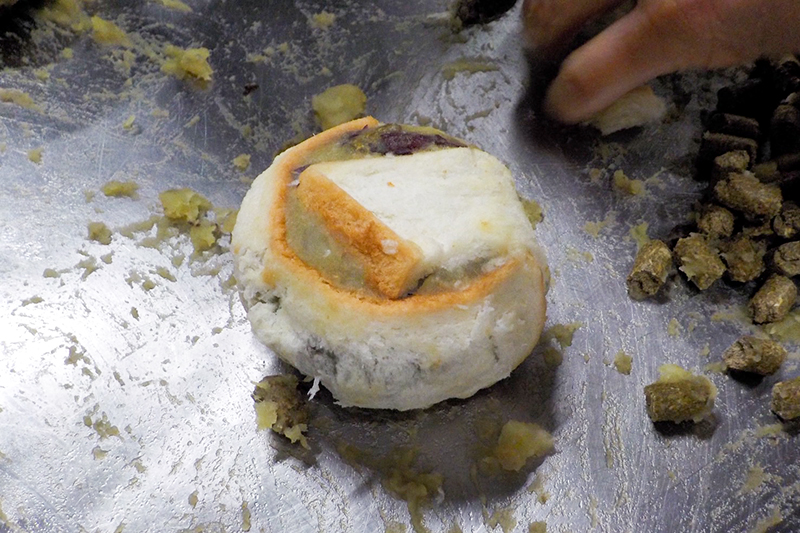
If your health deteriorates and your physical strength declines, you may lose your appetite and further lose weight, potentially leading to a life-threatening vicious cycle.
First, I focused on increasing the amount of food I was giving them by giving them a variety of foods, mixing in their favorites.
Gradually, Liza's appetite began to recover, and she started eating hay again, something she hadn't done for a while.
It seems that the finely chopped food that he liked before he got sick is easier for him to eat, and he's gradually starting to eat other foods as well, just like before.
In addition to adjusting their diet, we continuously conduct blood tests, urine tests, and fecal tests to determine the cause of any health problems.
Although the definitive cause of the loss of appetite has not yet been identified, medications and vitamins are being administered based on the test results.
Thanks to these efforts, the weight that had dropped has started to rise again along with the increase in food intake.
We will continue to provide care that takes quality of life (QOL) into consideration and will continue to face Liza's needs head-on.
[Suzuki, Tama Zoo]
Related articles
(February 20, 2026)