

Flamingo chick - afterwards
December 5, 2025
It's the season when leaves pile up and clog drains, making cleaning a hassle.
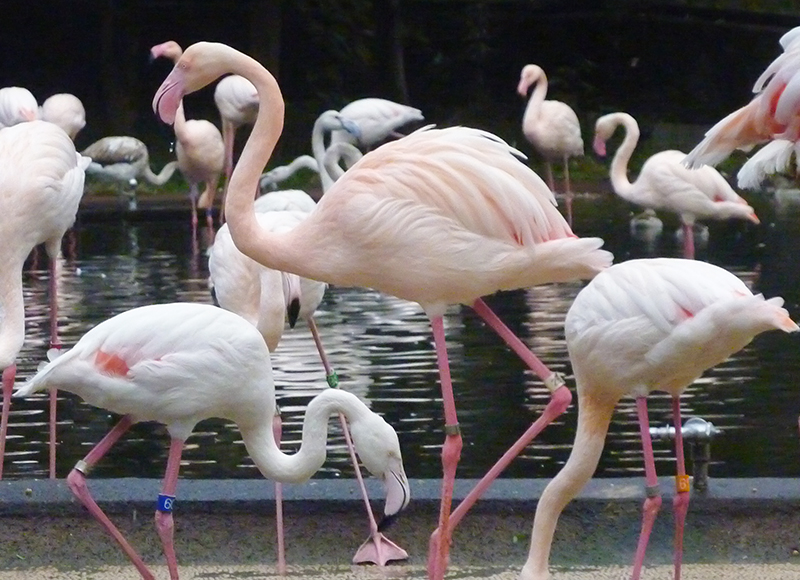
At this time of year, flamingos begin preparing for the next breeding season. You can see Greater Flamingo, their bodies now a deep pink, shaking their heads from side to side while chattering noisily to each other. If you look closely, you may see some with only a gray beak or flamingos that are completely gray. We will tell you about the young flamingos born at Tama Zoo between last year and this year.
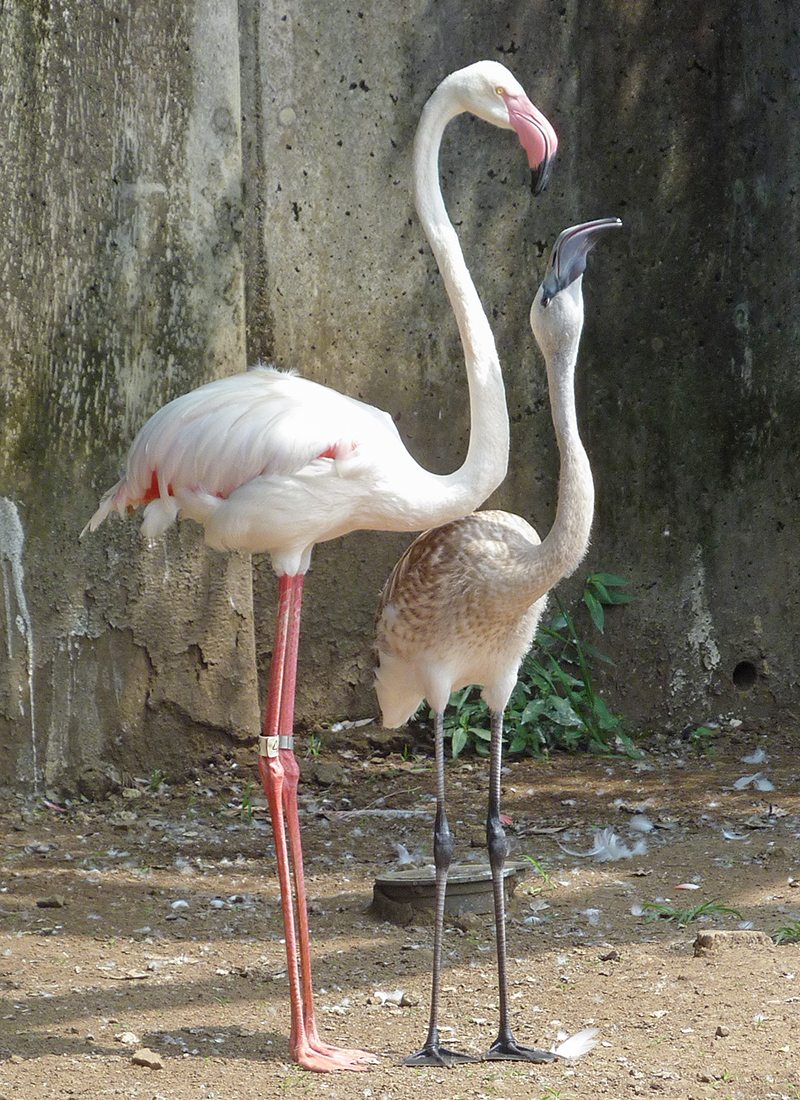
Last year (2024), Tama Zoo welcomed the first flamingo chicks in five years. Breeding has continued this year, and the chicks are now about six months old. The all-gray chicks mentioned earlier are what they will look like when they grow up.
Flamingos live in groups, and when one starts singing, the others often start singing in unison, but recently I've been hearing one bird singing repeatedly. I happened to look over and saw a gray flamingo running after an adult flamingo. It seemed the chick still wanted to be pampered by its parents, but the parents had run away as if to say that raising the chicks was over. Although the chicks have grown to a size slightly smaller than their parents, their movements still retain a childlike quality.
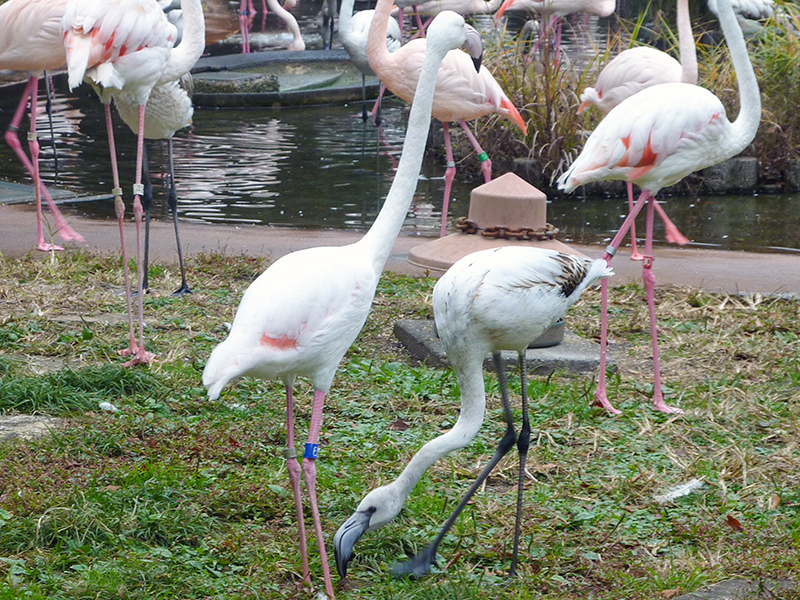
Among the groups engaging in courtship behavior (see Zoonet article from 2021), there are sometimes young birds born last year. However, rather than being able to breed, it seems that they are simply imitating the adults around them.
This spring, I saw some bees imitating the adults who had laid eggs by sitting on a nest without any eggs in it. I thought that rather than imitating them, perhaps the nest was just the right height for them to sit on.
However, during the breeding season, two or three young flamingos would approach the group of adults and imitate them by shaking their heads from side to side (a behavior known as flag waving). However, when the marching (a group walking together) began, they were left behind, and when they started walking early, no one followed, so it seemed they still didn't quite understand the meaning of the behavior.
As the chicks grow up, it will be the turn of the young flamingos born last year to become parents. Until then, they will continue to repeat these actions and learn how to reproduce within the flock. When you see a flamingo and think, "It seems like it's behaving a little differently from the others," it may be a young flamingo that is currently learning from the flock.
[Tama Zoo]