Following
our report Domestic Pig' health checkups, we'll now show you the regular health checkups for Inca Tern kept and exhibited at Ueno Zoo 's Children's Zoo STEP "Birds' Home I".
Humans can tell us when they're feeling unwell by saying, "I'm not feeling well." However, wild animals rarely show signs of weakness. Although we observe animals daily, we can't fully determine their health just by looking at them. Therefore, regular health checkups are extremely important for their care and management.
On October 30th, a day the zoo was closed, we captured 11 Inca Tern terns (7 females, 4 males) and 1 Eurasian Oystercatcher (female) for health checks. The tern enclosure, where these two species live, has a ceiling that reaches 8 meters to its highest point. To safely capture the terns, all the staff in charge of the children's zoo worked together. They divided up the tasks: some caught the terns with long nets, some guided them to places where they could be easily caught with the nets, some removed the captured terns from the nets and placed them one by one into boxes, and some pointed out the terns' location from the outside. They confirmed their movements and the flow of the work in a pre-event meeting before the actual operation.
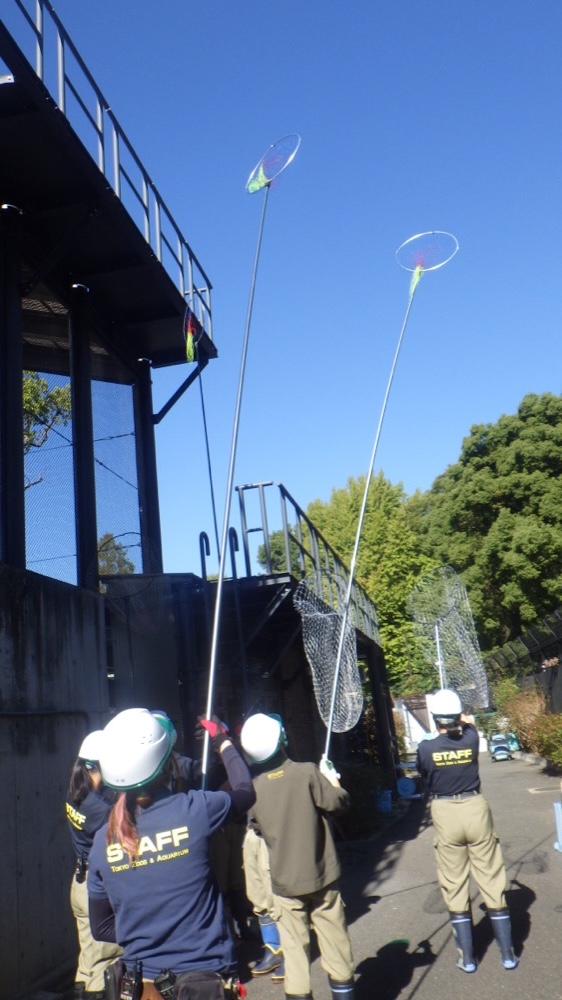
The net used for capture. First, we checked how to use it outside.First, we captured them. Eurasian Oystercatcher are often found on the ground, and stepping on them can be dangerous, so we captured them beforehand.
Next, we captured the tern. We didn't want to stress the bird by chasing it for too long, so we carried out the capture quickly. The tern cleverly tried to escape by hiding in crevices in the ceiling and hovering (suspending in mid-air while flying), but with a veterinarian from the animal hospital present, we were able to capture it smoothly in about 20 minutes.
The captured tern was then moved to the next room, where a veterinarian conducted a health check. The health check was carried out in the following three steps:
1. Individual identification
First, we checked the rings attached to the birds' legs for individual identification. Because it is difficult to distinguish individual terns by appearance alone, we use two types of rings on their legs: aluminum rings engraved with letters and numbers, and colored rings. The colored rings, which can be seen from a distance, are useful for observing the behavior of parent birds during pair formation and while raising their young.
To ensure identification even if the ring falls off, the terns are also implanted with microchips, the same type used for identifying pet dogs and cats. Therefore, a special device is used to read and verify the microchip number for each bird. If the ring or microchip has fallen off, a new one is attached, and the record is updated.
Individual identification is very important for breeding and management, so we use multiple methods to do so.
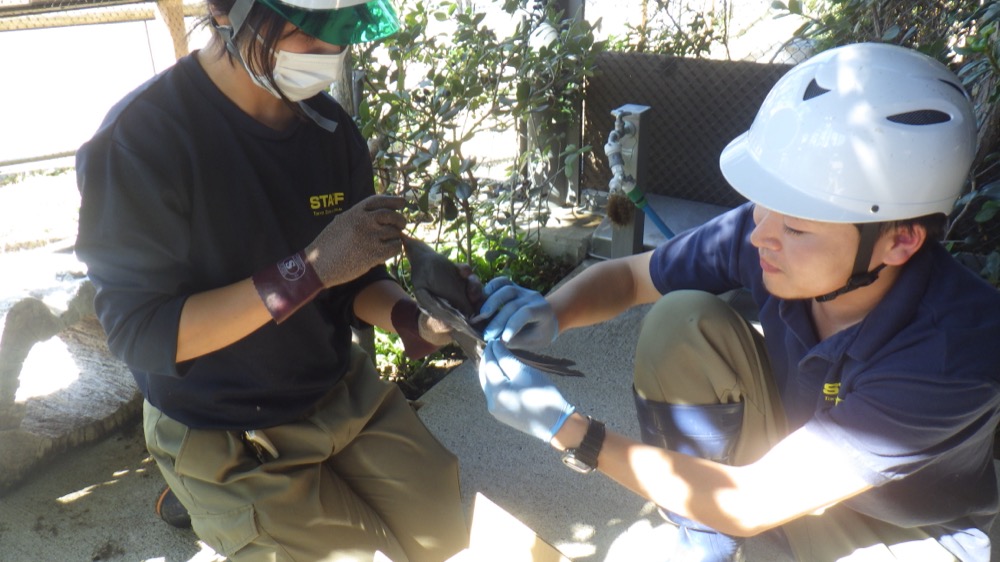
Check the ring on your foot.
2. Weight measurement
We weighed the terns while they were still in their boxes, then subtracted the weight of the boxes after removing the terns to record their weight. Weight changes are an important indicator of an animal's health and can be used to determine the amount of food to feed.
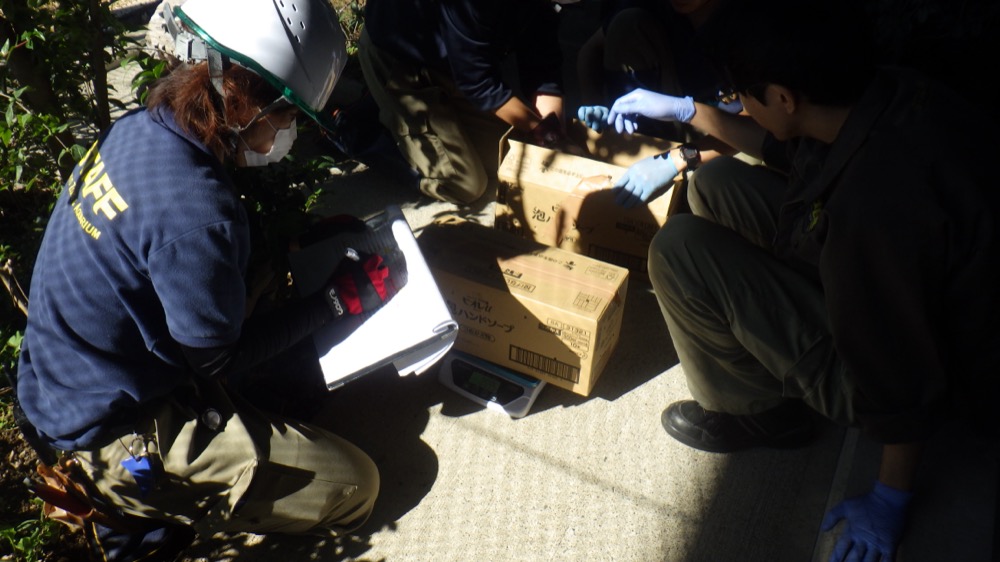
Weight measurement
3. Confirmation of health status by palpation
The veterinarian examined each bird individually by touch, checking for injuries, the condition of its chest, and the condition of its soles. Because birds have feathers, they can be thinner than they appear, so direct physical examination is crucial.
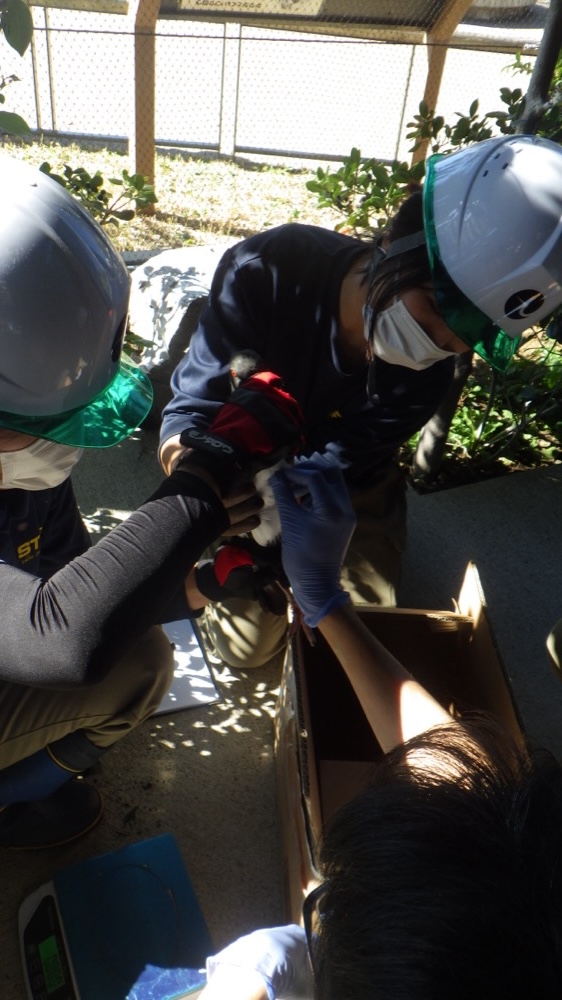
Veterinary palpationAfter completing all the tasks, we released the terns and Eurasian Oystercatcher into the tern enclosure. When we opened the box lid, they came out on their own, flew away, and began preening their feathers in places where they felt comfortable, such as on the artificial rocks.
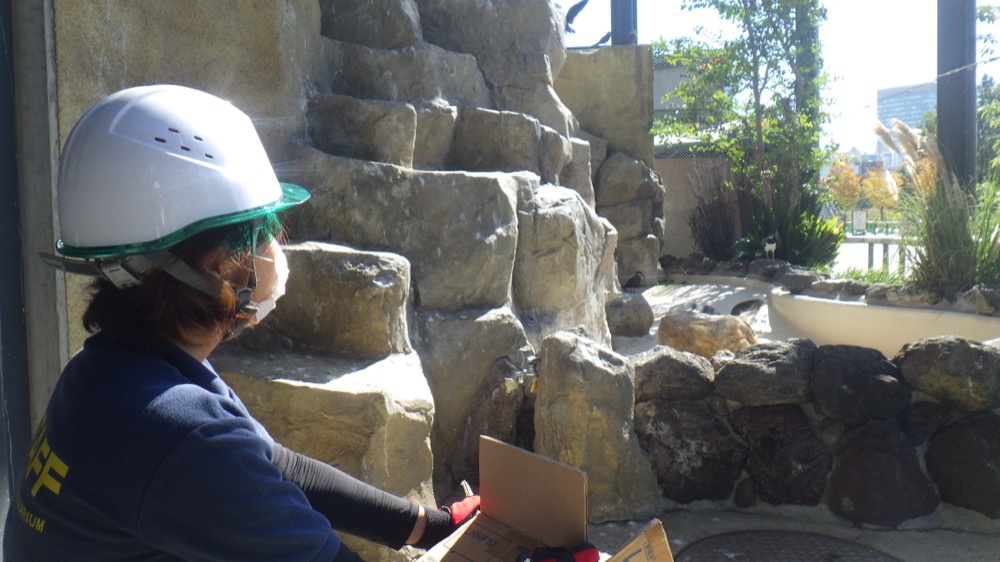
The birds being releasedThe results of this routine health checkup revealed that there are no particular health problems with the birds. We will continue to carefully observe them on a daily basis and strive to manage their health.
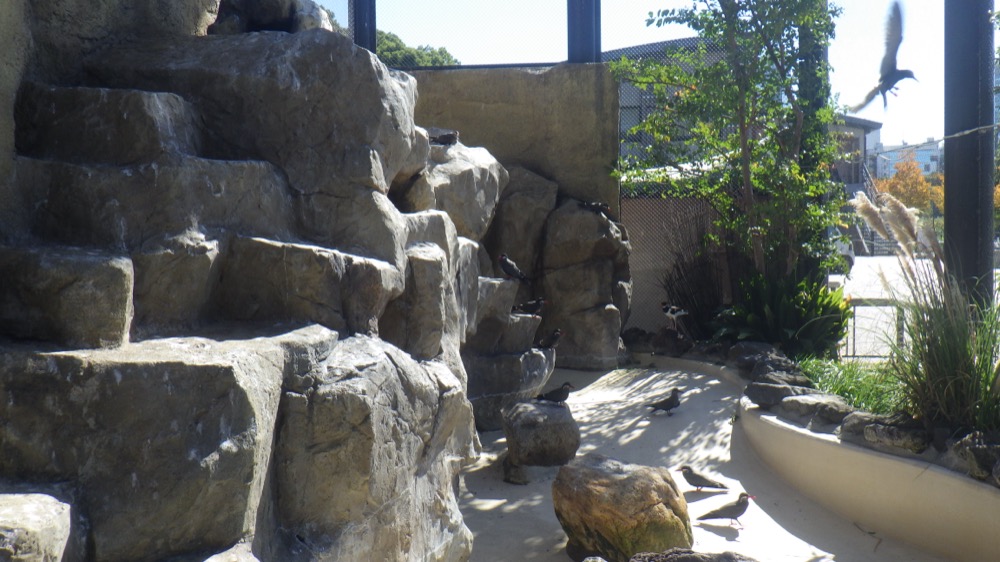
The terns and Eurasian Oystercatcher returned to the tern enclosure.(Ueno Zoo Children's Zoo Staff)
(November 23, 2023)