In a previous news report, we shared our efforts to improve the diet of Kame-kichi, a Galapagos tortoise. We are still working hard to improve Kame-kichi's picky eating habits and ensure he stays healthy for as long as possible. This time, we'd like to give you an update on our progress.
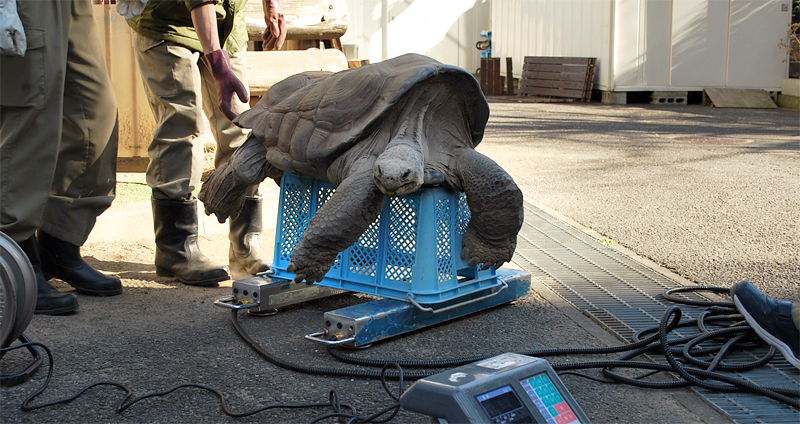
Kame-kichi during weight measurementAfter discovering that purple cabbage was the favorite food of Kamekichi, who was not interested in cabbage, we tried a variety of feeds from October to December 2014, with the help not only of the feed room staff, but also of the gorilla staff, who used a variety of vegetables in their feed, and the staff of the Children's Zoo, who used several different types of hay to feed their animals. From October to December 2014, we tried a variety of feeds - white clover, Chinese cabbage, potherb mustard, Chinese cabbage, lettuce, sunny lettuce, tomatoes, rice straw, Bermuda hay, timothy hay, turnip leaves, radish leaves, and more.
Surprisingly responsive, and again, it was the Chinese cabbage that made me gasp with glee, "Okay. The color of the Chinese cabbage was not bright, and when I gave it to Kamekichi lightly without much expectation, he ate it so vigorously that the expression "gobbled it up" was apt.
On the other hand, the one that did not live up to my expectations was the sunny lettuce. Sunny lettuce, with its purple tips, did not seem to please Kamekichi, and he did not respond well to it. Moreover, there was a later story that he ate the ordinary lettuce better. I am ashamed to say that I have not yet fully understood Kamekichi's preferences.
Since mid-November, he has been eating grass of the grass family more than ever. We are not sure if it is because of the change in climate or the change in the taste and smell of grass. Although he eats unevenly, this is a big change for Kamekichi, who used to eat only fruit on some days.
With the improvement in his diet, we have also seen some changes in Kamekichi's body. He used to produce very little feces, and when he did, it was often in a very soft state, but recently he has been producing high-fiber feces almost every day.
And his weight, which has been almost unchanged for the past 20 years, increased by 1.5 kg at the December measurement. The next weigh-in is scheduled shortly. Our staff is very excited to see how the numbers will turn out.
We are very excited to see how the numbers turn out, but we believe that the most important thing is "not to rush and not to rush. We will continue to monitor Kamekichi's physical condition and try to slowly and gradually move in the right direction.
Ueno Zoo Mayu Kawasaki, Amphibian Breeding and Exhibit Section
(January 23, 2015)