At this time of year, there's something that deer keepers eagerly await: the moment when the deer's iconic antlers fall off.
Deer antlers are shed and replaced in a yearly cycle. Like many deer species, only male Sika Deer grow antlers. In spring, the antlers naturally fall off, and new antlers grow over the summer. By the autumn breeding season, the antlers stop growing and "break down" (the outer layer of skin peels off), and the brown antlers turn white. Even after the breeding season is over, they retain their magnificent antlers throughout the winter and welcome spring again.
Let's take a look back at the past year for "Q," the Hokkaido Ezo Sika Deer at Ueno Zoo. Last year (2015), Q shed his antlers on April 25th, which was later than in recent years. I was determined not to miss that moment, but the antlers fell off during the few hours I was away from Q.
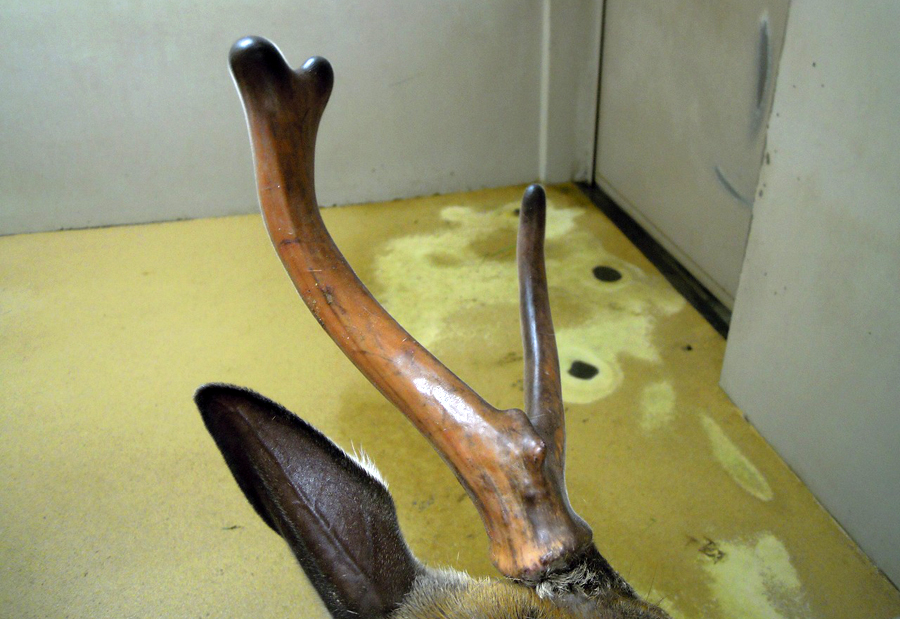 | | 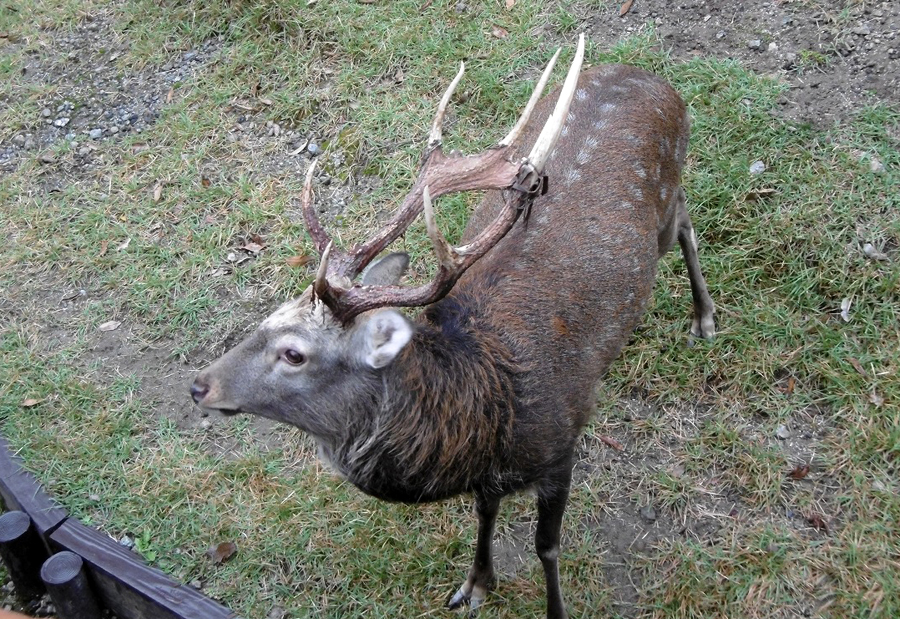 |
| Horns that have just begun to grow | The outer layer of the horn breaks (horn breakage). |
Just when I thought it was starting to look like a female, new horns began to grow, and after half a month they were 5 centimeters long. After that, the horns continued to grow rapidly, sometimes growing 1 centimeter in a single day. At this stage, the horns have blood flowing through them, so they feel very warm to the touch.
In mid-August, the horns were about 70 centimeters long at their longest point. They stopped growing at this length. After that, the bark on the surface of the horns gradually thinned, and the unevenness of the bones beneath the bark became more visible. The horns broke off on October 12th. As the blood flow to the horns stopped, the temperature began to drop from the tips where the bark started to break. At the same time, there was a change in its behavior, and it began to try to peel off the bark by rubbing it against anything it could get its hands on, such as trees, walls, and logs used for retaining soil.
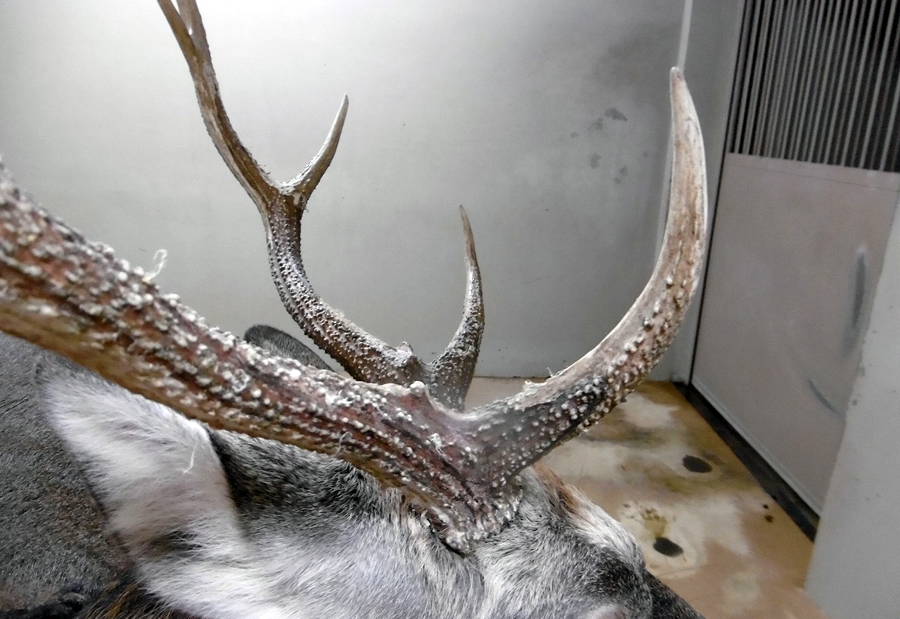 | | 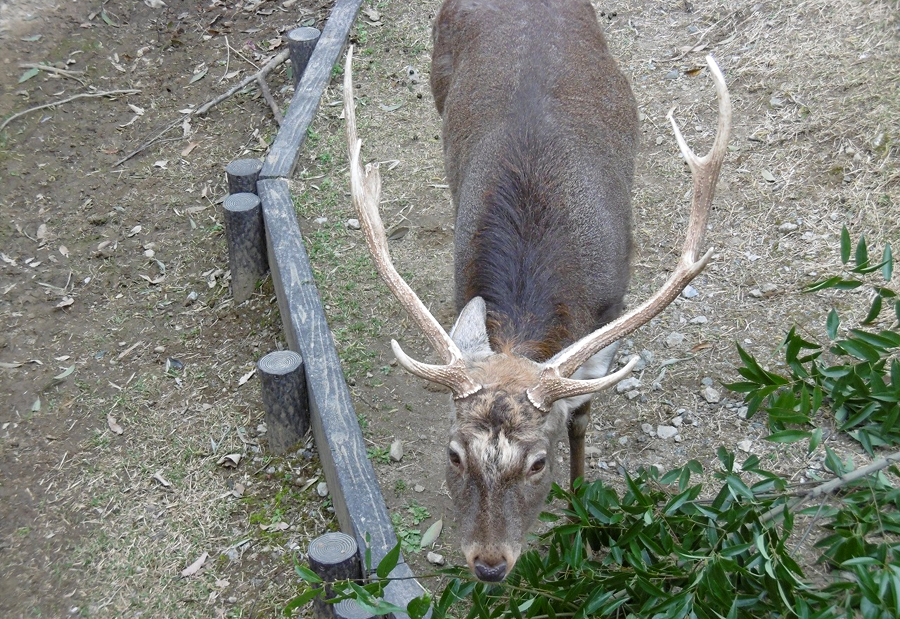 |
| bumps and indentations carved into the corners | Current corner |
In this way, by the time of mating season, the white, hard "dead horns" are fully formed. In the wild, during the breeding season, males use their horns to push against each other, and the winner mates with the female. Perhaps it is an instinct, but around this time Q also began to exhibit the behavior of pushing up logs and tree stumps placed in the exhibit area with his horns. They must weigh 20 to 30 kilograms, but sometimes he can push them from the center of the exhibit area to the wall in just a few hours. As he does this, the base of the horns becomes stained brown with bark and mud, creating a contrast between the white tip and the brown base of the horns.
And now, spring has arrived again, and the time for antler shedding is just around the corner. Having watched the antler changes up close for a year, I was surprised at how quickly the changes occurred—even though I watched them every day, I would easily miss them if I wasn't careful. I was impressed by how the deer sensed the subtle shifts in the seasons and adapted their behavior accordingly.
The patterns (bumps and indentations) etched into the antlers were rougher than I had imagined, giving them a sense of strength, and the antlers, which become polished little by little as they are rubbed, look like works of art. At Ezo Sika Deer exhibit in Ueno Ueno Zoo, you can see the bumps and indentations on Q's antlers when he approaches. Please come to the zoo and compare them to your own image.
Related news and video: "
The decisive moment! Ezo Sika Deer 's antlers fall off" (Filmed March 20, 2002)
[Yukie Tokuda, Animal Care and Exhibition Staff, Ueno Zoo East Garden]
(April 8, 2016)