Ueno Zoo is running the Tokyo Metropolitan Zoo and Aquarium Winter Campaign
Visit Hot Zoo 2019 As part of this initiative, an event themed "Let's take a look at Japan's creatures - what's so amazing about them!!"
Ueno de Nippon! We are holding the event.
In conjunction with this event, which focuses on animals living in Japan, we are introducing Ueno Zoo 's efforts to protect Rock Ptarmigan in several installments.
Part 3: Why are Rock Ptarmigan declining?
Among the species of Rock Ptarmigan, the Japanese rock Rock Ptarmigan is distributed in the southernmost, warmest regions.
Although they advanced into temperate zones like Japan during the Ice Age when temperatures dropped, they survived precariously on high mountaintops after the Ice Age ended, so they are thought to be strongly affected by global warming. Since bacterial activity is suppressed in cool, high-altitude areas, rising temperatures in mountainous regions increase the risk of infectious diseases. Furthermore, there is a possibility that alpine plants, which have been used as food in the past, will decline due to global warming.
Furthermore, other animals that have not previously inhabited high-altitude areas are directly threatening the survival of Rock Ptarmigan.
Deer, whose populations are increasing nationwide, are venturing into high-altitude areas and eating the alpine plants that Rock Ptarmigan rely on for food. Foxes and martens also prey on Rock Ptarmigan. In recent years, there have also been cases of Japanese Macaque preying on Rock Ptarmigan.
The expansion of predators into high-altitude areas is actually caused by human behavior. When tourists discard leftover lunches and containers, foxes and carrion crows gather to eat them, and as a result, they establish themselves in high-altitude areas where they previously did not live.
Furthermore, there have been reports of tourists chasing after Rock Ptarmigan and even holding chicks in their hands to take pictures. Such behavior not only stresses Rock Ptarmigan but also poses a risk of infecting them with various pathogens that are not found in high-altitude areas.
Rock Ptarmigan, designated a special natural monument of Japan in 1955, is rapidly declining due to a combination of these various factors. In the 1980s, it was estimated that there were 3,000 of them in Japan, but by the 2000s, that number had fallen to around 1,700.
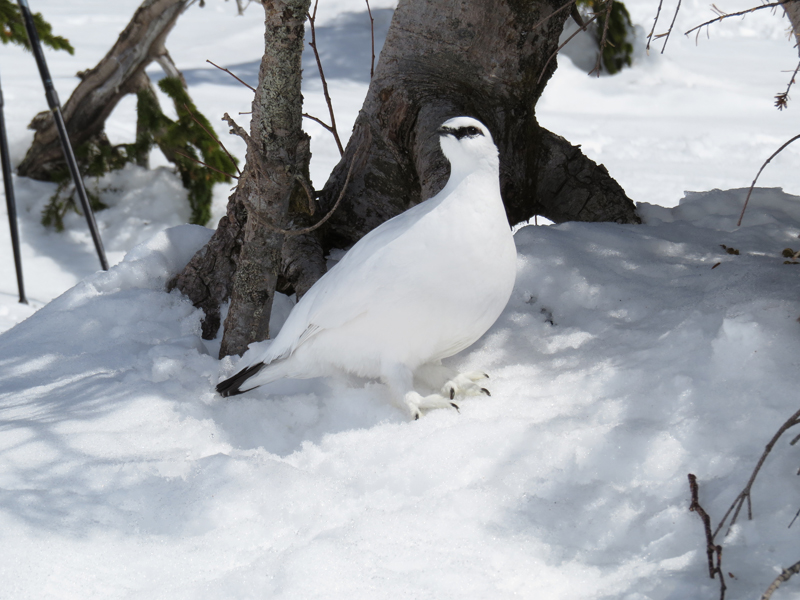
A male wild Rock Ptarmigan ptarmigan in winter plumage.
(Tsugaike Plateau, Nagano Prefecture)◎ "Ueno Zoo 's efforts to protect Rock Ptarmigan"
・
Part 1: "What kind of bird is Rock Ptarmigan?"・
The second installment: "Japanese Rock Ptarmigan and Svalbard Rock Ptarmigan"・Part 3 (This article)
・
The 4th installment: "To protect Rock Ptarmigan in Japan"・
The 5th installment: "An experiment at Ueno Zoo"・
The 6th installment: "Regarding the Public Display Rock Ptarmigan"
◎Related articles
・
We will be releasing images of the Japanese Rock Rock Ptarmigan. (February 1, 2019)
(February 1, 2019)
(March 11, 2019: Added links up to the final installment [Part 6] of the series)