On November 19, 2020, the Ministry of the Environment announced a plan to relocate individuals of the rare land snail species Chichijima Land Snail and Land Snail land snail, which are native to the Ogasawara Islands, from captivity at the Ogasawara World Heritage Center to Tatsumijima Island, one of the islands belonging to Chichijima, in order to restore their wild populations (
Ministry of the Environment article). This is the first time that land snails bred in captivity have been transplanted to their wild habitats under the Ministry of the Environment's projects.
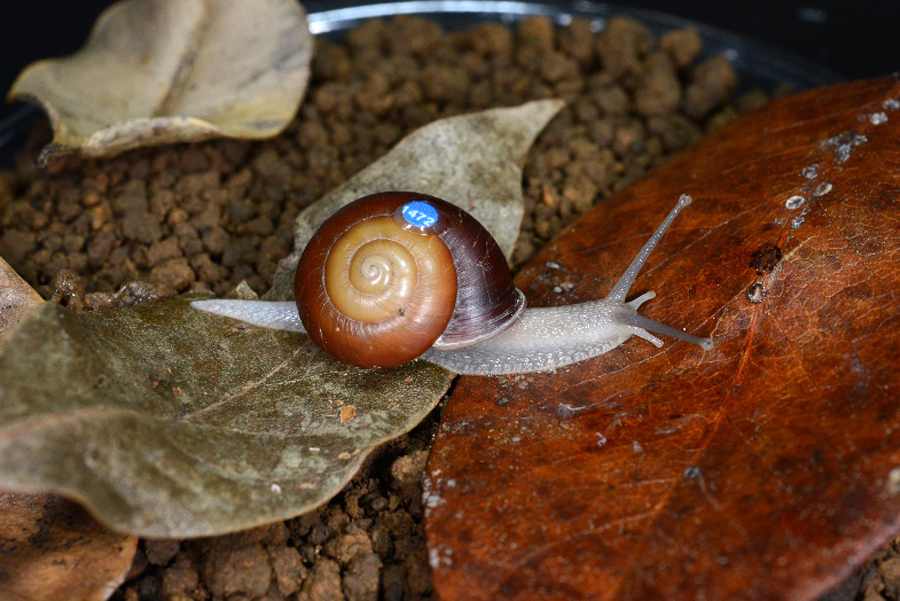 | | 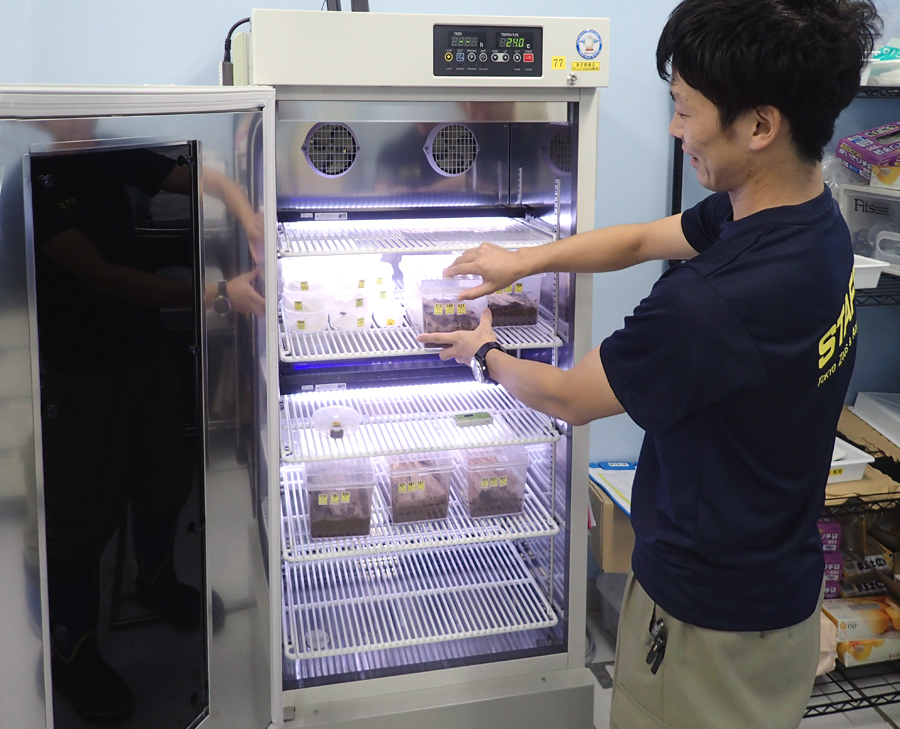 |
| Adult Land Snail | Rearing and management in a constant-temperature incubator. This is part of ex-situ conservation. |
As announced above, the government is promoting the conservation of rare land mollusks from the Ogasawara Islands. Tokyo Zoological Park Society has received a request for cooperation from the Ministry of the Environment and is working on the Ministry of the Environment's initiative.
Ogasawara Islands Terrestrial Mollusk 14 Species Protection and Propagation Project In cooperation with the "[organization name]", since 2017, Tokyo Metropolitan Zoos and Aquariums (Ueno Zoo, Tama Zoo Inokashira Park Zoo, and Tokyo Sea Life Park) have been working on the breeding and rearing of two endemic land snail species of the Ogasawara Islands that are threatened with extinction: the Japanese giant land snail Land Snail noctiluca) and Land Snail. The purpose is to mitigate the risks to endangered species, preserve their lineage, and raise public awareness. In 2018, they succeeded in breeding Land Snail.
notice).
Currently, Tokyo Metropolitan Zoos and Aquariums are implementing breeding plans that take genetic diversity into consideration, with the aim of restoring the populations of Ogasawara terrestrial mollusks. They are also providing test specimens to the Ministry of the Environment to accumulate scientific knowledge. Going forward, each facility will actively promote public awareness and education about Ogasawara terrestrial mollusks.
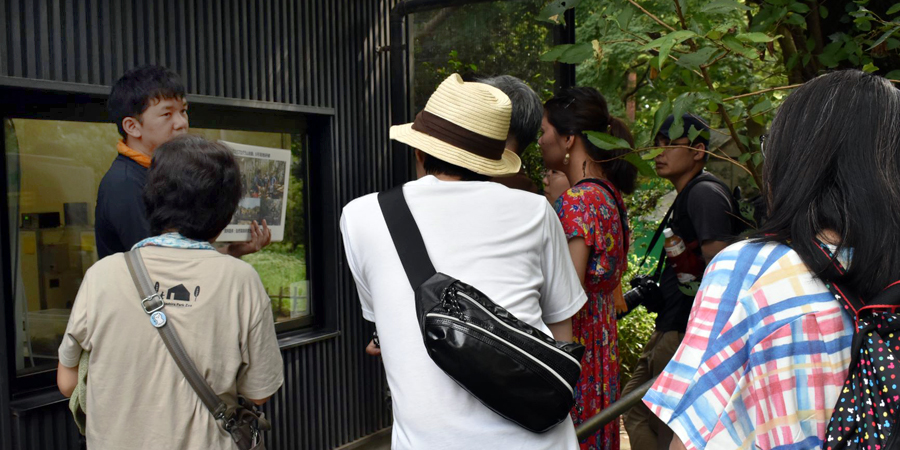
A talk about shellfish from the Ogasawara Islands, conducted as part of public awareness activities (Inokashira Park Zoo)
Mandarina chichijimana Land Snail Critically Endangered (CR+EN)]
Distribution area: Southern tip of Chichijima Island and Tatsumijima Island in the Ogasawara Islands
Habitat: It mainly inhabits the forest floor of wetland forests where plants such as Livistona chinensis are abundant.
Characteristics: Shell length approximately 20.0 mm, shell diameter approximately 24.0 mm. The shell is somewhat rounded and hard. The spire is tall, and the whorls are slightly bulging. The margin of the body whorl is rounded. The shell surface is almost smooth. The shell color is pale yellowish-brown, and the shell has four color bands. The umbilicus is closed. The aperture is thick, hypertrophied, and inverted.
Mandarina hirasei (Land Snail) [Critically Endangered (CR+EN)]
Distribution area: Southern tip of Chichijima and Tatsumijima in the Ogasawara Islands. Northern part of Hahajima.
Habitat: They utilize the space from the trees to the ground within forests where screw pine and purslane grow.
Characteristics: Shell length approximately 13.0 mm, shell diameter approximately 21.0 mm. The shell is flattened, somewhat thin, and the whorls are slightly bulging. The margin of the body whorl is rounded. The shell color ranges from pale yellowish-brown to dark brown, without color bands. The shell surface is almost smooth. The luster of the shell surface is weak. The umbilicus opens widely. The aperture is thick, thickened, and inverted.
Land Snail mandarina (a type of land snail) [Critically Endangered (CR+EN)]
Distribution area: Distributed in the Ogasawara Islands, excluding the northern tip and eastern part of Chichijima and the northern part of Anijima.
Habitat: It is commonly found on the forest floor of wetland forests where tree species such as Livistona chinensis grow abundantly.
Characteristics: Shell length approximately 21.0 mm, shell diameter approximately 28.0 mm. The shell is somewhat rounded and somewhat hard. The spire is low, and the whorls are slightly bulging. The margin of the body whorl is rounded. The shell has two broad dark purplish-brown bands, and rather appears to have a pale yellowish-brown band of the shell color on the margin of the body whorl. The shell surface is almost smooth. The umbilicus is closed.
(November 20, 2020)