According to the Japanese Association Japanese Association of Zoos and Aquariums, as of the end of December 2020, there were 20 Western Western Gorilla (10 males and 10 females) being kept in six zoos across Japan. Gorillas live in groups consisting of a sexually mature male, known as a "silverback," and several females and their offspring.
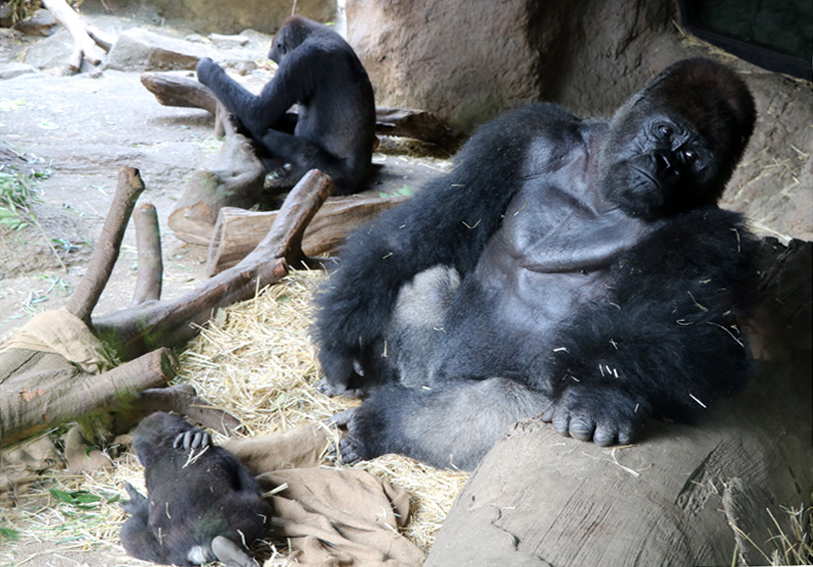
Haoko (right), a silverback in a herd.In three of the six zoos, groups of silverbacks have formed and are breeding. However, Haoko, a silverback at Ueno Zoo, and Shabani, a silverback at Higashiyama Zoo in Nagoya, are brothers, and Momotaro, a silverback at Kyoto City Zoo, is the son of Momoko, a female at Ueno Zoo, meaning they are related. Unfortunately, there are very few options to avoid inbreeding.
Furthermore, even when the existing young gorillas reach breeding age, it is currently unknown whether they will successfully form breeding pairs. This is because compatibility is uncertain, and it is unclear whether they will engage in mating behavior that leads to pregnancy.
In order to properly maintain the gorilla population in Japan in the future, it will be necessary to introduce individuals from zoos overseas to refresh their bloodline. However, introducing gorillas from overseas zoos is not easy. Even if a zoo capable of importing gorillas is found, many problems must be solved in order to carry out the legally mandated procedures and quarantine requirements. Incidentally, currently there is only one facility in Japan that is capable of conducting the quarantine necessary for the import and export of gorillas.
In recent years, Ueno Zoo has been sending staff to overseas zoos to introduce new gorilla care methods. We believe it is important to strengthen relationships with overseas zoos and to cultivate personnel to introduce the latest technologies. Specifically, we have formed a group of 6-7 gorillas, centered around the silverback gorilla Haoko, so that they can spend 24 hours a day as a family.
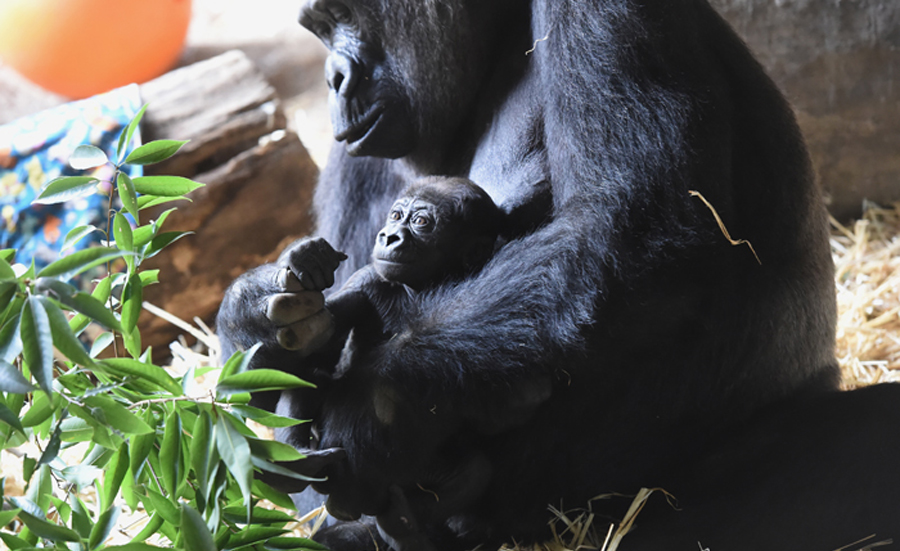
"Riki," a male born on October 9, 2017 (photo taken on November 28, 2017)Currently, baby gorillas are being born and raised within a group at Ueno Zoo. The babies are watched over by their families and learn many things through various experiences. animal keeper take great care to protect the gorillas' health by providing them with living spaces, play equipment, and food. In particular, they pay close attention to their diet to prevent obesity. Some fruits and vegetables, such as bananas, are sweet and contain a lot of sugar. These are avoided, and the gorillas are given foods that are rich in fiber, such as tree leaves. animal keeper consider nutritional balance and exercise levels, and divide the gorillas' favorite foods into small portions and hide them in various places in their living spaces so that the gorillas can search for food as they eat.
There is no end to improving breeding and management methods so that gorillas can live healthy lives in zoos and continue their lineage.
Director Ueno Zoological Gardens
Toyo Fukuda
Related articles
"
Endless Challenge [1] Giant Panda Breeding (1)” (May 26, 2017)
"
Endless Challenges [1] Giant Panda Breeding (2)” (July 7, 2017)
"
Endless Challenge [1] Giant Panda Breeding (3)” (July 31, 2017)
"
Endless Challenges [2] Renovation of the Children's Zoo” (August 6, 2017)
"
Endless Challenge [3] Breeding Asian Elephant” (January 21, 2021)
"
Endless Challenge [4] Conservation of the Rock Rock Ptarmigan the Bird of God” (January 30, 2021)
"
Two Lidth's Jay Jays have moved to Hirakawa Zoological Park.” (November 29, 2020)
"
Endless Challenge [5] The Return of Lidth's Jay” (February 6, 2021)
"
Endless Challenges [6] New Developments in Educational Outreach Programs” (February 21, 2021)
"
Endless Challenge [7] Creating a "Panda Forest"” (March 8, 2021)
(March 28, 2021)