Ueno Zoo confirmed Giant Panda mating on March 6, 2021 (
see announcement), and has been carefully observing the condition of the female, "Shin Shin." We are making this announcement because there is a possibility that she is pregnant.
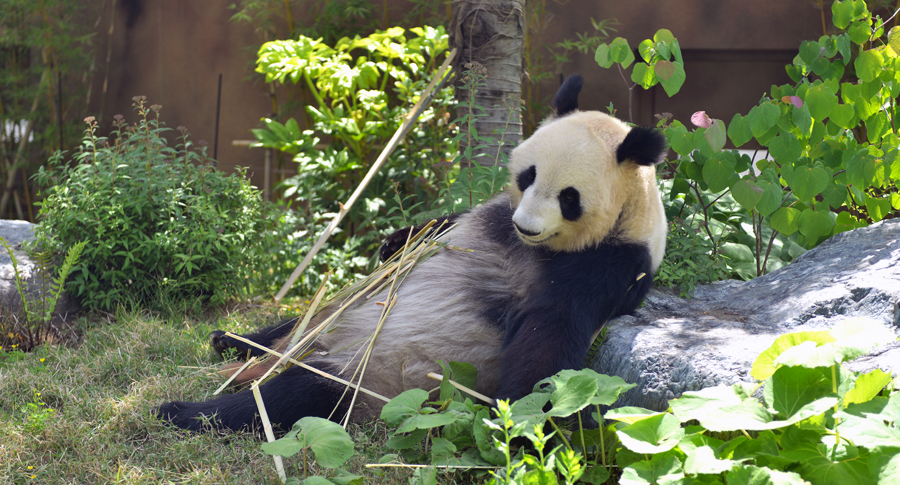
Shinshin (photographed on May 10, 2021)Although Ueno Zoo reopened today, June 4, 2021 (Friday), public viewing of Shin Shin will be suspended to allow her to give birth in a safe environment. Furthermore, it is known that Giant Panda can experience a phenomenon called "false pregnancy," so her pregnancy has not yet been confirmed.
Xin Xin was born on July 3, 2005, at the Wolong Protection Center in China. Her current health remains good. As of May 25, her weight is 126.2 kg, and no significant changes have been observed.
Regarding the criteria used to determine the possibility of pregnancy
- Changes in appetite: A slight decrease in Take's food intake was observed around May 23rd, and since around May 31st, it has decreased to about one-quarter of the normal amount.
- Changes in behavior: Around May 23rd, rest time began to increase slightly. By June 2nd, rest time was about twice the usual amount.
- No physical changes have been observed so far.
- Hormonal changes: The results of tests for hormone metabolites in urine that indicate pregnancy show characteristic changes observed during pregnancy.
Starting on May 10th, we began "acclimatizing" Shin Shin to the birthing room inside the animal enclosure. Currently, we have confirmed that she occasionally uses the birthing room when she is resting.
*Male panda "Ri Ri" is on display in West Garden" Panda Forest," while female panda "Xiang Xiang" is on display as usual in East Garden panda enclosure.
Future plans
Because Giant Panda have a wide gestation period, the expected delivery date is unknown. We will continue to make comprehensive assessments of her appetite, behavior, hormonal changes, etc., and proceed with preparations for childbirth. The following is a summary of Shin Shin's condition in 2017, the year she gave birth to Xiang Xiang.
2017
Around May 16th, a decrease in foraging and an increase in resting time begin to be observed.
May 25th: Exhibition suspended in preparation for childbirth.
June 12th: Childbirth
Note
- false pregnancy
- Pseudopregnancy is not a disease but a type of physiological phenomenon. It is known that even without fertilization after ovulation, the process can follow the same course as pregnancy. For example, phenomena similar to those of pregnancy may appear, such as elevated urinary hormone levels, decreased activity, prolonged rest periods, loss of appetite, prominent nipples, breast swelling, and nest-building behavior. These phenomena eventually disappear, and the pseudopregnancy ends.
- Delayed implantation
- This phenomenon occurs when a fertilized egg does not immediately implant in the uterine lining, but instead floats in the uterus for a while as a blastocyst before implantation and development begin. It is known to occur in bears, weasels, pinnipeds, and kangaroos that are distributed in temperate and cold regions. The duration of pregnancy also varies depending on the time it takes for implantation to occur.
(06/04/2021)