The panda twins, who will soon be 50 days old, are growing well.
As mentioned in
our recent updates, we have previously reported that she is "growing well," but we understand that it can be difficult to visualize this from daily figures alone. Therefore, we have created a graph showing her weight and length, including Xiang Xiang.
You can see that the three pups are following roughly the same growth curve.
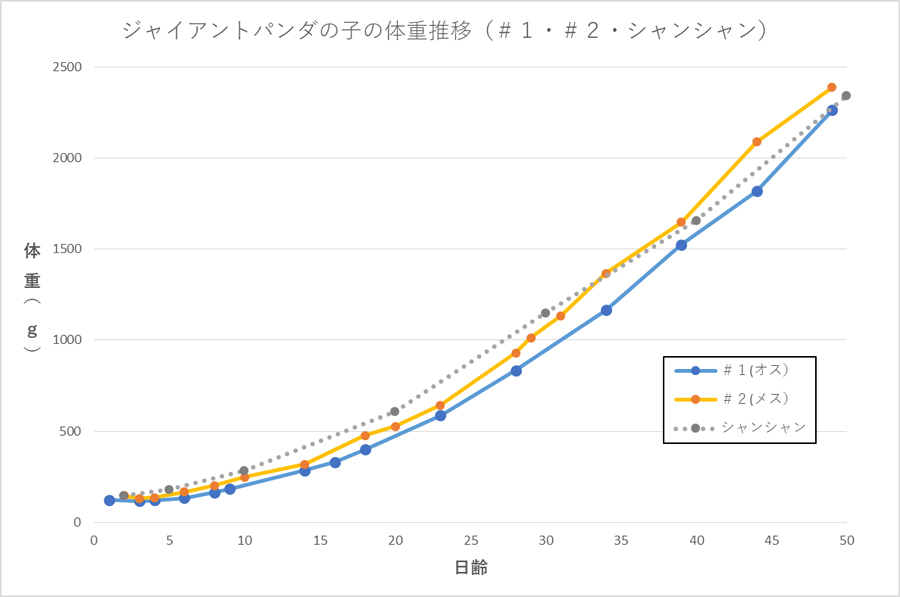
Figure 1: Weight gain of the two puppies born in 2021 and Xiang Xiang, born in 2017.
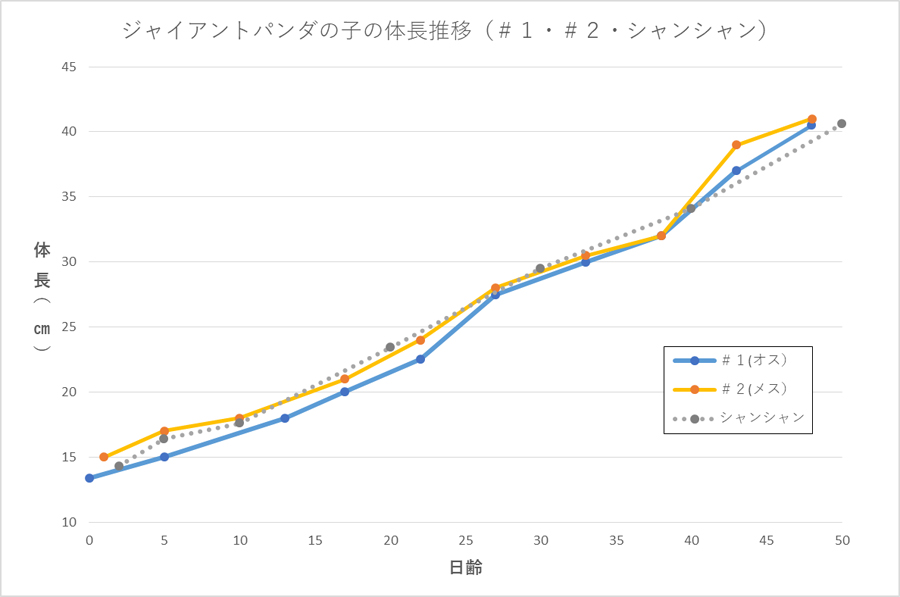
Figure 2: Changes in body length between the two puppies born in 2021 and Xiang Xiang, born in 2017.In addition to quantitative changes such as weight and body length, it is also necessary to pay attention to qualitative changes such as body shape and motor function. The current condition compared to immediately after birth is recorded by the veterinarian who was mainly in charge of management in the nursery, and is included at the end of this article. Furthermore, no problems have been observed in the physiological conditions (heart rate, respiratory rate, abdominal surface temperature, and transcutaneous arterial oxygen saturation).
Based on these results, we believe the development is progressing well. We have also received the opinion from Chinese experts that the progress is on track.
This is the first time Ueno Zoo has had twins born and is managing their care, and so far, things are going smoothly. However, they are still very young, and we cannot let our guard down. We will continue to provide careful care, maintaining a 24-hour system and exchanging information closely with the Chinese side.
A comparison of twins immediately after birth and their current state—a veterinarian's record.
Physical changesThe twins, born entirely pink with their eyes and ears closed, now have thick fur, clearly defined black and white markings, half-open eyes, and are sensitive to sound. Their long eyelashes and already firm, adult-like paw pads are noticeable.
motor functionUnlike immediately after birth, when its limbs moved haphazardly and it hopped around in a jerky manner, it can now move forward with an inchworm-like motion and occasionally use its front legs to lift its upper body.
Reflexes and reactionsThe frequency of the twitching and spasms throughout the body, which were seen immediately after birth, is decreasing. In particular, I feel that the puppy has become more sensitive to touch, sometimes crying out in response to human voices and sounds, and jumping sharply in surprise when touched.
Sleeping position/turning overImmediately after birth, they slept on their stomachs, but around two weeks old, they started to be able to sleep on their backs. Males are especially good at this. They've gotten better at rolling over than before, but they still often manage to flip over on their own but can't get back up on their own, so they frequently cry out loudly, "Ngyaa," "Aaah," and "Ogyaa," asking for help.
Feeding frequency and amountIn artificial rearing in incubators, as the babies grow, the amount they drink per feeding increases while the frequency of feeding decreases. The total amount of milk consumed per day increases, with some babies drinking more than 300 ml.
Defecation and urinationThe baby's ability to defecate on its own is not yet clear, and defecation is being stimulated artificially. Even when fed 100% formula, the baby's bowel movements are relatively stable.
(August 11, 2021)
(August 24, 2021: Figure 1 revised)