Giant Panda at Ueno Zoo, who gave birth to twins on June 23rd this year, have had their exhibit in West Garden 's "Panda Forest" closed to ensure the healthy growth of their offspring. We apologize for any inconvenience this may cause.
This time, we'll tell you about what Xiang Xiang (female) and Ri Ri (male), who are not currently on display, have been up to this summer.
We understand that some people may be unable to visit Ueno Zoo due to the spread of the coronavirus, but please rest assured that all five animals are doing well.
1. Regarding Xiang Xiang's condition
Giant Panda are native to the cool mountainous regions of China, so they cannot spend long periods of time in places where the temperature exceeds 25°C. For this reason, Xiang Xiang has always stayed indoors in East Garden panda enclosure, where the room temperature is kept below 25°C, during hotter periods. In particular, during Tokyo's summers when temperatures rise from early morning, it is difficult to let her outside even for a short time, so she has been kept indoors all day long.
As temperatures drop, Xiang Xiang will be taken outdoors more often. However, animal keeper stationed at East Garden panda enclosure will not only consider the temperature but also observe her feeding habits, behavior, and the surrounding environment to make a comprehensive decision on the most comfortable place for Xiang Xiang.
Xiang Xiang, who turned four on June 12th, has developed behavioral patterns such as feeding and resting, as well as seasonal variations, that are similar to those of an adult. Her weight has also reached 90kg, with only slight fluctuations, and she is growing steadily.
Some people worry that living alone in East Garden might be lonely, but Giant Panda are naturally solitary animals. Once they reach adulthood, even related individuals will fight over food and territory, so living alone is not a problem at all.
The pandas are fed 4-5 types of bamboo, including Moso bamboo, Madake bamboo, and Shino bamboo, in 3-4 portions throughout the day depending on their foraging habits, along with panda dumplings, carrots, apples, and solid feed as supplements. Xiang Xiang is particularly picky about the bamboo she eats, and animal keeper have to go to great lengths to select the bamboo that she is more likely to eat each time. Sometimes, she won't eat the bamboo purchased as feed at all, so the zookeepers have to cut bamboo from the grounds and give it to her, but they are relieved once she calms down and starts eating.
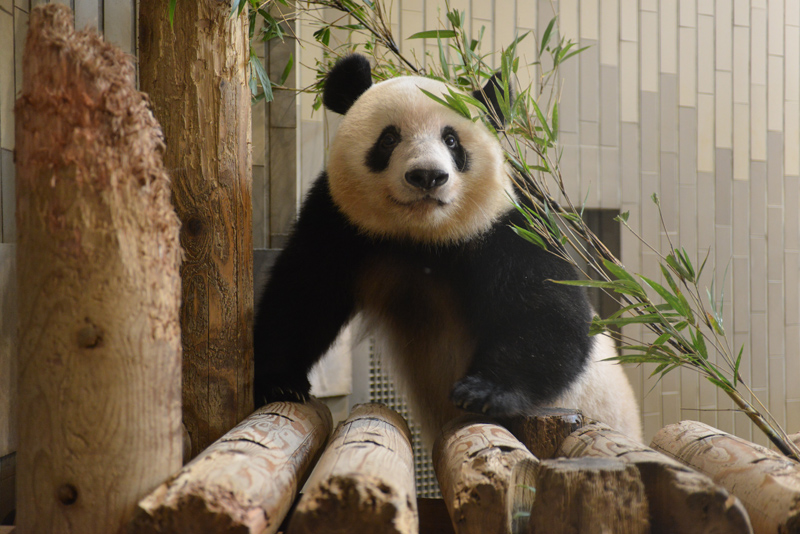
Xiang Xiang
(Date of photo: August 23, 2021)
2. Regarding Leelee's condition
During the hot summer months, Ri Ri spends his time in indoor exhibit rooms 2 and 3 of the "Panda Forest" in West Garden, as well as in his bedroom in the back area.
The cubs are fed 4-5 types of bamboo, including Moso bamboo, Madake bamboo, and Shino bamboo, divided into 3-4 meals a day depending on their foraging situation, and are also given panda dumplings, carrots, and apples as supplementary food.
Giant Panda at Ueno Zoo typically become less active and eat less during the summer months. However, their weight doesn't change significantly, suggesting that this is a natural seasonal variation in Giant Panda.
Furthermore, all pandas, including Ri Ri, exhibit some degree of preference when it comes to bamboo. In particular, they seem to prefer the leaves to the culms (the stem-like part) of the bamboo during the summer. animal keeper select and feed the pandas bamboo while taking these changes in preference into account, but the truth is, it is not entirely clear what criteria Giant Panda use to choose which bamboo to eat. Therefore, Ueno Zoo is continuing its research to investigate the reasons behind this preference by examining the components of bamboo.
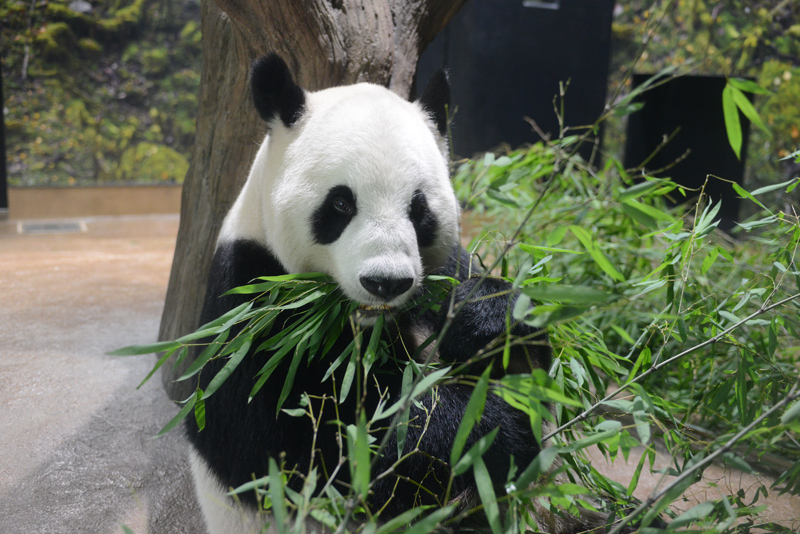
Lily
(Date of photo: August 23, 2021)
3. The ingenuity of Giant Panda animal keeper
Food is one of the important factors for animals to live healthy lives.
Giant Panda, being carnivores, have stomachs and intestines with a basic structure similar to other carnivores, making it difficult for them to fully digest bamboo, their main food source. Furthermore, bamboo is less nutritious than the typical diet of herbivores. Therefore, they spend a significant amount of time foraging while awake.
Furthermore, since pandas tend to get less exercise in zoos compared to the wild, animal keeper make an effort to provide each panda with fresh bamboo, which they like, at the right time, so that they can have a balanced schedule of feeding, resting, and being active.
While many people have the image of Giant Panda as being gentle and calm, they are actually sensitive to changes in their environment and can become suddenly nervous in response to unfamiliar noises or unexpected events. It is important to provide them with a quiet and calm environment.
To achieve this, it is crucial to carefully observe Giant Panda' behavior. We constantly monitor them while preparing food, cleaning, and Giant Panda, and we analyze daily videos recording their 24-hour activities to ensure their health.
Accumulating such observations and records can help unravel the mysteries of Giant Panda 's ecology.
[Ueno Zoo Animal Care and Exhibition Department]
(September 4, 2021)