I think everyone has likes and dislikes when it comes to food. The same is true for animals. However, since it affects weight maintenance and health, it's ideal for them to eat all the food they're given. This time, we'll be talking about African Bush Elephant...
Tomu This article will cover the diet of the male () and the efforts of the caretakers to manage it.
African Bush Elephant are herbivores, and in the wild they eat grass, fruits, tree branches, leaves, roots, and bark. Eating plenty of fiber is important for herbivores to maintain their health, so many zoos feed their herbivores hay (dried grass).
Tomu is fed a variety of foods, including hay, twigs, grass, and root vegetables, with hay making up the majority of his diet, at approximately 50 kg per day. At Tama Zoo, he is given two types of grass hay: timothy and sudan grass. However, when timothy is given in various feeders, including hay nets, he tends to leave a lot of it uneaten (see
this article for more information on feeder modifications). As his caretaker, I would like him to eat more timothy, which has more protein and is more nutritious than sudan grass, but it seems that timothy is not something Tomu is particularly keen to eat. However, it is also necessary for Tomu to have as long a feeding time as possible to mimic his natural wild state. Our challenge as his caretaker became to meet two conditions: "increase the feeding time" and "get him to eat more timothy."
So, I decided to mix timothy hay, sudan grass, and green grass together. In other words, the plan was to mix their favorite foods together and get them to eat them all. However, mixing about 50 kg of hay and about 20 kg of green grass by hand is a surprisingly difficult task.
This is what it looks like when hay and fresh grass are mixed together and placed in a hay net.
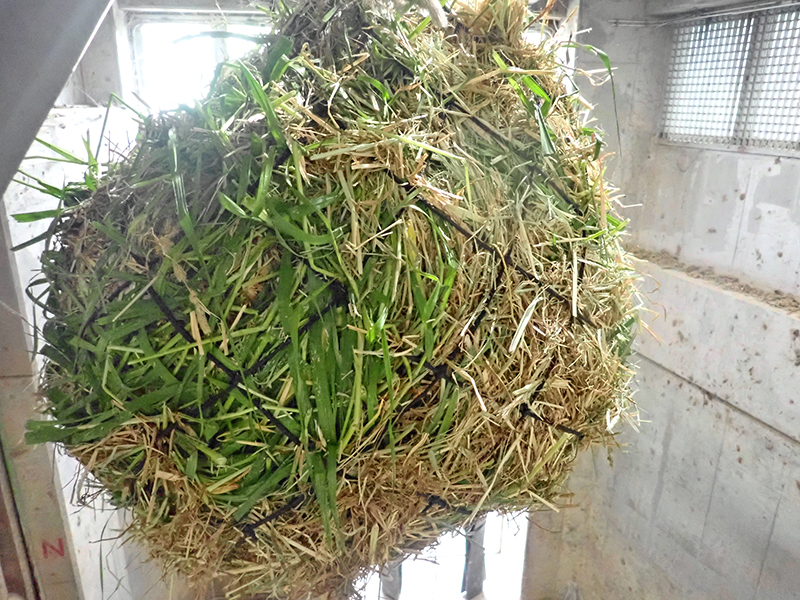
Hay and green grass packed into a haynetAnd when Tomu finishes eating, it looks like the picture below.
It might be hard to tell from the picture, but it left most of the timothy hay untouched. Apparently, it used its dexterous nose to pick out the green grass and Sudan grass and eat that instead. I'm beyond amazed; I'm actually impressed.
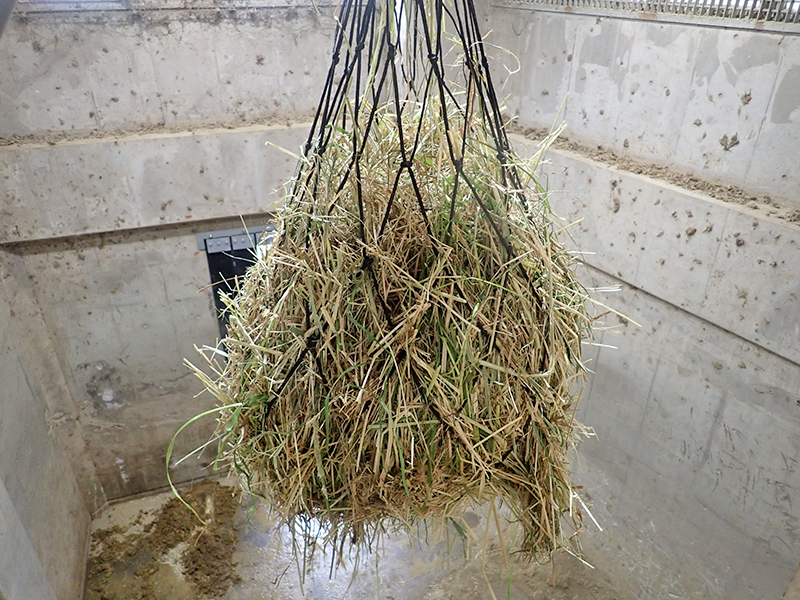
Haynet after feedingI'm still trying different methods to get Tomu to eat timothy hay. He does eat it sometimes, so I think I'm seeing some results, but it's still not stable.
In people, there are times when foods they disliked as children become perfectly fine to eat as adults, right? I'm hoping that will be the case for Tomu as well, and I'm watching him grow up.
[Tama Zoo North Garden Animal Care and Exhibition Staff, Mimatsu]
◎Related News
・
The challenge of African Bush Elephant "Tomu" (September 21, 2022)
・
The Challenge of African Bush Elephant "Tomu" [Part 2] (November 11, 2022)
(May 12, 2023)