Up until now, Tokyo Metropolitan Zoos have accumulated a wealth of experience in developing technologies and achieving breeding successes for various rare species, including the development of artificial feed for Crested Ibis crested ibis and the development of captive breeding techniques for the Oriental white stork.
In 2006, Tokyo Zoological Park Society was selected as the designated manager and began operating three metropolitan zoos and one aquarium. At that time, "contributing to wildlife conservation" was set as one of its business objectives, and the Wildlife Wildlife Conservatio Center Care and Exhibition Division of Tama Zoo to coordinate conservation projects for the metropolitan zoos and aquariums. This fiscal year, the Conservation Center has been reorganized into a section under the jurisdiction of the General Affairs Department. It now has a new two-section system, a Research Section and a Conservation Section, and will continue to promote research and conservation activities.
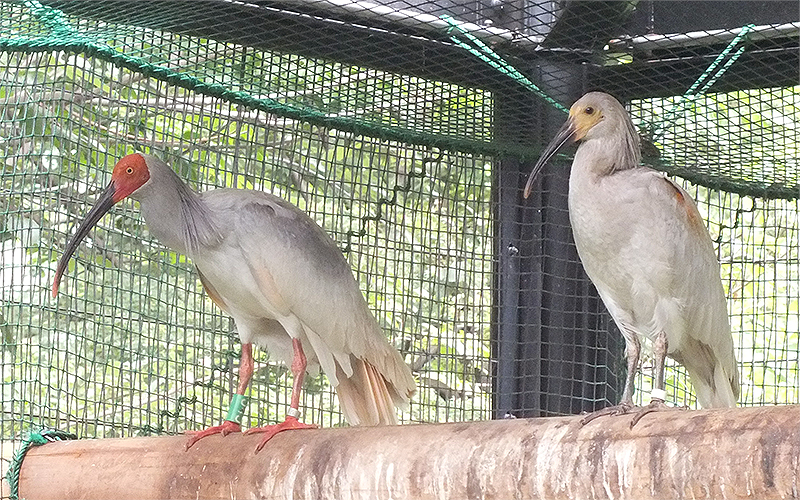
Crested IbisSince 2006, the Conservation Center has been working on sex determination and parentage testing of birds using DNA analysis, and analysis of estrus cycles by measuring sex hormones in feces or blood, utilizing biotechnology to aid in the breeding of rare species at Tokyo Metropolitan Zoos. Furthermore, it is working on "promoting ex-situ conservation," such as captive breeding of rare Japanese birds like Red-headed Wood Pigeon Japanese Newt Rock Ptarmigan ptarmigan, and developing artificial incubation and rearing techniques, as well as "contributing to in-situ conservation," such as ecological and habitat surveys of rare species (populations) native to Tokyo, including the Japanese fire-bellied newt and the Tokyo Japanese Killifish (a Tokyo native population of the southern medaka). These three pillars of activity have led to significant achievements in wildlife conservation efforts by the four zoos.
Meanwhile, the situation for wildlife on Earth is becoming increasingly dire.
The International Union for Conservation of Nature (IUCN) lists approximately 42,000 endangered species on its Red List in 2022, a nearly fourfold increase over 20 years. Regarding wildlife within Japan, the
number of endangered species listed on the Ministry of the Environment's Red List continues to grow with each revision, with over 3,700 species being classified as endangered in the 2020 edition.
The ultimate goal of wildlife conservation is to maintain wild populations in good condition in their habitats over the long term. Ex-situ conservation activities can be highly effective when linked with in-situ conservation activities.
The International Union for Conservation of Nature (IUCN) has various committees, but the Conservation Planning Specialist Group (CPSG) within the Species Survival Commission has adopted a method called the "One Plan Approach" to effectively and efficiently promote the conservation of endangered species. This is an "integrated conservation plan that considers all populations both inside and outside the habitat, and involves conservationists, target species experts, governments, and landowners from planning to implementation." This approach has also been incorporated into the conservation strategy of the World Association of Zoos and Aquariums (WAZA) and is being used to conserve various endangered species.
Tokyo Zoological Park Society has previously sent staff to the annual general meetings of CPSG and WAZA to gather information, and has also worked with CPSG experts to develop conservation plans at conservation workshops for Red-headed Wood Pigeon. In order to further advance wildlife conservation in the future, it is desirable to strengthen efforts to conserve wild populations, both directly and indirectly, by collaborating with experts and stakeholders both domestically and internationally, and to broaden the scope of conservation activities.
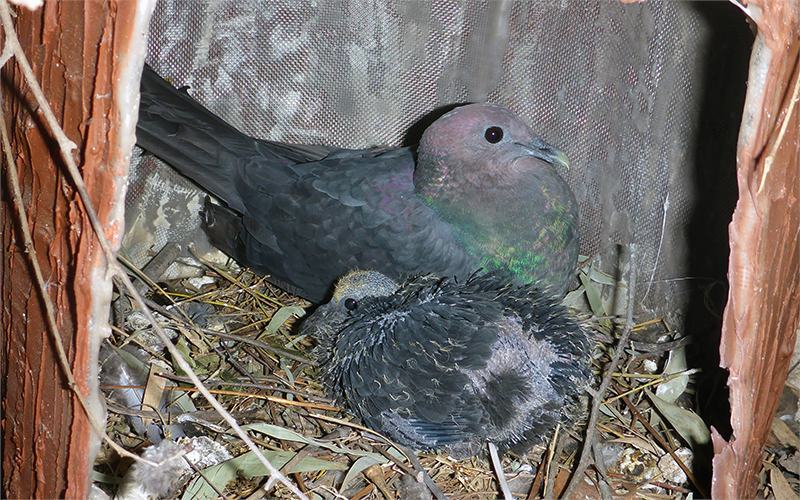
Red-headed Wood PigeonThe newly established research section will explore new research topics in addition to conventional DNA testing and hormone analysis. Furthermore, it plans to compile and utilize basic information that will contribute to conservation activities both within and outside the habitat, including publishing scientific findings obtained from captive animals. The conservation section will also participate in the national and metropolitan government's conservation and breeding programs for rare wild animal species, advancing the development of captive breeding and rearing techniques for endangered species. The conservation center also plans to provide information to the general public regarding wildlife conservation at zoos and aquariums through lectures and its website.
Wildlife conservation cannot be achieved by Tokyo Metropolitan Zoos and Aquariums alone. Under the new structure of the Conservation Center, we will further promote collaboration with zoos, universities, and research institutions both domestically and internationally to advance wildlife conservation.
[Sakata, Research Wildlife Conservatio Center General Affairs Department]
◎Related News
・
The path to success in artificial insemination of Chimpanzee (February 25, 2022)
・
White-tailed Eagle breed for the first time in 19 years, and their fifth generation is born. (May 27, 2022)
・
Four crested Crested Ibis were raised in 2022 – 2022 Breeding Results Report (July 7, 2022)
・
Behind the scenes of "Four crested Crested Ibis fledged in 2022" (September 23, 2022)
(May 19, 2023)