Tama Zoo has maintained herd keeping of Giraffe since the completion of African Zone in 1962. To date, 198 Giraffe have been bred at the park, and at one point, the herd reportedly exceeded 30 individuals. As of October 2023, there are 17 Giraffe in the herd. Currently, the park maintains a number of no more than 20 individuals to ensure the nutritional status of the entire herd and to take into account the size of the new facilities.
With the move to the new Giraffe enclosure, we switched the breeding male "Jill" to isolated enclosure. Previous breeding males had limited breeding numbers because they were only compatible with a limited number of females, but Jill, who was compatible with most females, produced many offspring. While this had the advantage of allowing females who had not bred before to produce offspring, Jill's ability was simply too high.
Tama Zoo is entrusted by the Biodiversity Committee of Japanese Association of Zoos and Aquariums of Zoos and Aquariums with managing the bloodlines of Giraffe in Japan. Based on the bloodlines of Giraffe throughout the country, breeding plans are made, and individuals are moved between zoos to promote breeding. However, if only a specific bloodline increases, it will reduce genetic diversity, which is likely to have negative effects such as decreased reproductive capacity and reduced ability to cope with various risks.
Considering the overall situation in the country, we cannot allow Jill to have any more offspring, so we have isolated her from the group. In addition, measures are needed for the male offspring to ensure the stability of the group and prevent unintended breeding. Males that have reached sexual maturity will cause fights within the group and mate with other females, so we have been performing castration surgery on the young males in the group since 2020. We have performed this surgery on six males up until last year.
However, during the neutering surgery performed on Gigi in January of this year
, an unfortunate incident occurred where the animal died under anesthesia. The caretaker, who saw Gigi every day, said there were no health problems, but compared to the general growth rate based on our knowledge, her development was worse than expected, and her weight was also considerably low, which seems to have caused a greater shock from the anesthetic.
We immediately held a debriefing session with the veterinarian, animal care staff, and the department head and section chief to identify the problems and decide to make various improvements for the next neutering surgery. Up until now, we had been performing the surgery on cats that were 1.5 years old or older, when their testicles had definitely descended and they had sufficient physical strength. However, we thought that performing the surgery at a younger age would be less stressful on the body, so we decided to perform the surgery
on "Jun," who was born in August of last year, at 1 year and 1 month old. We will isolate him for two weeks before the surgery, but learning from our previous experience, we tried to measure his weight directly rather than estimating it.
Giraffe are herbivores and are very wary, so I thought it would be difficult to measure their weight without gradually getting them used to it. However, by luring them with highly palatable food, they readily stepped onto the scale with a step from the very first day of isolation. Their weight was 272 kg, and they continued to eat calmly thereafter, so their weight remained stable, reaching 275 kg two days before the procedure. We also reduced the fasting period to one day to lessen the burden on their body, and because we were able to accurately track their weight, the amount of anesthetic was also accurate, and the anesthetic worked well, as did their recovery.
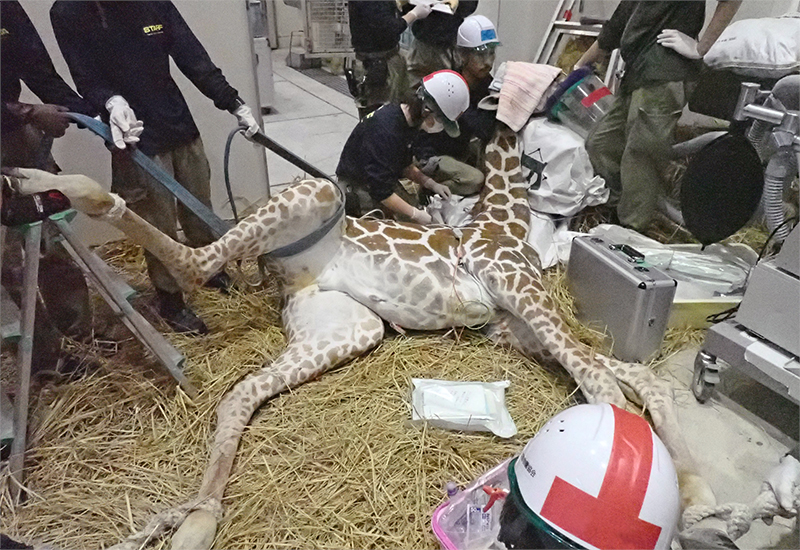
Up until now, the animals we've treated weighed over 500 kg, making handling and moving them a major undertaking. However, with this animal weighing half as much, the workload was significantly reduced. Furthermore, the smaller incisions resulted in faster recovery, which is another advantage of early treatment.
Unfortunately, the individuals scheduled for future procedures have already reached an age greater than Jun's, but it was a great discovery that weighing them was easier than expected. This will also be useful when administering anesthesia or medication during treatment. In order to continue maintaining the group living arrangement, we will reflect on our shortcomings and gradually improve our group maintenance and management techniques, including neutering surgeries.
[Tama Zoo]
◎Related News
・
On June Giraffe, a giraffe named "Jill" will be arriving from Saitama. (June 22, 2015)
・
Giraffe named "Jill" has joined Eurasian Moorhen area! (July 24, 2015)
・
The mysterious relationship between Giraffe "Jill" and "Kansuke" (February 26, 2016)
・
Giraffe "Jill"'s life alone (March 12, 2021)
・
Jill Giraffe has returned to the herd after ending her solitary life. (August 27, 2021)
・
Shin-Giraffe sha - The Three Sacred Treasures? (April 28, 2023)
(October 20, 2023)