When you find a hard, white lump in African Bush Elephant enclosure, it's usually either a fragment of a male elephant named "Tomu's" tusk or a piece of cow bone brought in by a crow for the Lion. I picked it up, thinking, "I hope it's not a tusk," but it wasn't a tusk or cow bone. I also checked Tomu's mouth, as it could be a tooth, and found what appeared to be a missing tooth.
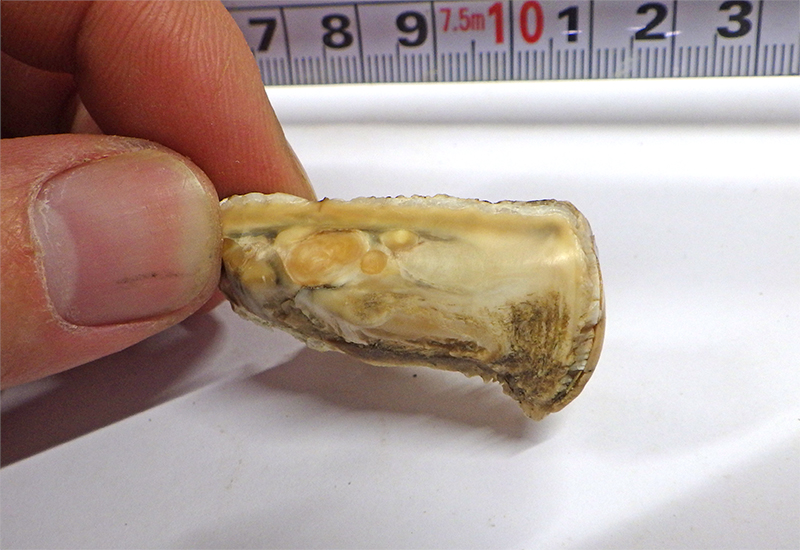
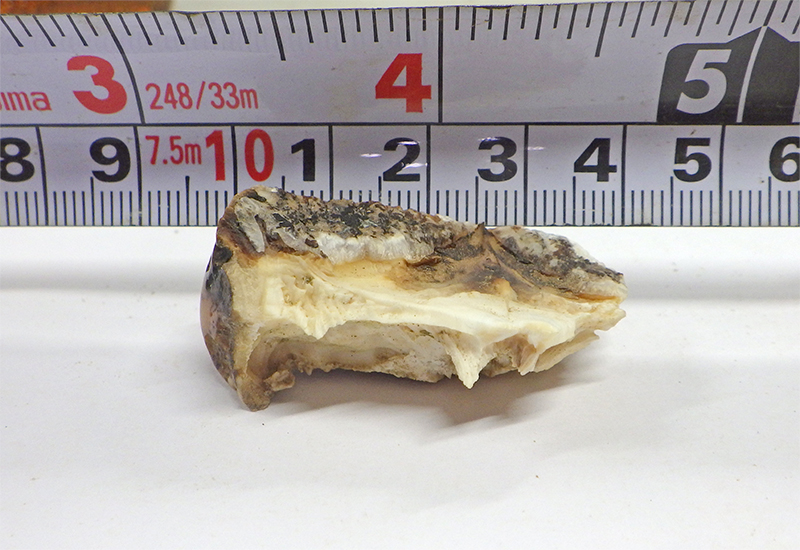
Missing teeth have both smooth and jagged surfaces.Even if an elephant's teeth fall out, they can be swallowed with their food or get mixed in with their droppings and other debris, making them difficult to find. I've been in charge of African Bush Elephant for three years now, but this is the first time I've seen a tooth fall out.
Some people may be worried when they hear that an elephant has lost a tooth, but please don't worry. Elephant teeth are very different in structure from human teeth, so there is no problem. Elephant teeth consist of two types: incisors (tusks) and molars. Elephant incisors grow in pairs from the upper jaw and continue to grow throughout their lives, just like those of rodents and other similar animals.
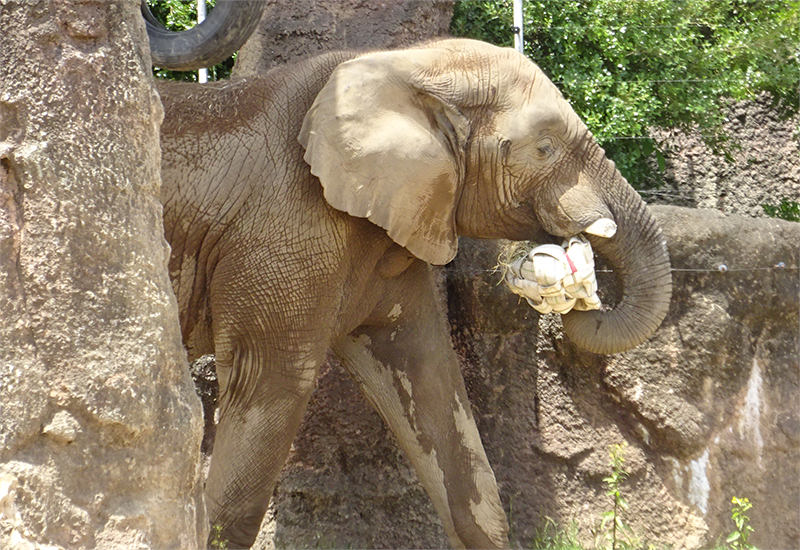
Right incisorAfrican Bush Elephant have one molar on each side of their upper and lower jaws. Each molar is large, with jagged surfaces that make contact with the teeth, giving them an overall diamond shape.
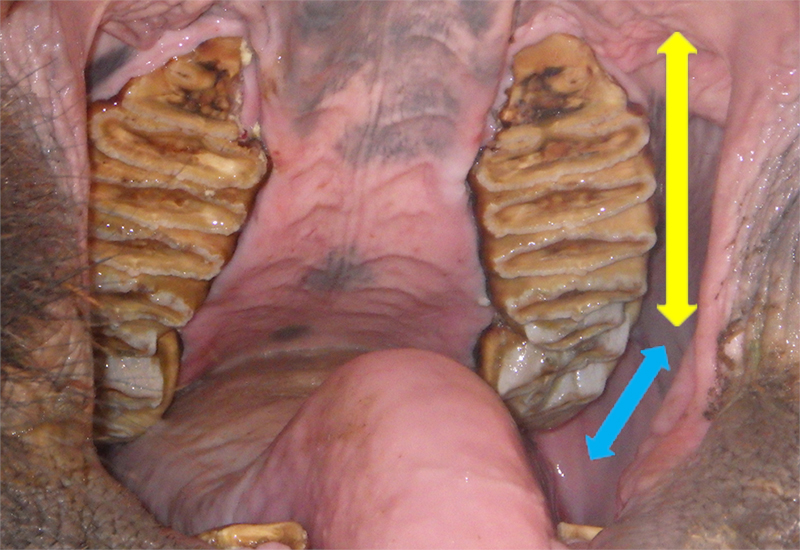
Tomu's mouth. The area indicated by the two arrows is the upper left molar.
The light blue arrows indicate teeth that are in the process of growing in.Elephants have a unique tooth replacement process. In most mammals, including humans, upper teeth are replaced by being pushed vertically from above, and lower teeth by being pushed vertically from below (vertical replacement). However, elephants replace their teeth by pushing them horizontally from the back of their mouth towards the front (horizontal replacement). Elephants perform this horizontal replacement five times in their lifetime.
Furthermore, while humans move their lower jaw up and down, elephants move their lower jaw back and forth, grinding their food like a millstone.
Tomu's feeding habitsAs a result, the elephant's teeth wear down. The worn-down teeth are pushed forward by the newly growing teeth and eventually fall out.
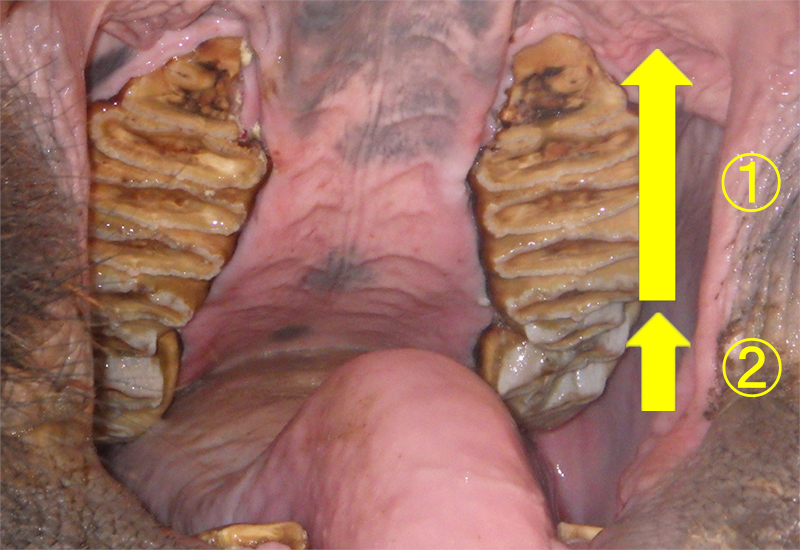
The new tooth (②) pushes the old tooth (①) forward horizontally, causing it to fall out.Tooth replacement appears to be correlated with age, and by examining how much wear is being seen on which teeth, it's possible to estimate a person's age.
The tooth that fell out this time was probably a worn-out tooth that had served its purpose and had partially chipped off. After examining Tomu's mouth, it appears to be the tip of the right side of his lower jaw.
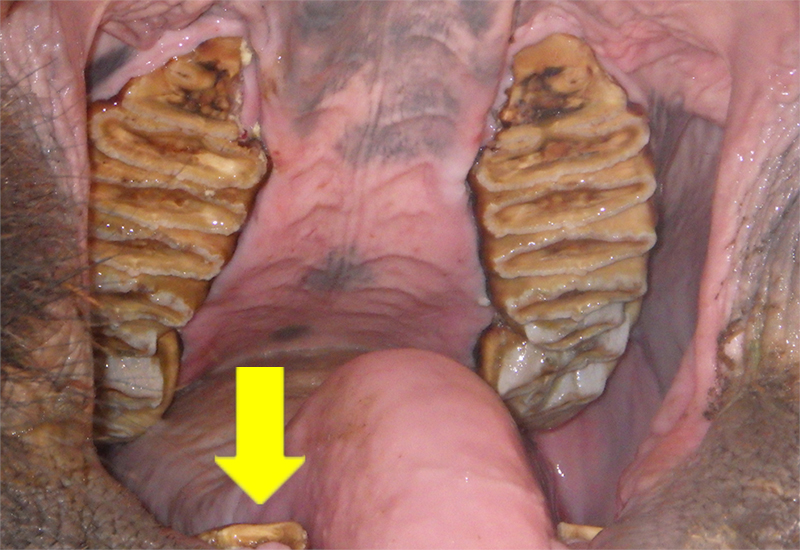 | 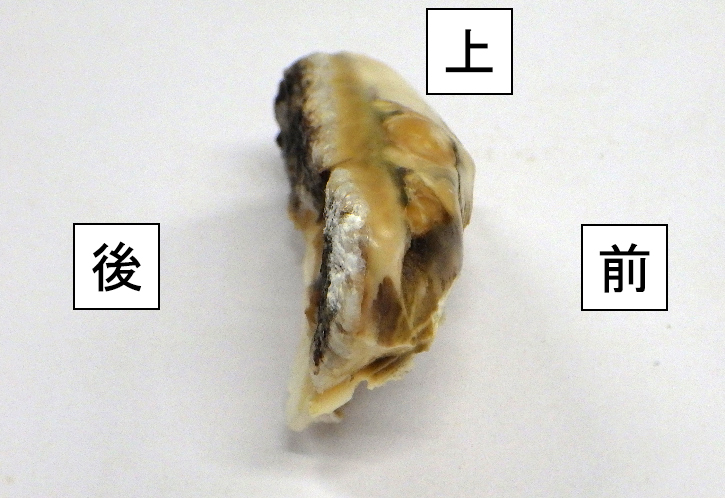 |
| It appears to have fallen off from the tip of the right side of the lower jaw. | Estimated angle when it was growing on the right tip of the lower jaw |
This time we talked about teeth, which are difficult to observe, but body parts differ in shape, function, and structure from one animal species to another. If you observe and compare them, you're sure to find new discoveries and interesting things.
[Tama Zoo, Tama Zoological Park]
◎Related News
・
Recent updates on African Bush Elephant "Tomu" (January 18, 2013)
・
We trimmed the tusks of African Bush Elephant, Tomu. (July 11, 2014)
・
It's the 7th birthday African Bush Elephant "Tomu"! But construction is underway... (March 11, 2016)
・
The growth and changes of African Bush Elephant "Tomu" (December 16, 2016)
・
Weight measurement of African Bush Elephant "Tom" (September 15, 2017)
・
Weighing down African Bush Elephant "Tomu" and the elephants in midsummer (September 14, 2018)
・
Tomu, who will soon be turning 10, continues to receive treatment for his fangs. (March 8, 2019)
・
The challenge of African Bush Elephant "Tomu" (September 21, 2022)
・
The Challenge of African Bush Elephant "Tomu" [Part 2] (November 11, 2022)
・
The Challenge of African Bush Elephant "Tomu" [Part 3] (March 3, 2023)
・
The diet of African Bush Elephant "Tomu" (May 12, 2023)
・
Mud – A heat countermeasure for African Bush Elephant "Tomu" (September 1, 2023)
(November 3, 2023)