|
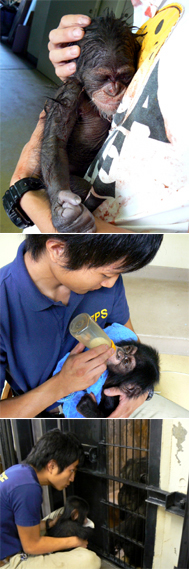
Jin, Chimpanzee who was raised by hand.
└─2008/10/17 |
|
|
|
|
On the morning of July 2, 2008, as I opened the door to Chimpanzee enclosure as usual, I was hit by the strong smell of blood. "No way!?" I hurried to the sleeping quarters and found Peach's room covered in blood. Peach was hanging from the ceiling in a state of agitation, but there was no sign of her baby in her belly. Looking down the stairs, I saw a baby that had been abandoned.
The blood wasn't dry, and it didn't seem like much time had passed, but the child wasn't moving at all. Just when I was about to give up, I heard an unfamiliar "squeak-squeak" sound. ...It's still alive!
I urged Peach to bring the baby, but as it was her first pregnancy, she didn't seem to fully understand what was happening to her. She was very agitated and wouldn't even go near the baby, let alone touch it. Thinking that saving the baby was the priority, I quickly pulled the baby away.
My child's body was very cold, and it was a matter of life and death. I quickly wrapped him in a towel and headed to the hospital. Before we arrived, he was gripping my clothes tightly with a strength I couldn't have imagined from his small hands.
Thanks to the veterinarian's diligent efforts, the baby quickly recovered. Chimpanzee are usually born weighing around 1,500 grams, but this baby weighed a hefty 2,100 grams. While I was relieved that the baby was safe, my mind was filled with worry: "What should I do about this baby...?"
Chimpanzee are social animals that live in groups. They learn essential survival skills from their mothers, such as how to greet other members of their group, and are raised with great care. Growing up in a group allows them to communicate with other individuals and develop social skills.
However, if humans raise Chimpanzee to adulthood, there is a high possibility that they will grow up without realizing they are Chimpanzee. If they do not develop social skills, they may end up living alone for their entire lives, even though they live for 40 to 50 years.
Returning Chimpanzee to their group is extremely difficult, but considering the future of our offspring and our strong desire for them to grow up as Chimpanzee, we have decided to proceed with the attempt to return them to the group.
Currently, we have placed incubators inside Chimpanzee enclosure so that the babies can hear Chimpanzee voices and learn about their scents. Only four animal keeper are responsible for caring for the babies, including feeding them five times a day. This is also to minimize contact with humans and increase the amount of time spent with Chimpanzee. Whenever time permits, we also allow the babies to be introduced to the other members of the group.
Peach, the mother, is a very strong individual and a very gentle Chimpanzee to her young. Hoping to pass on that strength, we decided to name her after an alcoholic beverage. We named her "Gin" because it pairs well with various fruits and liqueurs, and we hope that she will blend in well with the unique personalities of the Tama group, like a cocktail.
Jin will undoubtedly face many challenges ahead, but all of us animal keeper will do our best to ensure he can safely join the group. Please cheer for Jin! -- "Let's do our best, Jin!!"
Photo above: July 2, 2008, the day of birth.
Photo in the middle: September 27, 2008, showing the baby nursing.
My weight exceeded 3,600 grams by the end of September.
Photo below: September 28, 2008, "showing its face" to the members of the herd.
[Shinichi Kioka, Animal Care and Exhibition Staff, Tama Zoo North Garden]
(October 17, 2008)
|
|
|

|

)