The zoo receives all sorts of phone calls every day. For example, customers sometimes call and ask, "How many [animal species] are there?" In such cases, we in the coordination department use the "list of animals in the zoo" to answer. Also, if someone asks, "How old is [individual name] of the [animal species]?", we use the "individual animal card" to answer.
The animal roster summarizes the number of animals of each species at the end of each month, allowing visitors to see at a glance how many males and females of each species there are, and the total number. If the same species is kept in multiple locations within the zoo, the roster also shows how many are in each enclosure.
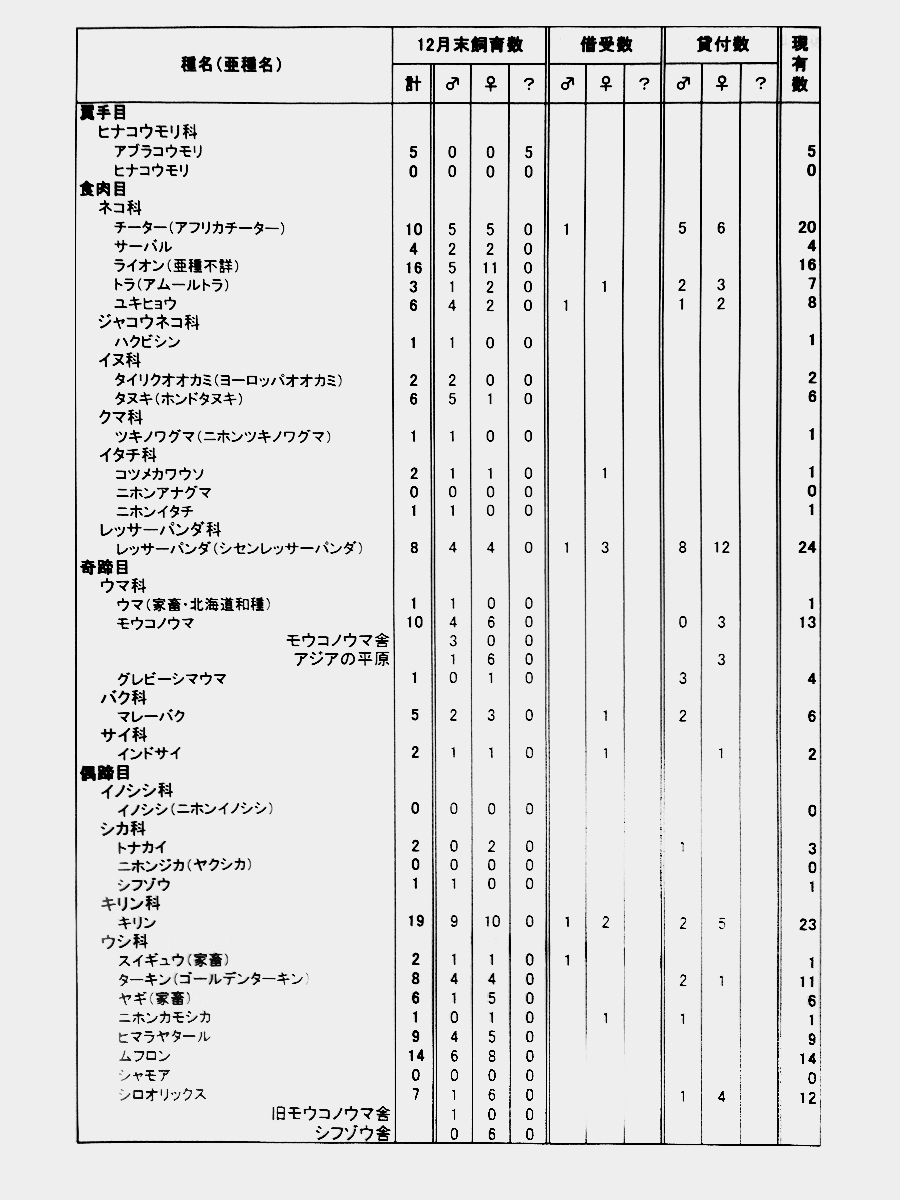
List of animals kept in a certain monthAt the end of each month, the animal caretakers submit four types of forms and a "staffing list" detailing how many of each animal are kept in each enclosure to the coordinator. The four types of forms are used depending on the information that needs to be conveyed.
An increase form, commonly known as a "blue form," is submitted when an animal under your care breeds or arrives from another zoo. A decrease form, commonly known as a "red form," is submitted when an animal under your care dies or is moved to another zoo. A transfer form, commonly known as a "yellow form," is submitted when an animal under your care moves to another animal enclosure within the zoo. A "blank form," commonly known as a "white form," is submitted when you want to change or add information about an individual animal, such as when a new tag is attached, its sex is determined, or it is named.
The coordinating staff compares these figures with the tally sheet every month to ensure that no reports are missed and to keep track of any increases or decreases in the number of animals. Afterwards, information about each animal is recorded on an individual card, much like a family register for humans.
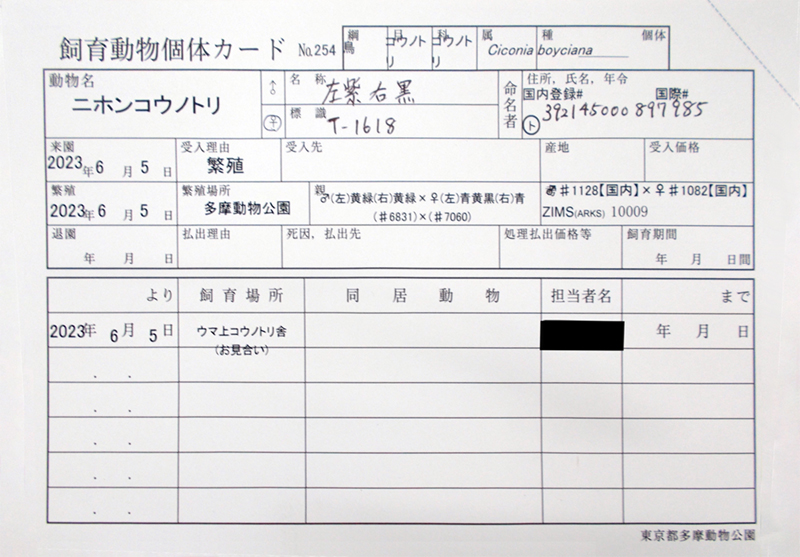
Individual CardThe individual animal card includes space to record the animal's name, sex, date of birth, date of arrival at the zoo, which zoo it came from, its parents, and where it was kept. Finally, the date and cause of death, as well as the number of years it was kept at the zoo, will be recorded. If the animal is transferred to another zoo, the date of transfer and destination will be recorded.
In this way, the coordination staff compiles the information submitted by the animal caretakers and uses a list of animals and individual cards that accurately record this important information, enabling them to properly respond to your daily questions.
Individual animal cards are also featured in
the "Animal Care Day" panel exhibition, "Animal Care - The Secrets of Zoo Work." Please also see "
An Introduction to Behind-the-Scenes Zoo Work: Animal Management Administration."
[Tama Zoo Coordination Section, Asakawa]
(March 29, 2024)