At Tama Zoo 's Asian Elephant enclosure, the elephants' behavior is recorded and observed using video cameras. By recording 24 hours a day, the zookeepers can closely observe the elephants' actions, including their nighttime behavior, which is helpful for their care and management.
What we mainly observe is the elephants' sleep patterns. Normally, they spend a total of 3-4 hours each night "lying down to sleep" and less than an hour each night "standing up to sleep," alternating between these positions in short bursts. Lying down to sleep is particularly strenuous for a heavy elephant, so they alternate between "standing up to sleep" and other activities, repeating short periods of about an hour of lying down, with their right and left sides facing downwards.
When they "lie down to sleep," they rest half their bodies on their favorite sandcastle, curling the tip of their noses, narrowing their eyes, and looking incredibly happy while they sleep...and they stretch and contract their legs, as if they were flying through the air.
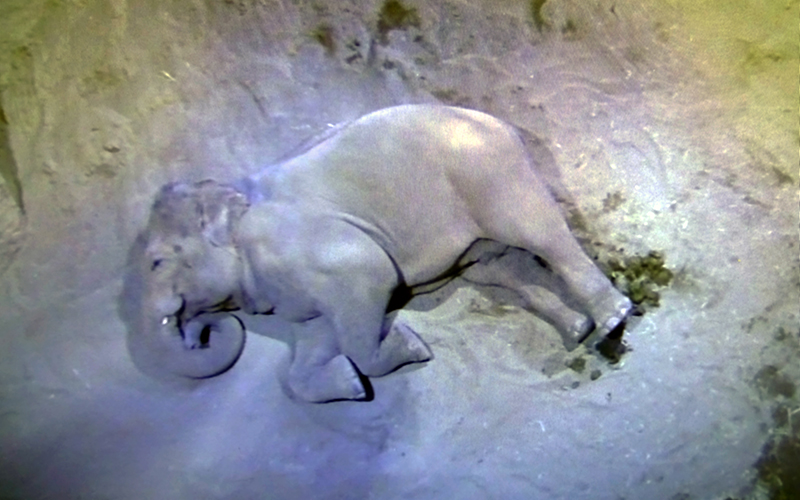
Vidura's sleeping postureSince around May, Amara (female, 19 years old) and Vidura (male, 16 years old) have been sharing a home even at night. The two often sleep close to each other, sometimes even touching parts of their bodies. Wild female elephants form herds with their maternal family and their offspring, and they sleep huddled together. For Amara, who doesn't have any herd members, sleeping close to Vidura may provide a sense of security.
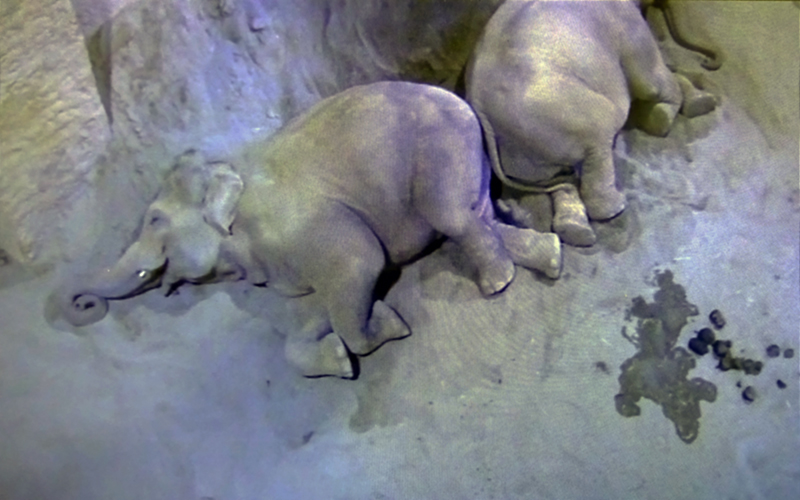
Sleeping with their bottoms touching. Left: Vidura, Right: AmaraAnura (male, estimated 71 years old), the oldest elephant in the country, also displays a sleeping face that makes you feel happy just looking at it. Incidentally, Anura is the latest of the three to go to sleep, finally lying down around 3 a.m. (Amala goes as early as 8 p.m., and Vidura goes as early as midnight). Although there are differences in when they go to sleep, the elephants are fully awake by 6 or 7 a.m., after sleeping, eating, and walking around.
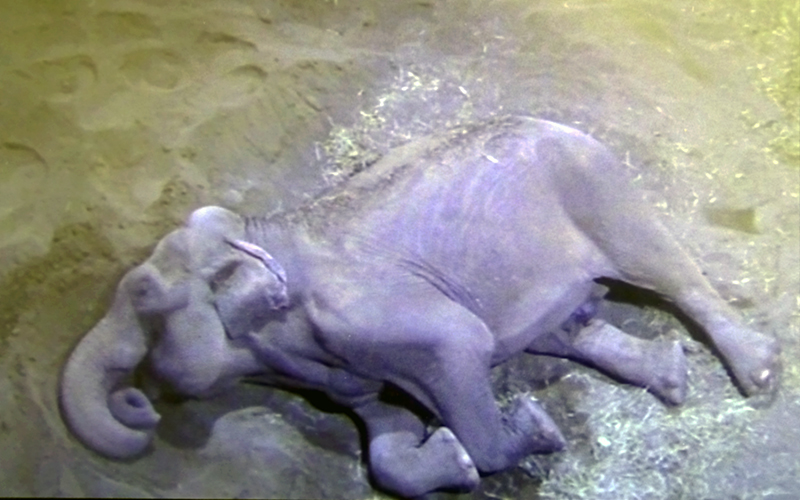
Anura's sleeping postureChecking an elephant's sleep patterns isn't just for our own amusement at seeing them sleep; it actually serves a very important purpose: early detection of their health. For example, if an elephant drastically reduces the amount of time it sleeps on its left side, there might be something wrong with its left side. In such cases, we can carefully examine its left leg and, if we notice anything unusual in its appearance or behavior, we can immediately take it to a veterinarian.
If their sleep time has decreased, it could be because the female is in heat and restless, or perhaps she doesn't like her sandcastle bed. In such cases, you can take various measures, such as increasing the amount of time Amara and Vidura spend together or rebuilding the sandcastle to suit their preferences.
Observing the elephants' sleep time has become a secret pleasure of ours, as it allows us to learn about their health and, above all, see their peaceful sleeping faces.
[Tama Zoo]
◎Related articles
・
How Asian Elephant spend their nights (March 21, 2014)
・
Traces on the sandy ground... Elderly animals in a new environment (February 20, 2020)
・
Asian Elephant "Vidura" is released into the wild at night for the first time since moving. (June 10, 2022)
・
Vehicles working in the "Valley where Asian Elephant Live" (November 10, 2023)
(July 26, 2024)