The flamingo breeding season has begun again this year at Tama Zoo. The first eggs were laid 11 days earlier than last year, on March 5, 2015. Last March, 18 eggs were laid, but this year 45 eggs have been laid. Hatching also occurred a week earlier than last year, with the first two chicks of the year hatching on April 9. Since then, there have been days when as many as 7 chicks hatched in a single day.
At first glance, the flamingo breeding process seems to be going smoothly, but let's take a look at the journey from nesting to the chicks leaving the nest.
After mating, pairs that have formed through courtship behavior during the winter begin searching for a place to build a nest (for more information on courtship behavior, especially its display behavior, please see
this article).
Because the underside of trees is a popular nesting spot, fierce competition for territory can be seen every year. They refuse to give in, sometimes pecking at each other, and occasionally even having their nests taken over after they have started building. The flamingo society is also highly competitive.
The couple who secure a spot sit there and skillfully gather soil with their beaks to create a pudding-like mound. Each pair lays one egg, and the male and female take turns incubating it. Even during incubation, they cannot let their guard down. Other individuals may knock the egg off or trample it.
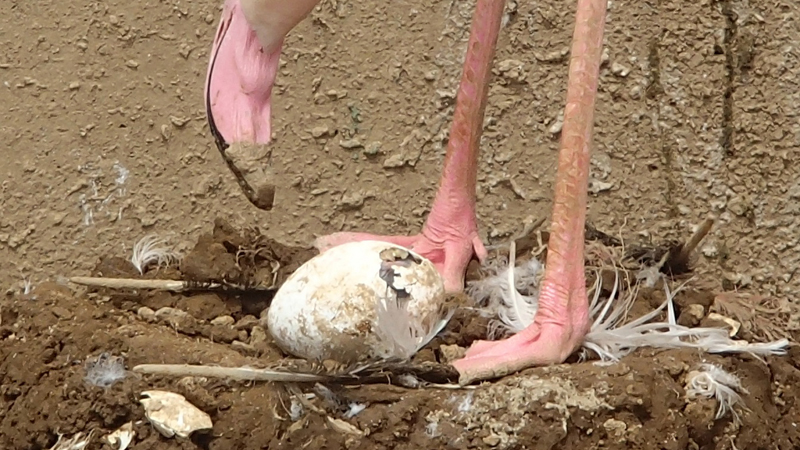
The chicks look like they'll hatch soon.Eggs that are properly incubated and develop will hatch after about a month. The chicks have a projection on their beaks called an egg beak, which they use to crack open the shell. The chicks use this egg beak to make a small hole from the inside and then emerge on their own.
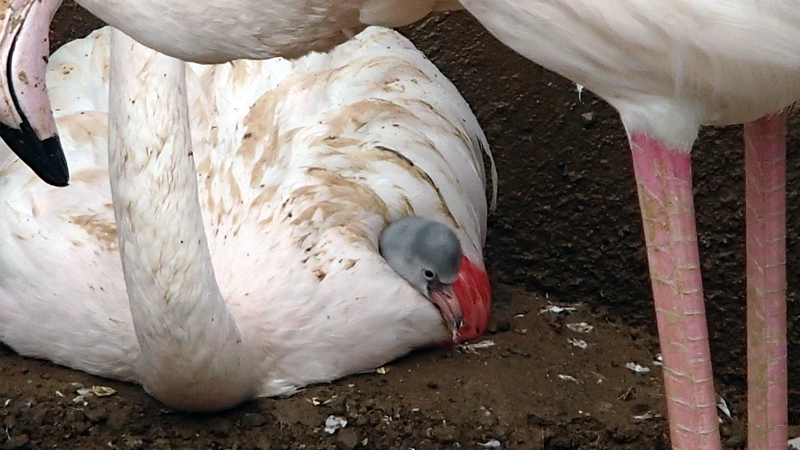
A chick warming itself in its parent's feathers.The chicks that have emerged don't resemble their parents yet. Their beaks are straight, and their feathers are a pale gray. When they are warming themselves under their parents' feathers, they look like they're wrapped in a down comforter. However, it seems to get too hot if they stay inside all the time, as they occasionally stick their heads out from under the feathers or from the parents' backs. Also, perhaps because they are warm and sleepy, they sometimes fall asleep with their heads sticking out.
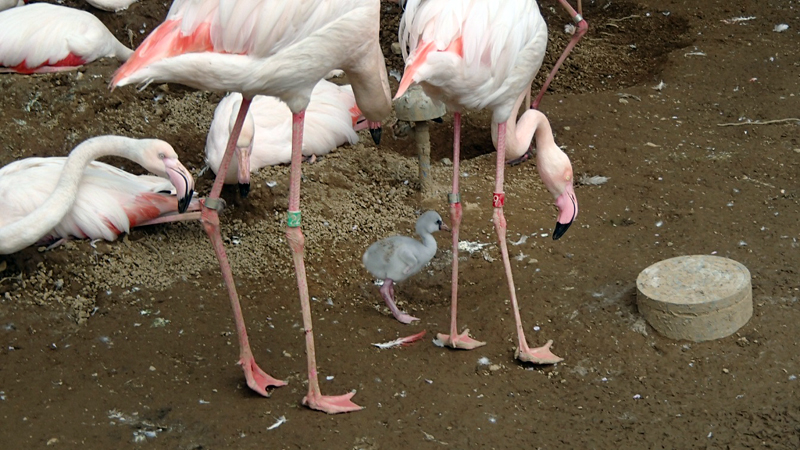
A chick taking a walk with its parentsFlamingos raise their chicks in pairs, with both parents feeding them a red secretion called "flamingo milk" from their mouths. Protected by their parents, the chicks that grow up safely fledge in about a week. Once fledged, the chicks begin to walk around the enclosure accompanied by their parents. The parents are naturally worried about their offspring. When accompanying their chicks, the parents lower their heads and guide them while watching their movements to prevent them from wandering around aimlessly.
As of April 29th, 29 chicks have hatched. Please cheer them on so they can grow into healthy adults.
[Tama Zoo North Garden Animal Care and Exhibition Staff, Eiji Takeyama]
(May 1, 2015)