Greater Flamingo chicks have hatched at Tama Zoo for the first time in five years. This time, we'll introduce everything from their breeding behavior to the chicks' growth.
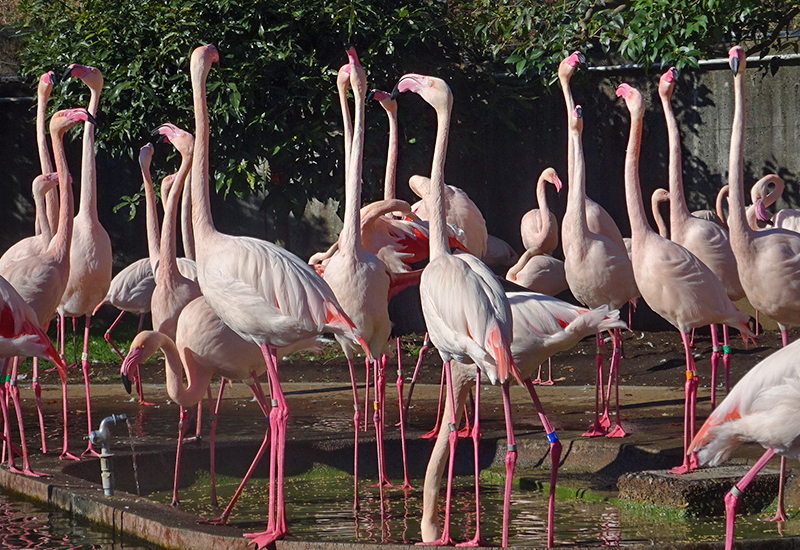
Greater FlamingoFlamingos perform several types of courtship displays, including "flag waving" (shaking their heads from side to side), "saluting" (spreading their wings and bowing their heads), and "marching" (walking in unison) (see
this article for more information on courtship displays).
From around November, these courtship displays become frequent in groups, and successful pairs search for nesting sites and mate. Flamingos that fail to find a mate continue to diligently perform displays until they find one.
Regarding flamingo breeding, for the past five years, we have been able to observe Greater Flamingo at Tama Zoo displaying, forming pairs, and mating, but they have not laid eggs. We have tried various methods to determine the reason for their lack of breeding, such as changing the muddy areas where the flamingos usually gather to shady spots, and softening the soil to make it easier for them to build mounds, but the response has been lukewarm.
Birds that breed in groups, such as flamingos, tend to lay their eggs at the same time. Therefore, we decided to try stimulating the flamingos' breeding instinct by placing artificial eggs (fake eggs made to resemble flamingo eggs). Initially, we placed five artificial eggs one by one on nesting platforms made by animal keeper, but they were all knocked off. Undeterred, we tried placing them again a couple of times, and one pair began to incubate their eggs. This incubation by that pair prompted flamingos to gather at the previously empty nesting site, and more individuals began to warm the artificial eggs.
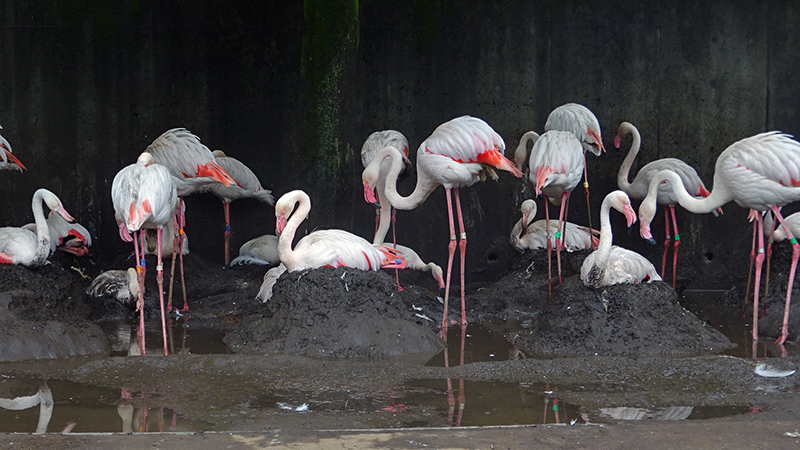
Flamingos incubating eggs in a mud area created animal keeper.The first egg was confirmed to have been laid on May 11, 2024, about a month after the artificial egg was placed. Unfortunately, when it was discovered, this egg had fallen from the nest and broken, but other pairs also began laying eggs, and a total of 28 eggs were confirmed in May alone.
Then, on June 17th, the first chick hatched. Some eggs cracked or otherwise failed to hatch, but chicks continued to hatch one after another, and by mid-July, 18 chicks had been born.
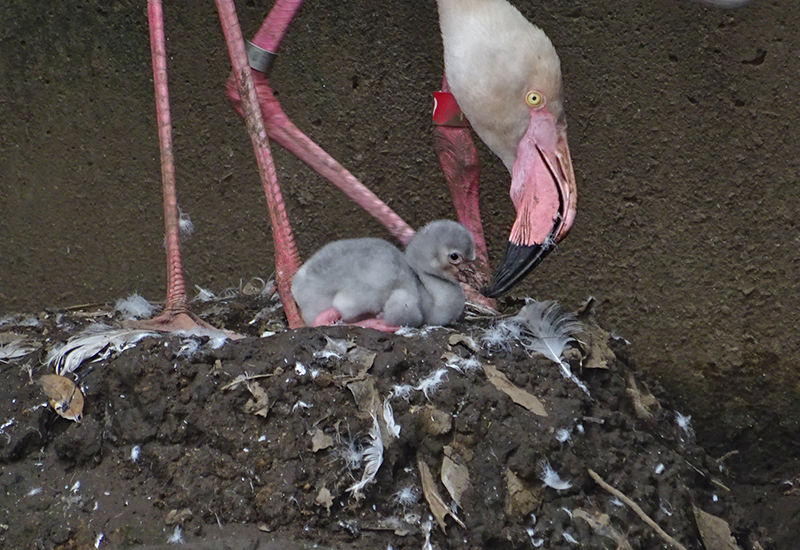
Newly hatched chicksFlamingos secrete a reddish substance called "flamingo milk" from their crop, which is part of their esophagus. This flamingo milk is the first food given to newly hatched chicks. The chicks can stand up as early as the day after they hatch, and once they can stand, they begin to climb up and down the nest repeatedly. After about 4 to 15 days, they fledge and form a group of chicks called a "crèche" (derived from the French word "crèche," meaning "nursery").
Currently, 18 chicks have formed a creche, and you can see their adorable faces.
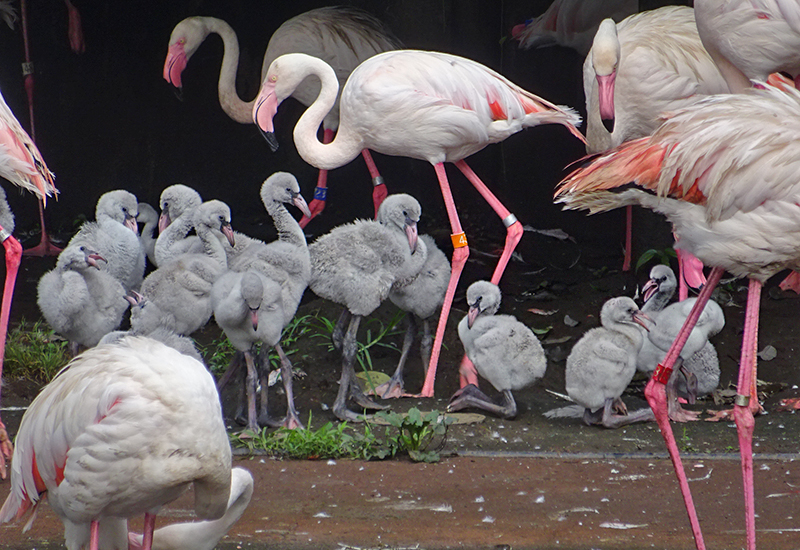
Chicks forming a crèmeTama Zoo 's flamingo enclosure also houses Cape Teal, which are about the same size as flamingo chicks and have a similar coloring. Visitors often see Cape Teal and exclaim, "They're baby flamingos!" However, flamingo chicks have fluffy, gray feathers and small, pointed beaks. Their legs are long and slender, and they are dark in color. You might even see them standing on one leg like a grown adult.
I highly recommend trying to find and observe a group of flamingo chicks.
[Tama Zoo North Garden]
◎Related articles
・
The growth of a greater flamingo chick (November 19, 2010)
・
Greater flamingo pairing situation (September 19, 2014)
・
Greater flamingo chicks until they leave the nest (May 1, 2015)
・
The reason why the greater flamingo is noticeably dirty is... (July 19, 2019)
・
Flamingo courtship displays: "flag waving," "salute," and "marching." (January 2, 2021)
・
Hoping for flamingo breeding success... (February 11, 2022)
(August 2, 2024)