Currently, young Red-headed Wood Pigeon Tama Zoo. This is a case of "natural rearing," where the parents raise the chicks themselves.
For over 10 years, Tama Zoo has successfully bred these birds using methods involving human intervention, such as artificial incubation and artificial rearing, but natural rearing has not been observed. Therefore, we have undertaken several experiments.
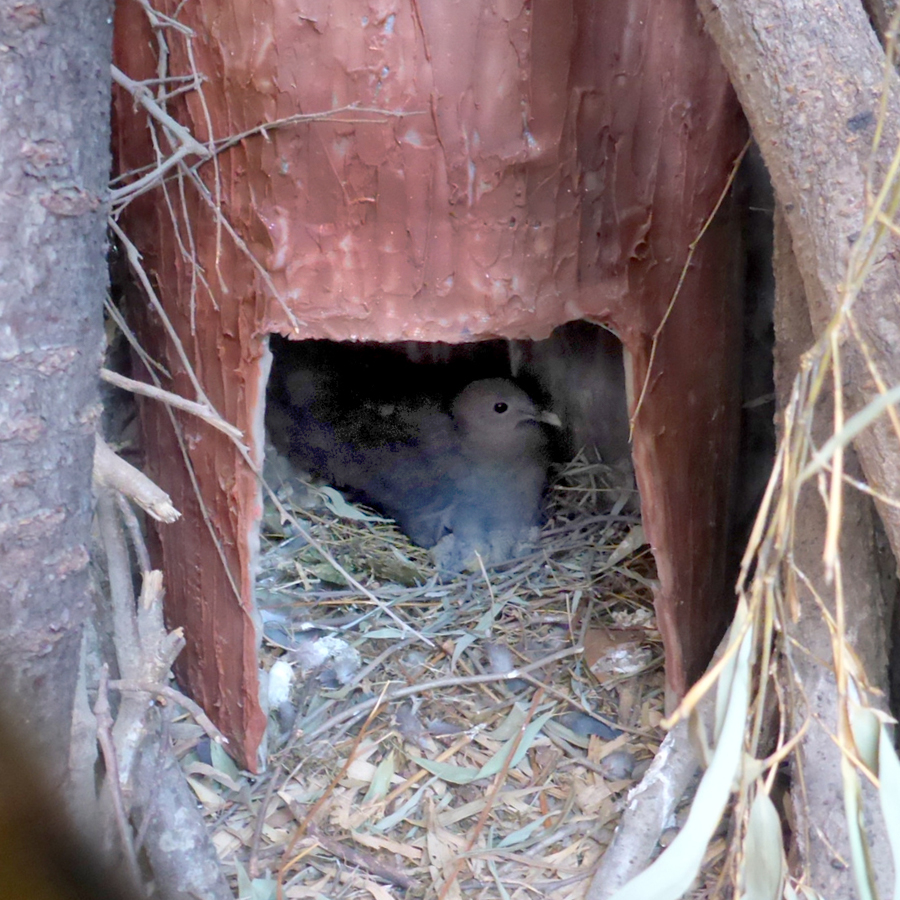 | | 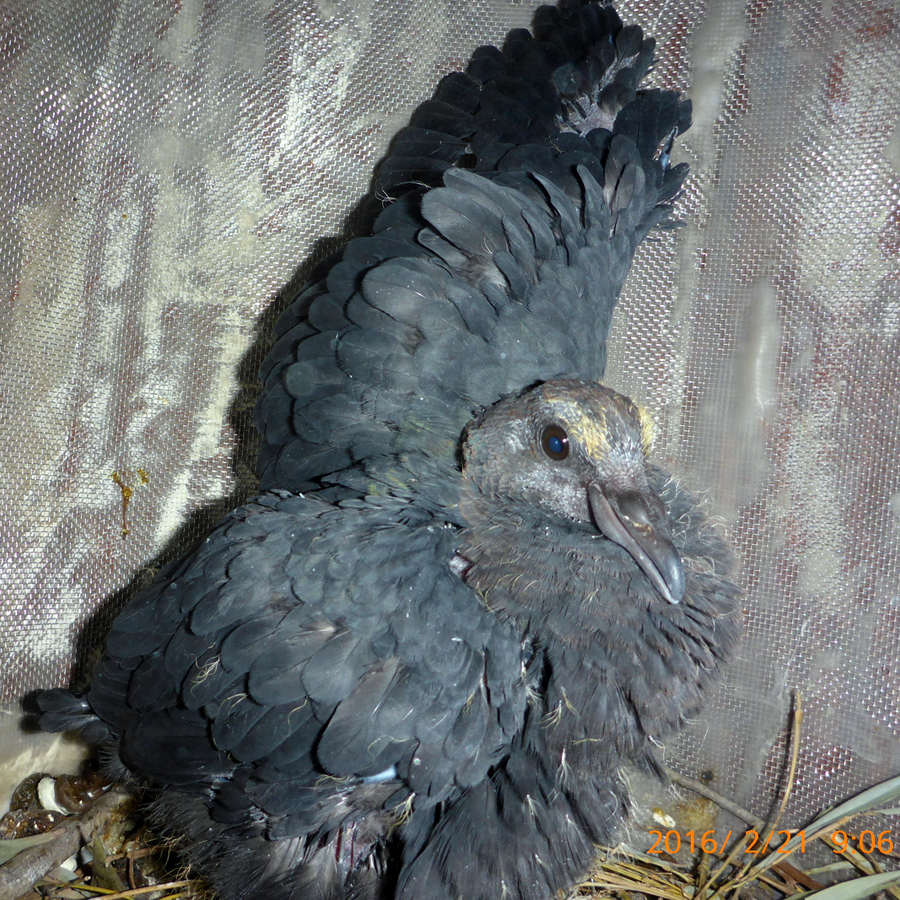 |
| A nest made of FRP and a 7-day-old chick (under the parent's belly) | 19 days old. During the day, the parents spend more time away from the nest. |
First, we changed the shape of the nest to make it more comfortable for the parent birds. Previously, they laid their eggs in a wooden nest box placed about 1.5 meters above the ground, but to make it closer to the nest we saw in the wild, we made a nest that mimicked a tree hollow using fiber-reinforced plastic (FRP) and placed it on the ground.
The mother was rescued on Chichijima Island after fracturing her right wing. She was brought to Tama Zoo on January 12, 2015, for treatment. Although her injury healed, her wing remained slightly lower than normal. While she could fly freely in her cage, it was determined that returning her to the wild would be difficult, so she will continue to be kept in captivity. The father was born at Ueno Zoo on July 25, 2011, and came to Tama Zoo on February 9, 2013.
When we placed the two birds together on December 25, 2015, we found them incubating eggs in a nest placed on the ground on January 14 of the following year. As a precaution, we removed the eggs and moved them to an incubator, and had the parents incubate dummy eggs. Up until then, the parent birds had always stopped incubating the dummy eggs before the expected hatching date, but this time, perhaps due to improvements to the nest, they continued incubating the eggs diligently.
On February 1st, we observed the chick pecking its beak (pecking at the shell from the inside to break the egg), so we returned it to its parents. The next day, February 2nd, we were able to monitor the parents emerging from the nest with the eggshell in their beaks, confirming that the chick had hatched. After hatching, the parents took turns caring for the chick, with the male during the day and the female from evening until morning. After about two weeks, however, the parents gradually spent less time in the nest during the day, which is a sign that the chick is growing well.
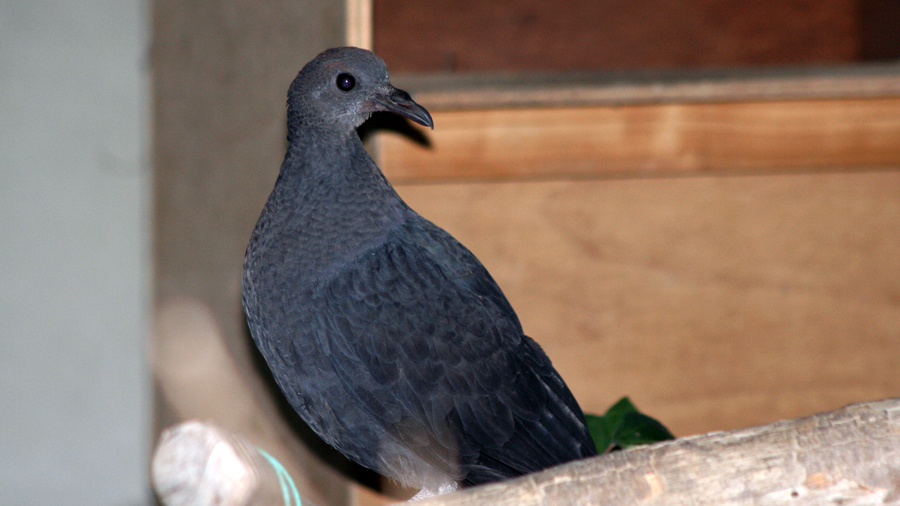
A chick that has just left the nest. 33 days old.On February 21st (19 days old), we took our first weight measurement and sample for sex determination. The chick weighed 316 grams, and we determined it was a male. It continued to grow well, and by March 3rd it weighed 409 grams. Once it exceeded 400 grams, it was getting closer to fledging. On the morning of March 6th, it was going in and out of the nest, but finally, in the evening, it was able to fly and reach a perch.
When working to conserve endangered species in zoos, it is crucial to avoid inbreeding. Because their populations are naturally small, it is difficult to easily introduce them from the wild, and opportunities like this to accept injured or sick individuals are extremely valuable. At Ueno Zoo, on August 19, 2012, a female Red-headed Wood Pigeon was attacked by a cat on Chichijima Island and was taken in for protection, and breeding was successfully achieved on February 4, 2013. We hope you will take note of this example of endangered species conservation.
[Former Tama Zoo Wildlife Conservatio Center / Current Ueno Zoo East Garden Animal Care and Exhibition Staff: Hideo Kamimon]
(April 8, 2016)