Bar-headed Goose have hatched in the Greater One-horned Rhinoceros enclosure at Tama Zoo. As of July 16, 2016, nine chicks have grown.
On the right side of the large enclosure, there is an area surrounded by a stone wall and planted with shrubs. Rhinos are not allowed in this area. Bar-headed Goose choose the deeper parts of this shrub thicket to build their nests in groups.
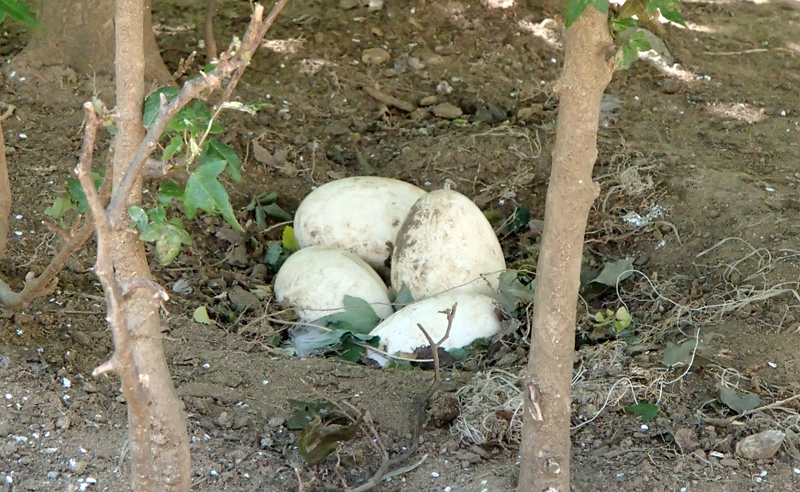 | | 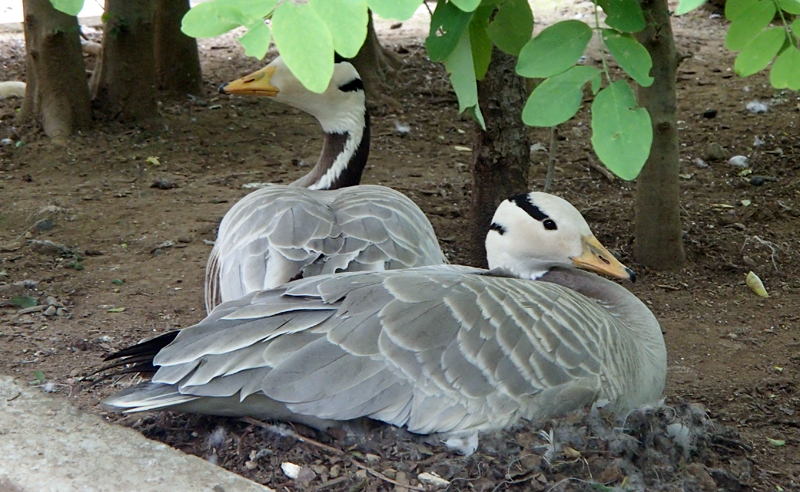 |
| Eggs laid in a hollow (May 7, 2016) | Incubating eggs (May 14th) |
Last year (2015), six chicks were raised here for the first time. This year, in late April, pairs of Bar-headed Goose appeared and began laying eggs. They make depressions in the ground and lay one egg at a time, and when there are four eggs, they begin incubating them. However, some eggs are laid in places where there is no nest and can be seen rolling around.
As May approaches, the number of pairs incubating eggs gradually increases, surpassing last year's seven pairs, with 11 pairs incubating eggs by the end of May. Once full-scale incubation begins, feathers are laid in the nests built in the crevices, and the amount of feathers increases. The females are responsible for incubation, while the males stay close by, keeping watch and protecting the nest from crows and other predators.
The eggs hatch in about 29 days. On May 27th, the first three chicks hatched. Subsequently, by June 17th, chicks had hatched from a total of five pairs. The remaining six pairs of eggs did not appear to hatch.
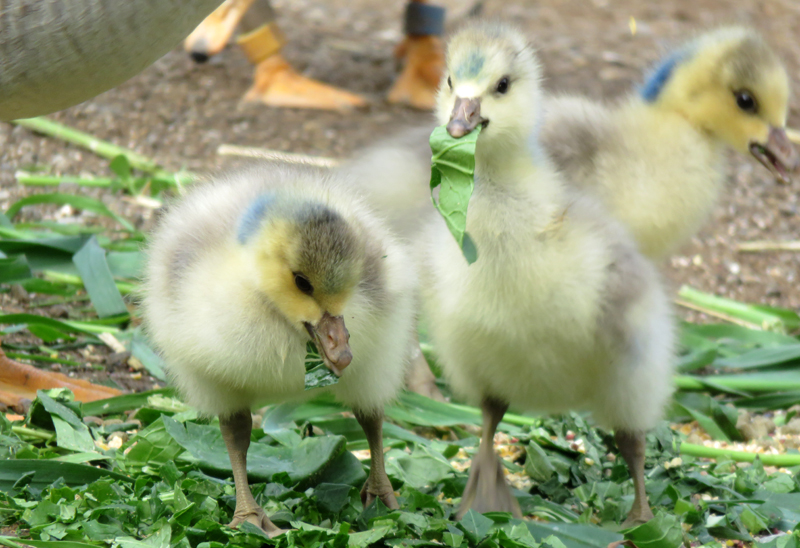 | | 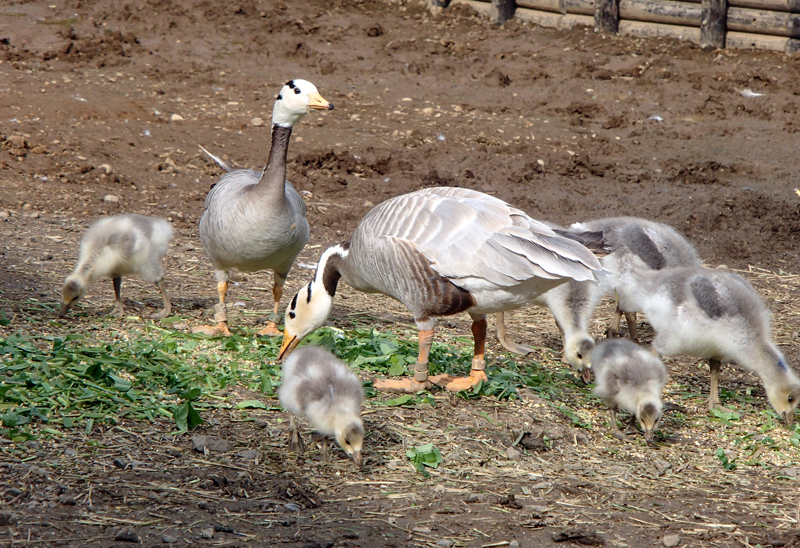 |
| A chick eating (June 5th) | A parent and child peck at food together (June 25) |
Once the chicks hatch, the parent birds bring them out of the bushes at the nesting site into the enclosure. The parent birds eat komatsuna (Japanese mustard spinach) and other grains, and the chicks follow suit, pecking at food on the ground. Then they move to the pool, where they drink water and take their first swim. Afterwards, they return to the safe bushes and come out periodically.
As they grow, the chicks become more active. Sometimes the chicks will walk ahead, with the parents following. When the three chicks and their parents are strolling together, if a chick separates, one parent will stay in their designated spot while the other parent chases after the chick, and they will reunite.
Bar-headed Goose carefully observe the rhino's movements and maintain a safe distance, but once they become accustomed to the environment, they may enter the pool where the rhinos are or eat grass and hay right next to where the rhinos are eating.
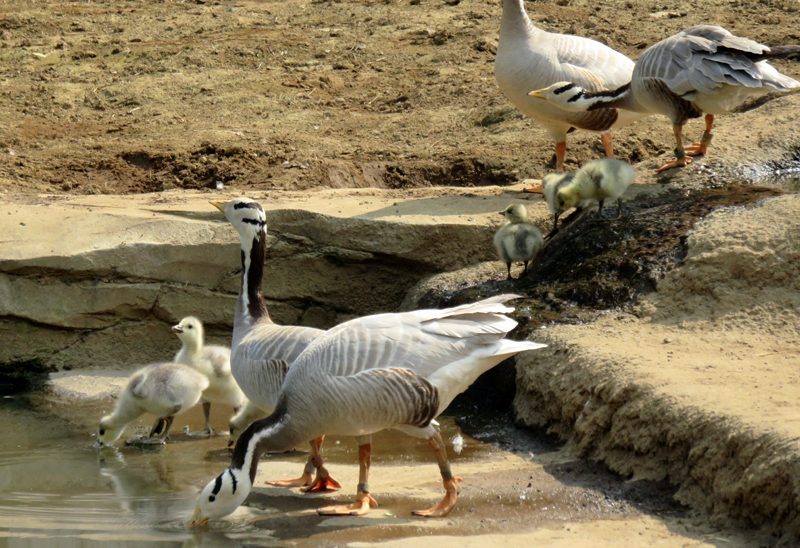 | | 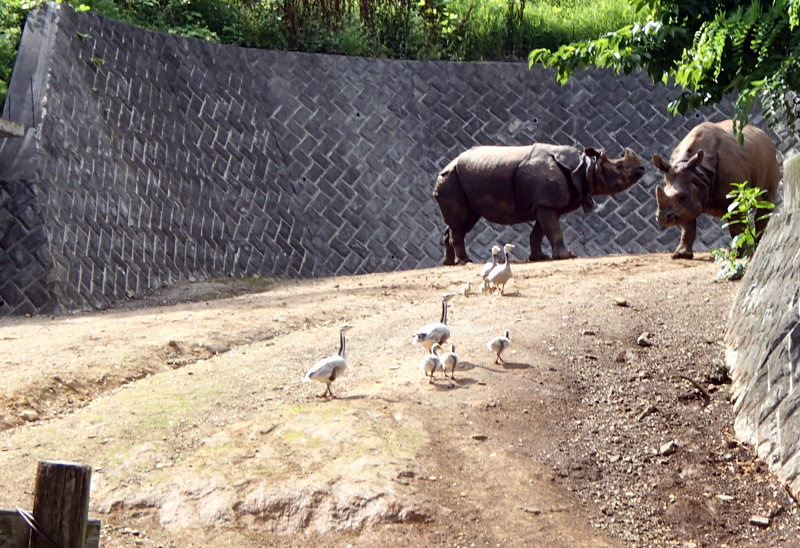 |
| A mother and baby Bar-headed Goose goose entering a swimming pool (June 10) | Greater One-horned Rhinoceros and Bar-headed Goose (June 17) |
Rhinos usually don't pay much attention to Bar-headed Goose, but one day, as a family of Bar-headed Goose was swimming in the pool, a male rhino named Vikram entered the pool from behind. The parent birds made loud warning calls, which only irritated Vikram, and he began chasing the geese. The parent birds quickly fled to land, but the three chicks that were left behind scattered and dove into the water. Vikram's violent movements created large waves.
If the chicks repeatedly dive and exhaust their energy, they won't be able to come ashore. So, we held out an oak branch to call Vikram and get him out of the pool, and before he could return to the pool, we scooped the chicks up with a net and moved them to land.
By late June, there were no longer any incubating pairs at the nesting site, and the parents and chicks were often out in the open enclosure. Their growth has been remarkable since then, and by July, the first chicks that hatched were almost the same size as their parents. This brings the number of Bar-headed Goose in Greater One-horned Rhinoceros enclosure to 50.
[Tama Zoo, Tama Zoological Park]
(August 16, 2016)