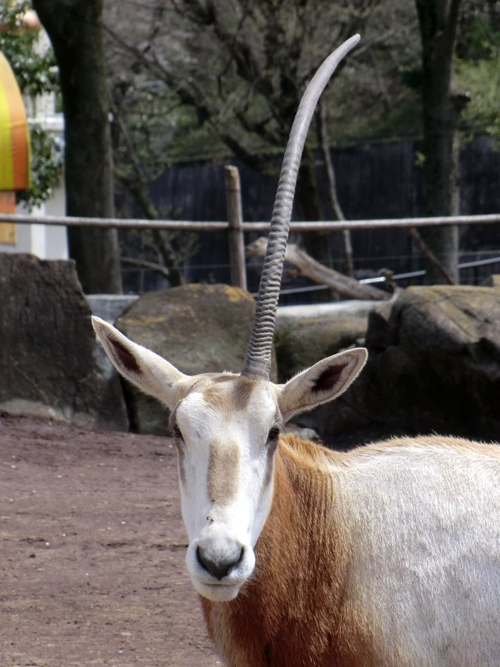
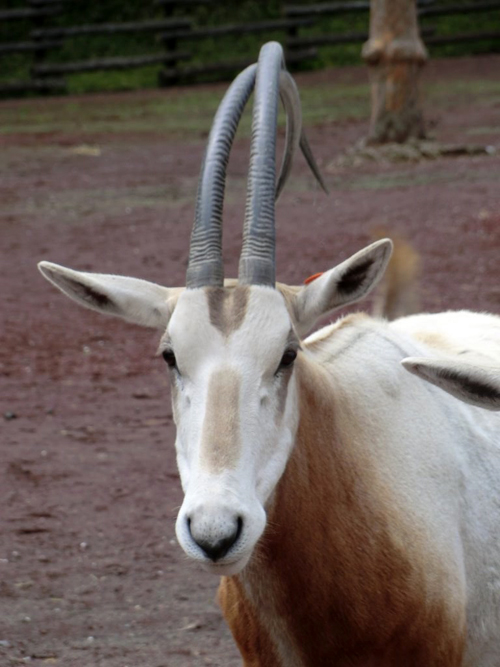
In African Zone of Tama Zoo, in an exhibit commonly known as "Eurasian Moorhen," oryx live alongside Giraffe, Domestic Horse, and pelicans in a spacious enclosure.
Of the four to five species of oryx, the one kept at Tama Zoo is Scimitar-horned Oryx, which was once widely distributed in North Africa.
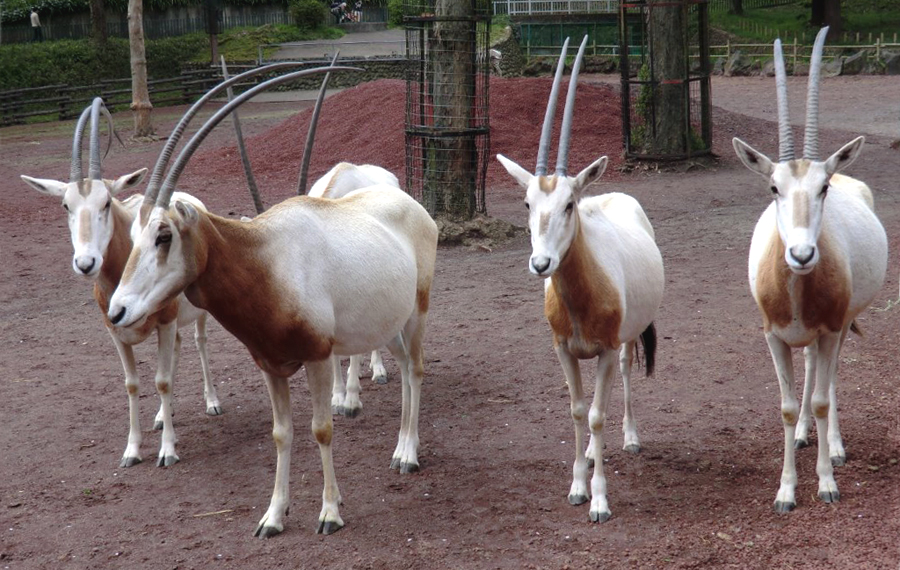
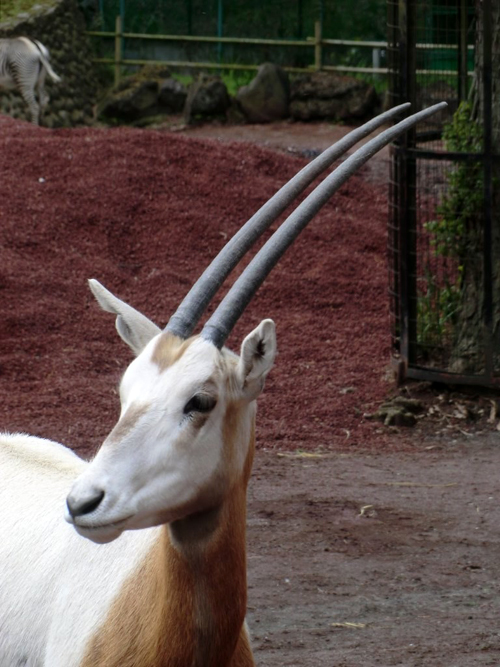
A herd of Scimitar-horned Oryx. From left to right: Sarah, Pepe, (face hidden) Milk Tea, Bibi, and Sakura.Scimitar-horned Oryx, as its name suggests, is a beautiful animal with two saber-like horns characteristic of oryx species, and its entire body is covered in short, pure white fur, with light brown accents around its eyes, throat, and back.
Listening to the cheers of the visitors, it seems they don't mistake Domestic Horse for Giraffe, but when it comes to Scimitar-horned Oryx, we often hear people saying, "Goat!" or "Deer!"
While Scimitar-horned Oryx belongs to the same bovine family as Goat, it is a much larger animal, standing around 120 centimeters tall at the shoulder and weighing 100 to 200 kilograms. Unlike Goat, oryx antlers do not regrow. Therefore, individuals with missing antlers due to accidents or those with distinctive antler growth patterns can be used as indicators for identification.
Eurasian Moorhen, where different kinds of animals live together, offers plenty to see, including the relationships between individuals of the same species, interactions between different species, habitat segregation, and how they graze.
Why not take some time to observe how Scimitar-horned Oryx, which is smaller than Giraffe and Domestic Horse, spends its day?
Individuals that are easy to distinguish by their horns include Bloom, a female who lost her left horn after being kicked by Domestic Horse, and Sarah, a female whose horns have crossed tips. Also, Bibi, a one-year-old female whose horns are not yet arched and grow straight, is young and active, making her a fascinating animal to watch.
Immediately after the park opens (9:30 AM), all three species of animals gather together at the "grass-laying" area (feeding platform with fresh grass), so you can see a lot of interaction between the individuals.
If you focus your attention on one oryx that catches your eye and observe it closely, you're sure to make new discoveries. Use this as an opportunity to learn more about Scimitar-horned Oryx.
[Tama Zoo North Garden Animal Care and Exhibition Staff, Michiyuki Nakao]
(September 2, 2016)