We are currently carrying out earthquake-resistant construction work at the animal enclosures in African Zone Eurasian Moorhen area of Tama Zoo (
Notice). As a result of this construction, we would like to provide an update on how Scimitar-horned Oryx, which were moved to two locations in Asian Zone are doing.
The seven female oryx were moved to the Père David's deer enclosure in Asian Zone. We were concerned about how the smaller space and the fact that only Scimitar-horned Oryx remained would affect them.
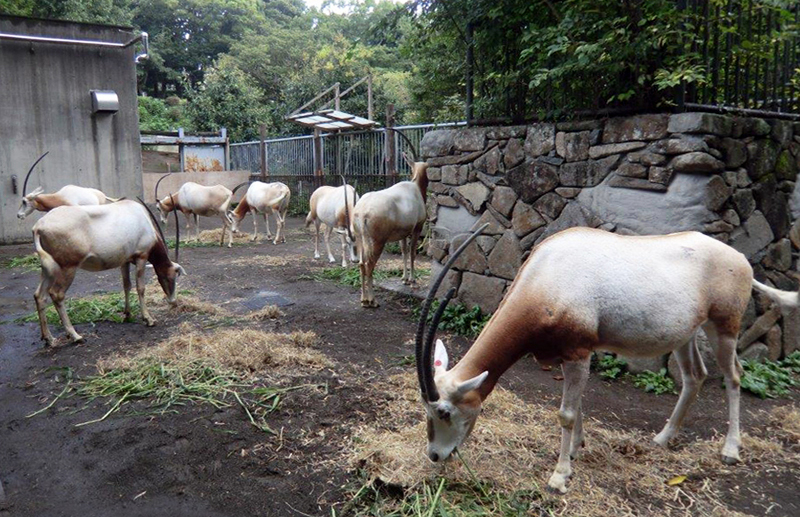
Females eatingImmediately after the move, the animals began to butt horns as if testing dominance, and were chased, falling and sustaining minor injuries more frequently. As a result, unnecessary obstacles were removed, feeding areas were provided for each animal, and a thicker layer of sand was laid underfoot so that they could get a better grip when running. The animals themselves also became accustomed to the environment, and they have calmed down.
Also, while Scimitar-horned Oryx previously used wire mesh or wooden fences to scratch the base of their horns and their faces, the Père David's deer enclosure is surrounded by a wide iron fence, which didn't seem suitable for scratching their horns. So, we tried attaching a used bamboo broom to the top of the stone wall, and Sakura and Bloom showed interest and approached it, but in the end, the dominant Mocha monopolized it, causing trouble within the herd, so we had no choice but to remove it immediately.
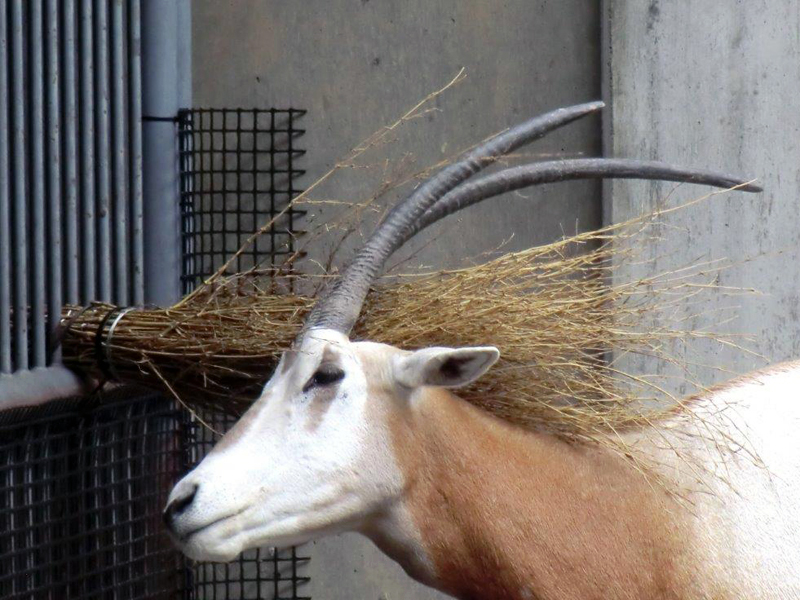 | | 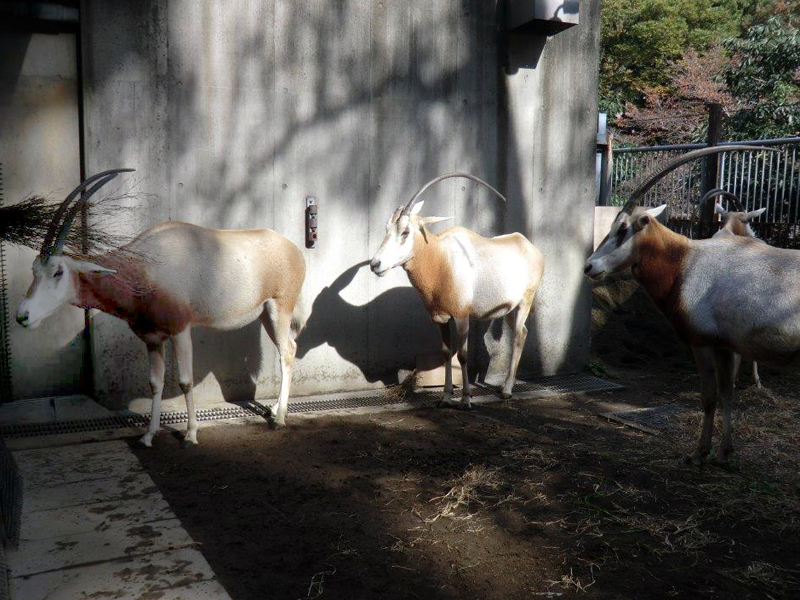 |
| Using a bamboo broom | Waiting in line for a bamboo broom |
About two months later, I tried putting the bamboo broom in a different location. Mocha was the first to lean in and use it, and afterwards, the other cats didn't interfere when they used it. Now they take turns using it.
However, old brooms only last a few hours, and if new ones are provided, the tips are eaten by a considerable number of individuals. So, we tried sticking branches of Japanese evergreen oak that Giraffe had left behind into the sand piles, and they neatly ate the thin branches. We also observed them using their horns to stick into sand piles that had been placed to replenish muddy areas. We are impressed by the resilience Scimitar-horned Oryx as they actively utilize their new environment.
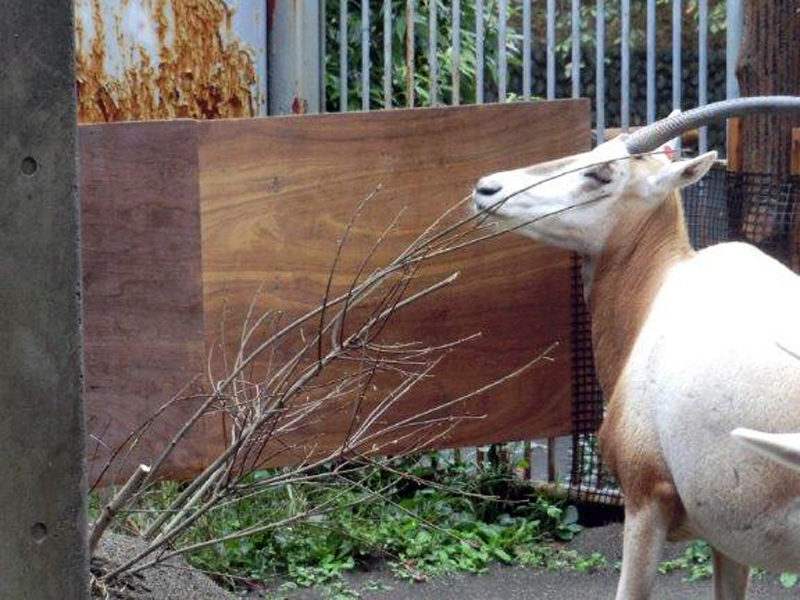 | | 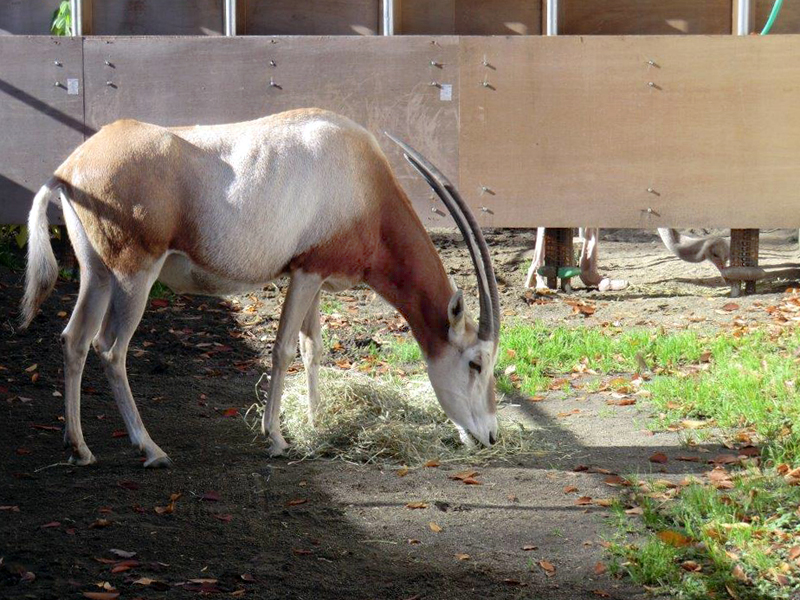 |
| Eating the branches of the Japanese evergreen oak. | The male is named "Crown." You can see an ostrich on the other side of the partition. |
Meanwhile, Crown, a male horse living alone in the former Przewalski's Horse 's horse enclosure, is separated from the ostriches and Grevy's Zebra he shares a enclosure with by a high partition, so they cannot see each other. This was done for safety reasons, but we plan to make improvements as each individual gets used to their surroundings.
We also attached a deck brush to the partition board as a substitute for a bamboo broom for Crown. However, Crown was wary of it, and continued to be reluctant to go in and out of the bedroom, and would stare at it from a distance. In the end, it took about a month before he started using the deck brush. I realized that trying out new toys on Crown required even more caution than with females.
[Tama Zoo North Garden Animal Care and Exhibition Staff, Michiyuki Nakao]
(December 22, 2017)