In response to a request for cooperation from the Ministry of the Environment, Tokyo Zoological Park Society has begun keeping two species of land snails endemic to the Ogasawara Islands, which are endangered (Land Snail and Land Snail), at four Tokyo Metropolitan zoos and aquariums (Ueno Zoo, Tama Zoo Inokashira Park Zoo and Tokyo Sea Life Park) (
Notice of commencement of keeping).
We are pleased to announce that we have successfully bred one species of snail Land Snail. Please note that there are no plans for public display at this time.
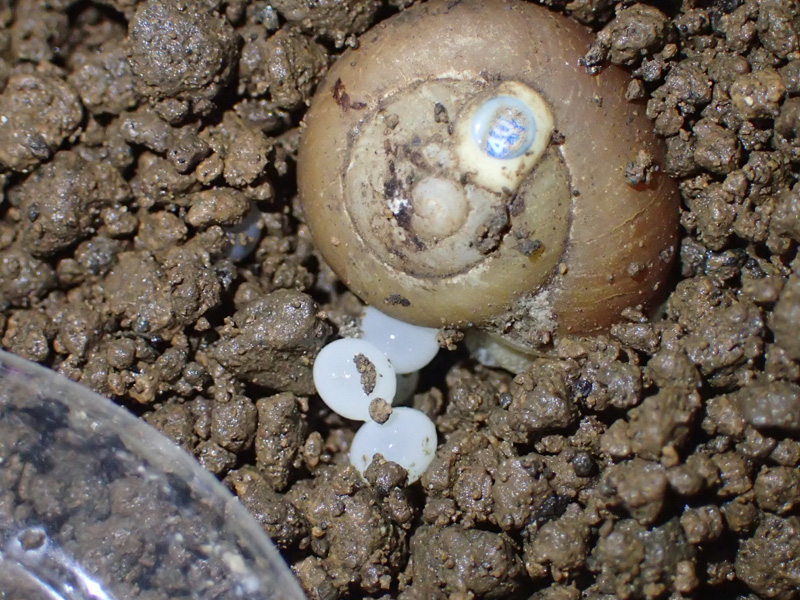 |  |
Spawning process
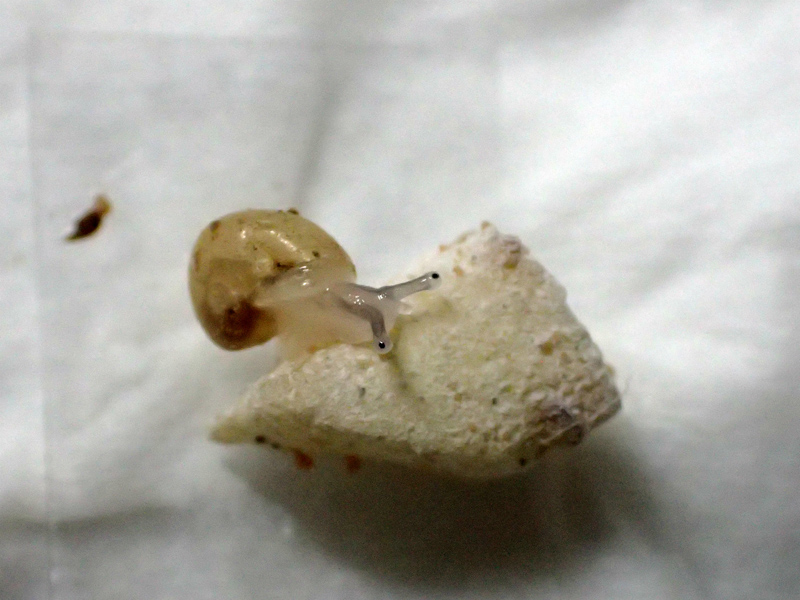
(January 16, 2018; egg diameter 3-4 mm) | Land Snail one day after hatching
(shell diameter approx. 3mm) |
Species successfully bred and the garden in chargeSpecies name: Land Snail (Mandarina hirasei)
Responsible garden: Ueno Zoo
Tama Zoo
Date and source of introductionDate of introduction: September 19, 2017 (Tuesday) 30 individuals at each garden
Introduced from: Ogasawara World Heritage Center
(Ogasawara Nature Conservation Officer Office, Kanto Regional Environment Office, Ministry of the Environment, Japan)
SituationAfter stable breeding management, cohabitation breeding for breeding started on November 23, 2017 at Tama Zoo ("Tama") and on December 4, 2017 at Ueno Zoo ("Ueno"), respectively.
Subsequently, four eggs were laid on December 22 at Tama and six eggs were laid on January 19, 2018 at Ueno. The eggs were housed in individual cases and placed in an incubator at a constant temperature, and hatching was confirmed for the first time on January 26, 2018 in Tama and February 22, 2018 in Ueno.
As of March 19, a total of 68 hatchlings (9 in Ueno and 59 in Tama) have grown to maturity.
In addition, rearing of Land Snail (Mandarina mandarina) is ongoing at Inokashira Park Zoo and Tokyo Sea Life Park.
Spawning and hatching status of Land Snail by each park up to March 19, 2018
| Total as of March 19th
*The number of eggs laid includes those that have not yet hatched. |
| Number of eggs laid | Number of hatches |
| Ueno Zoo | 29 | 9 |
| Tama Zoo | 114 | 60 |
About public accessTo focus on breeding, there are no plans to make them available to the public for the time being. We will inform you again when we decide to make them available.
Background leading to the implementationOne of the reasons the Ogasawara Islands were registered as a World Natural Heritage site is the "diversity of terrestrial mollusks." However, due to the invasion and spread of land mollusk predators such as planarians on Chichijima Island in the 1990s, as well as vegetation changes caused by invasive plants and predation by invasive rodents, the populations of endemic terrestrial mollusks inhabiting the Ogasawara Islands have drastically decreased and are now in danger of extinction.
In 2016, the Ministry of the Environment formulated the "Ogasawara Terrestrial Mollusk Protection and Propagation Project Plan for 14 Species" and has been promoting conservation activities. In addition, since 2010, some specimens have been collected and reared indoors on Chichijima Island, and the Ogasawara World Heritage Center is leading efforts to promote ex-situ conservation on the island.
Following a request for cooperation from the Ministry of the Environment, our association, which is dedicated to the conservation of rare wildlife inhabiting the Ogasawara Islands, will undertake ex-situ conservation efforts at its four affiliated zoos and aquariums to diversify the risks to captive individuals and to establish new breeding facilities outside the islands. Currently, the only facilities outside of Chichijima Island in the Ogasawara Islands that keep these species are the Tokyo Metropolitan Zoos and Aquariums.
Domestic breeding situation
Tokyo Metropolitan Zoos and Aquariums (as of March 19, 2018)Land Snail: 127 individuals in total across both zoos
Land Snail: 60 individuals in total across both zoos
Ogasawara World Heritage Center (as of March 9, 2018)Land Snail: 2,208 individuals
Land Snail: 1,216 individuals
(March 22, 2018)