The hot weather continues day after day, and this heat is a difficult season for many animals. In particular, animals whose natural habitats are in regions colder than Tokyo are sensitive to the heat, so we are taking various measures to keep them safe in our care.
Snowy Owl, which breed in the Arctic Circle, are one such animal. They typically lay eggs around May or June each year, but the incubation period and the time when the chicks hatch coincide with the rainy season and summer in Tokyo, making heat and humidity a major problem. Therefore, we have implemented various countermeasures.
First, because the female owl hardly moves from the nest while incubating eggs, her body and the inside of the nest get wet and dirty from rain that blows in, and her physical strength weakens due to the heat and humidity, and sometimes even fly larvae parasitize her body. So we worked to improve the incubation environment. Since Snowy Owl build their nests on the ground, as a measure against rain, we mixed well-draining river sand and large-grained Fuji sand and spread it inside the cage. We also put up a plastic sheet to prevent rain from blowing in from outside, but made it so that it could be opened and closed on sunny days to allow for good ventilation. In addition, the female owl becomes very wary and aggressive while incubating eggs, so it is difficult to clean. Therefore, we flexibly adjusted the amount of food we gave her to minimize the amount of food left uneaten.
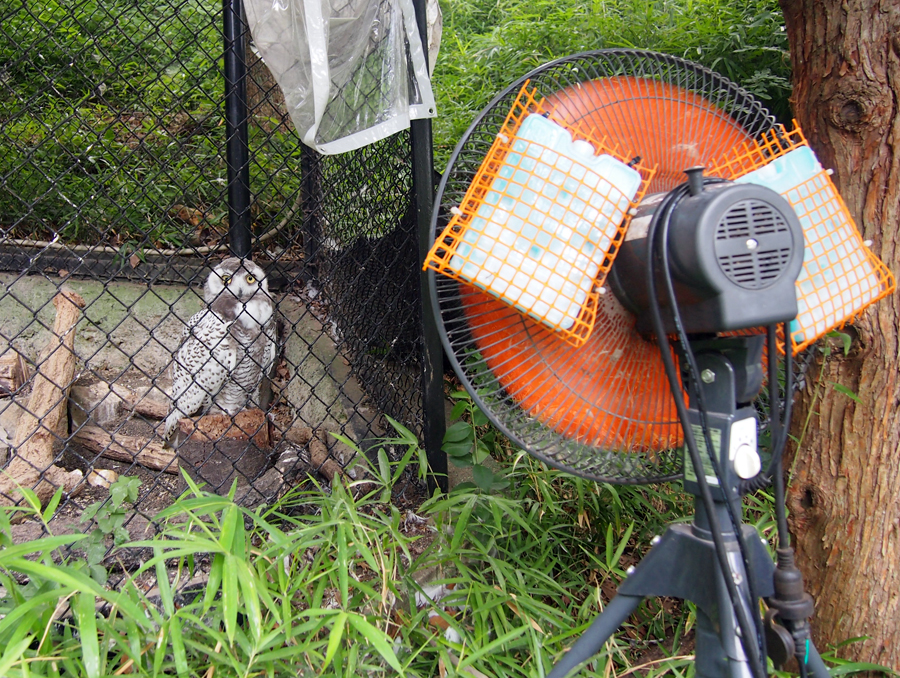
Furthermore, the chicks, lacking physical strength, often contracted fungal pneumonia. Therefore, to combat the heat and humidity, we installed fans and spot coolers. We also added sunshades to block strong sunlight, replaced the privacy screens with breathable shade cloth, and sprinkled water and placed ice containers on particularly hot days, all to help them stay as cool as possible in their outdoor cages.
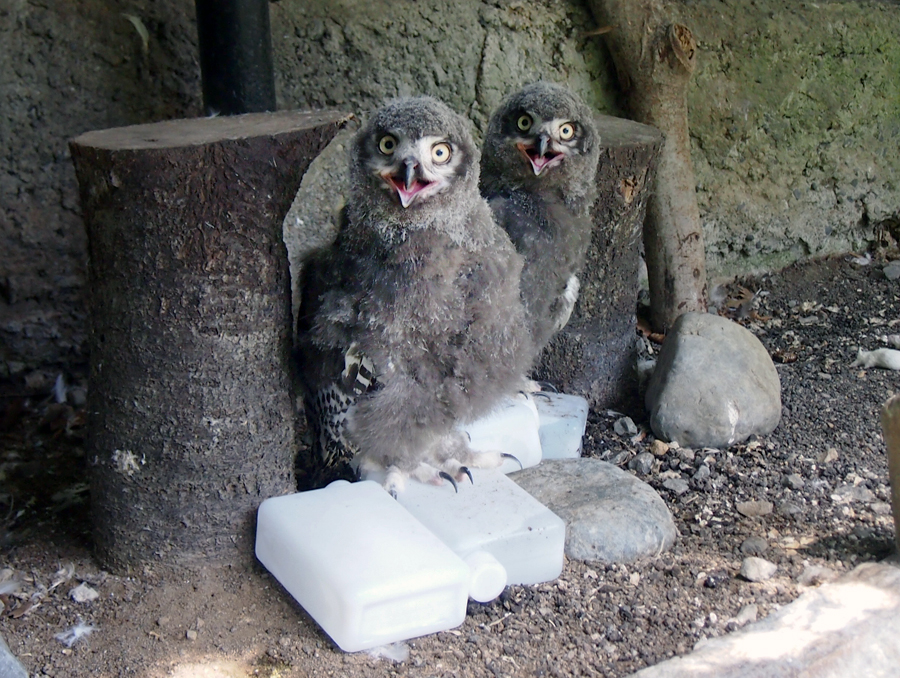 | |  |
A chick sits on top of a frozen container.
(Photo taken on August 11, 2015) | A chick born this year enjoying the breeze from a fan.
(Taken on July 25, 2018) |
However, breeding was not always successful, and we hadn't found a fundamental solution. So, based on advice from experienced breeders, we started trying to artificially control the length of daylight with lighting to bring the egg-laying season forward two years ago. In the first year, perhaps because the lighting schedule wasn't right, the birds didn't lay any eggs. However, last year and this year (2017 and 2018), they laid eggs in early April, more than a month earlier than usual, and the chicks hatched in May. As a result, the chicks fledged before the rainy season and were able to choose their own sheltered and cool places to live.
Although the intense heat is expected to continue, the chicks have already grown to almost the same size as their parents and are taking baths, so we can watch them with more peace of mind than before.
[Ami Nakajima Tama Zoo]
(August 3, 2018)