At Tama Zoo 's chick rearing facility, two pairs of Red-headed Wood Pigeon naturally bred, and chicks successfully fledged in August and September of 2019.
Tokyo Metropolitan Zoo is working on a conservation and breeding project for the Japanese Red-headed Wood Pigeon found in the Ogasawara Islands and an endangered species. To date, they have increased the population by establishing breeding techniques and securing a sufficient number of individuals, using artificial incubation in incubators and artificial rearing by animal keeper. The next challenge is to improve the genetic diversity of the captive population and create pairs that can breed naturally.
Therefore, Tama Zoo decided to try to create pairs using wild-caught individuals that have not previously bred, and also to work on "natural breeding," where the parent birds incubate the eggs and raise the young.
In March of this year, we placed female #102, who was rescued in 2013 but had not yet successfully bred, with two males who had experience breeding in the wild, allowing the female to choose a mate. The female paired with male #112, and on May 7th, she laid eggs in a nest surrounded by bamboo blinds on the ground. The male and female have since taken turns incubating the eggs.
However, on May 28th, the female preened and mated with another male, #80, in a separate nest box from the one on the ground. Since the eggs she was incubating were infertile, the male #112, who had previously been paired with her, was moved to the next room where another female, #147, was, leaving only male #80 and female #102.
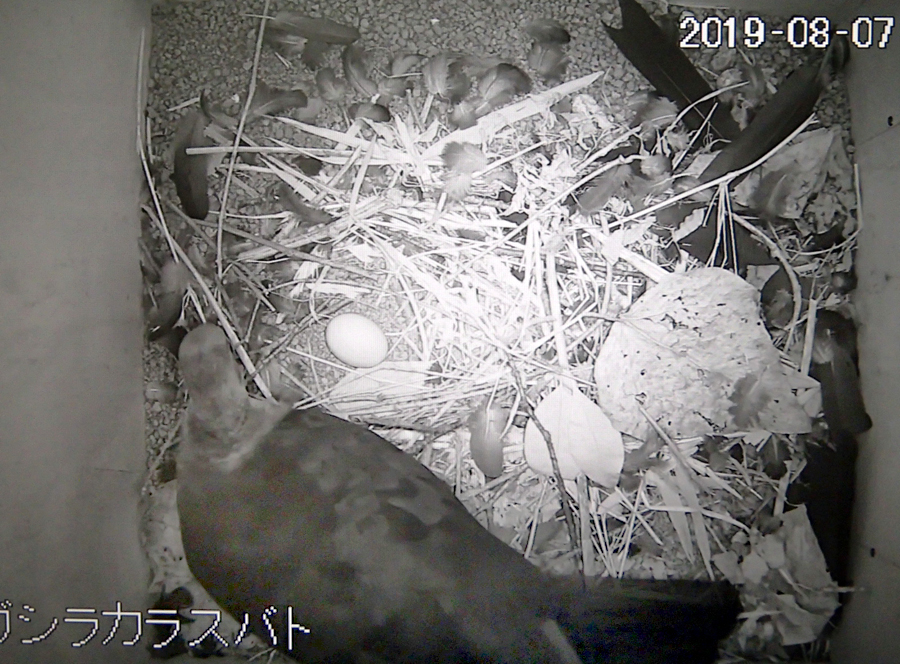 | | 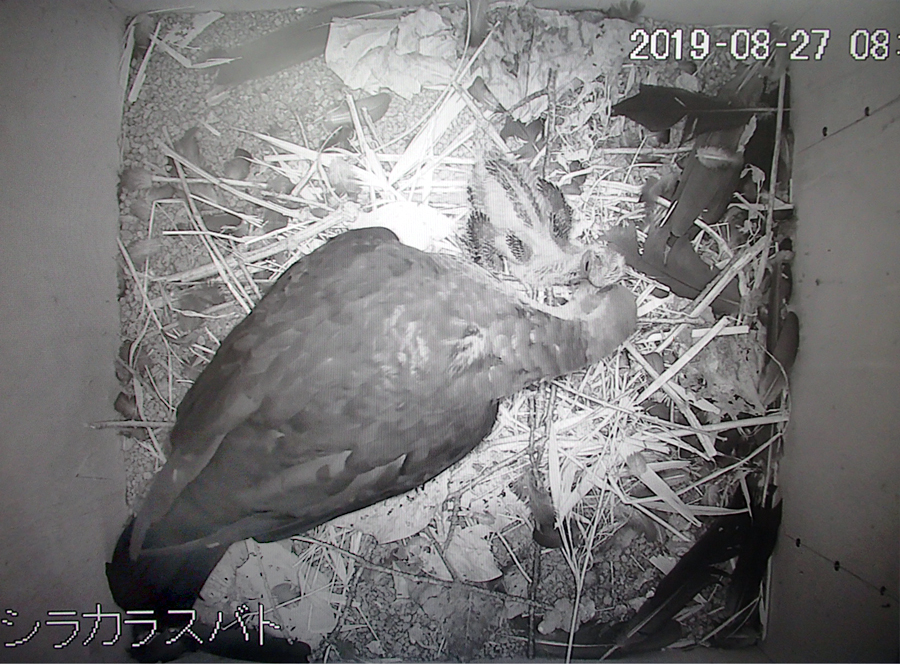 |
| #80 (male) and #102 (female) pair. Left: Egg-laying observed. Right: Parent birds feeding the chicks. 1 week old. |
After that, they were frequently seen carrying nesting material and mating, and on June 5th they laid an egg, but it was infertile. The next egg laid on July 4th was also infertile, but the third egg laid on August 1st was fertile, and a chick hatched on August 20th. The female incubates the chick at night, and the male incubates it during the day, feeding it. The chick puts its face into the parent bird's beak and receives food that the parent regurgitates.
The chicks were growing well. On the evening of September 16th, they left the nest box. For a while after that, they continued to go back and forth between the nest box and the outside. The female began to stay in the nest on the ground in preparation for the next breeding season, while the male was busy carrying nesting material and feeding the chicks. On September 29th, the chicks were finally able to spend the entire day outside and were observed foraging for food on their own.
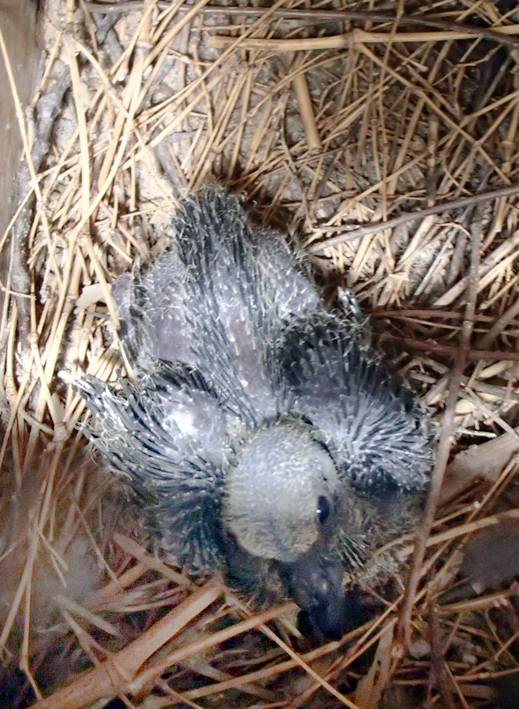 | | 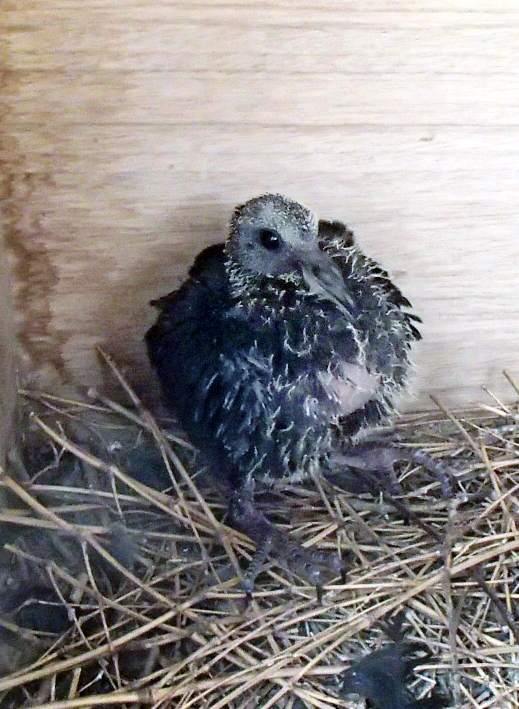 | | 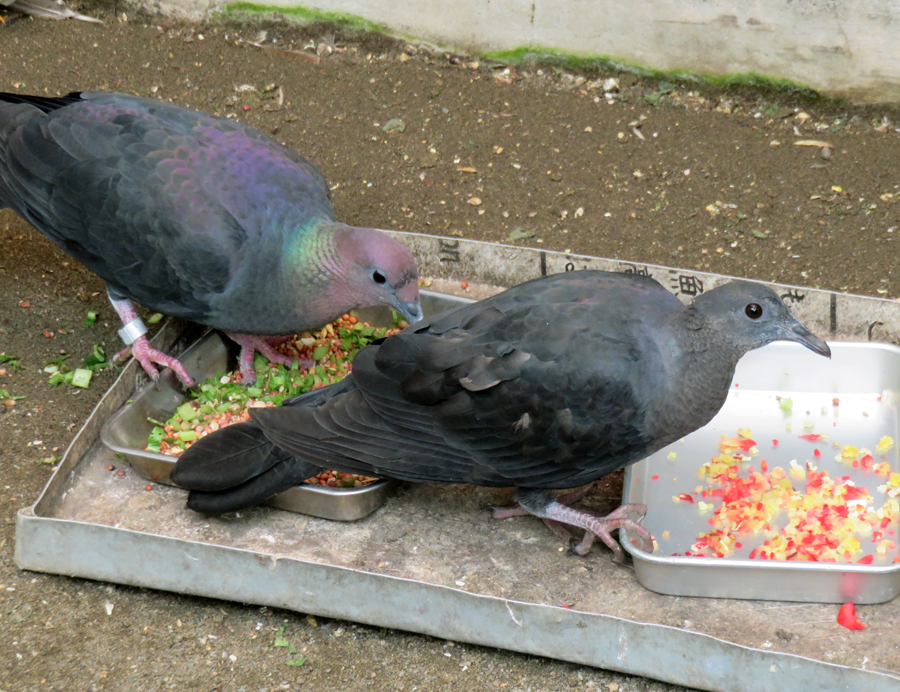 |
| #112 (male) and #147 (female) pair. Left: 9 days old, Middle: 15 days old, Right: Foraging behavior observed in fledglings. |
Meanwhile, male #112, who had been moved to the next room, began living with female #147. Both of these pigeons were raised by hand. The two paired up well, and their second egg hatched on July 24th. Again, the male cared for the chicks during the day, and the female from evening until morning. However, just before the chicks were about to fledge, the female stopped returning to the nest and completely lost interest in them. However, since the male was still feeding them, we continued to feed them by hand and observed the situation. On the evening of August 28th, the chicks left the nest box, and the next morning they were perched on a branch next to the male. We were also able to observe them pecking at food together. This is the first time that a pair of pigeons raised by hand have bred naturally.
This time, the fact that wild-caught female #102 has bred for the first time, and that two pairs have successfully bred naturally, represents a significant step forward.
[Yoshinori Kojima Wildlife Conservatio Center Tama Tama Zoo]
(October 11, 2019)