At Tama Zoo Asian Elephant on December 25, 2024, Asian Elephant "Anura" (male, estimated 71 years old as of the date of the move) was moved to the male enclosure where "Vidura" (male, 17 years old) had previously resided. As a result, Vidura will now spend the entire day in the female enclosure with "Amara" (female, 20 years old).
This time, I will explain the circumstances that led to the exchange of the housing locations for these two animals.
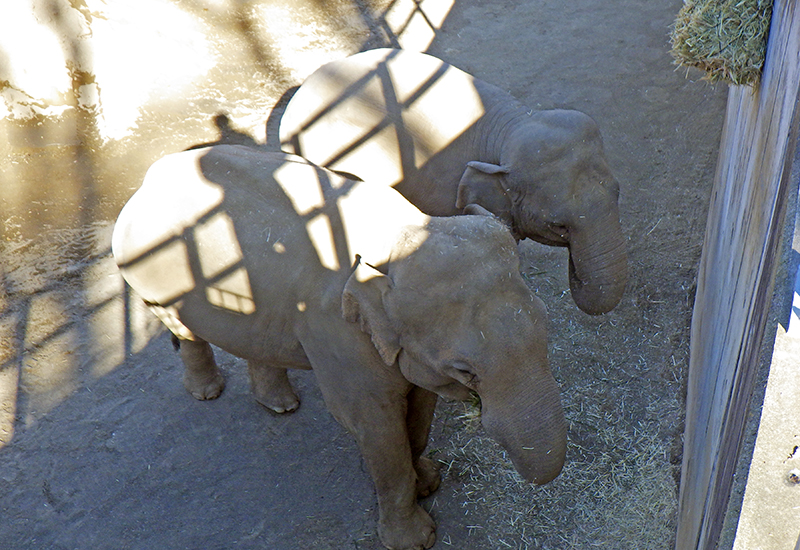
Foreground: Vidura (male), Background: Amara (female)At our zoo, since April 2024, we have kept Vidura and Amara together in the entire male enclosure and the outdoor enclosure of the female enclosure all day from spring to autumn and during the daytime in winter (excluding their respective training times), but they have not yet bred. Even when Vidura tries to mount Amara (the behavior in which a male places both forelegs on the back of a female in order to mate), Amara, despite being in estrus, does not accept Vidura and runs away.
As we considered solutions, we realized that we might also need to address Amara's mental well-being. In the wild, elephants form matriarchal groups, consisting only of females from the same family. Within these groups, they help each other, and a leading female calms down any females who become emotionally unstable.
In Amara's case, she had previously lived alone as the only female elephant, without any other elephant to rely on. Even without a leading female, Vidura seems to be a source of emotional support for Amara. As evidence of this, since Amara began living with Vidura, she has almost completely stopped exhibiting the behaviors that were previously seen in her, such as becoming excited during training, which seemed to be based on emotional instability.
On the other hand, since Vidura has no prior mating experience, spending more time with Amara will increase her opportunities to attempt mating.
Therefore, we decided to use the female enclosure to care for Vidura and Amara so that they could spend time together day and night. With this move, the two can now live together year-round, including at night during the winter.
The time the two dogs spend together during the winter months increases from approximately 2 hours to 24 hours (excluding their individual training time), which will lead to more opportunities for Vidura to attempt mating and longer periods of mental stability for Amara. We hope that Amara's continued good mental state will lead her to accept mating with Vidura.
The benefits aren't limited to Vidura and Amara. When Anura was kept in the female enclosure, she was confined to a limited area—the training area within the female enclosure—except when she was released into the female enclosure during exhibition hours, for cleaning purposes and to keep her separate from Amara. By managing Anura in the male enclosure, she can go out into the outdoor enclosure regardless of when the two are housed together.
This will allow us to utilize approximately four times the area compared to using only the training area. The female enclosure will no longer be available, but considering that we will be able to allow nighttime releases in indoor and semi-indoor areas as temperatures rise, the total usable space will increase.
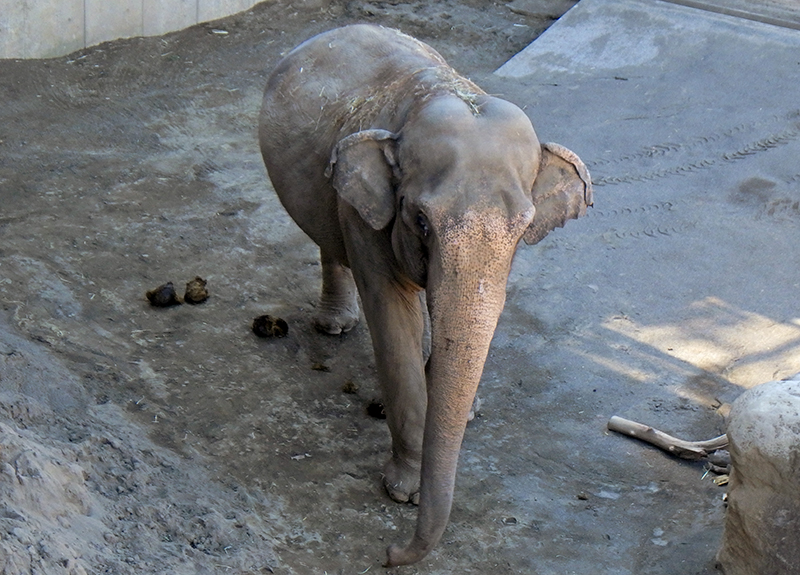
Anura (male)To further increase the variety of Anura's behavior, we are making efforts to encourage Anura, who is almost blind, to move around actively, such as by placing food all over the male enclosure.
We will continue to strive to provide elephants with the best possible living environment through our animal care and management practices.
[Tama Zoo]
◎Related articles
・
Towards the future of elephants (August 4, 2023)
(January 11, 2025)