Are you familiar with the term "malocclusion"? Malocclusion refers to a condition where the teeth are misaligned or the bite is incorrect.
In fact, malocclusion is said to be one of the three major diseases in guinea pigs. Guinea pigs have 20 teeth in total, two in the upper and two in the lower jaw. They have 4 incisors and 16 molars. Both incisors and molars continue to grow throughout their lives.
Another very distinctive feature of guinea pig teeth is the angle of their molars. Instead of growing straight up and down, the upper molars grow at an angle outward, while the lower molars grow at an angle inward.
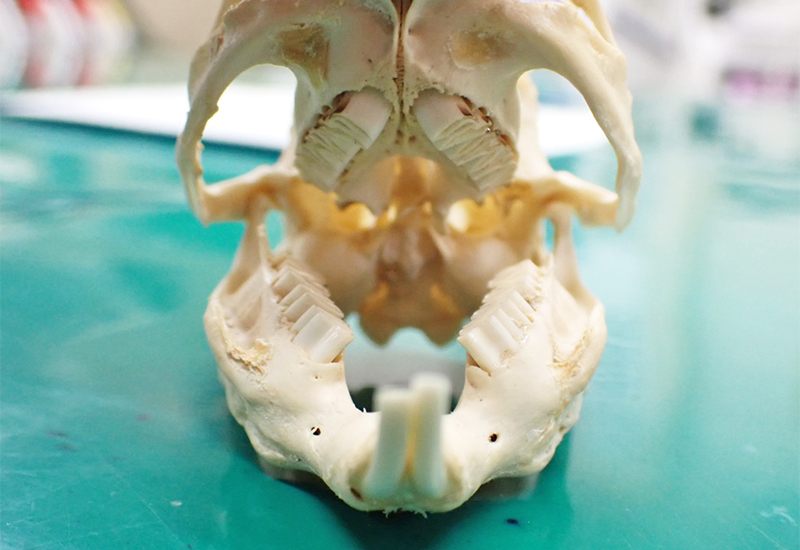
Guinea pig skull specimenThis malocclusion is primarily caused by the food the animal is eating. If an animal only eats soft food, it cannot wear down its teeth, which grow continuously throughout its life. As a result, the teeth may grow abnormally long or become deformed. Common symptoms include loss of appetite and excessive drooling.
If a guinea pig's molars have grown too long, all that's needed is to file them down to shorten them. However, guinea pigs don't always cooperate and let you file them down, so anesthesia is essential.
Therefore, preventing malocclusion is of utmost importance. At Tama Zoo, we mainly feed our animals hard hay so that their teeth wear down naturally through chewing, but we still sometimes encounter dental problems.
One day, we took our guinea pig in for an examination because it had lost its appetite and seemed a little lethargic. Since dental problems cannot be overlooked as a cause of loss of appetite in guinea pigs, we anesthetized it and thoroughly examined its mouth.
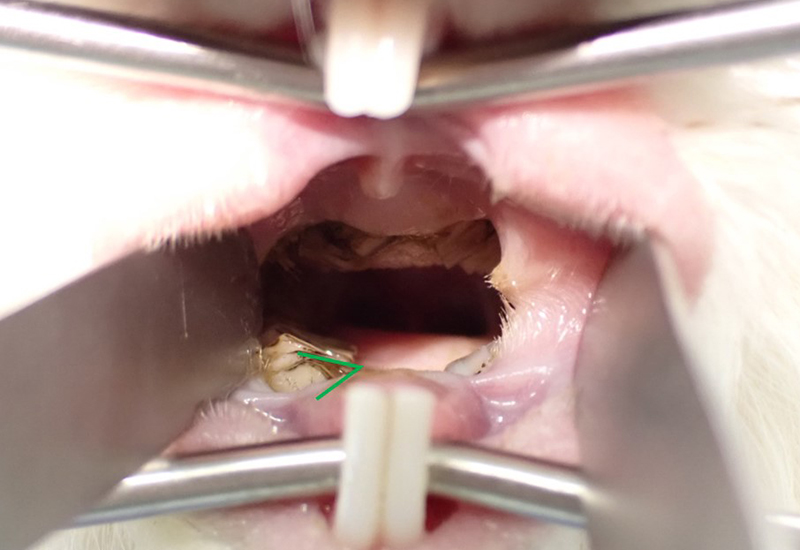
Guinea pig's oral cavity before treatmentYou can see that the right molar (indicated by the green marker) slightly overlaps the tongue.
In humans, we can eat even if our teeth slightly overlap our tongues, but in guinea pigs, the back two-thirds of the tongue is fixed, and only the tip can move. Because of this unique structure, if the teeth grow too long, as shown in the picture above, the movement of the tongue in the left, right, up, and down directions is hindered, making it impossible to send food to the back of the throat.
This time, we trimmed the overgrown molars and also slightly adjusted their angle.
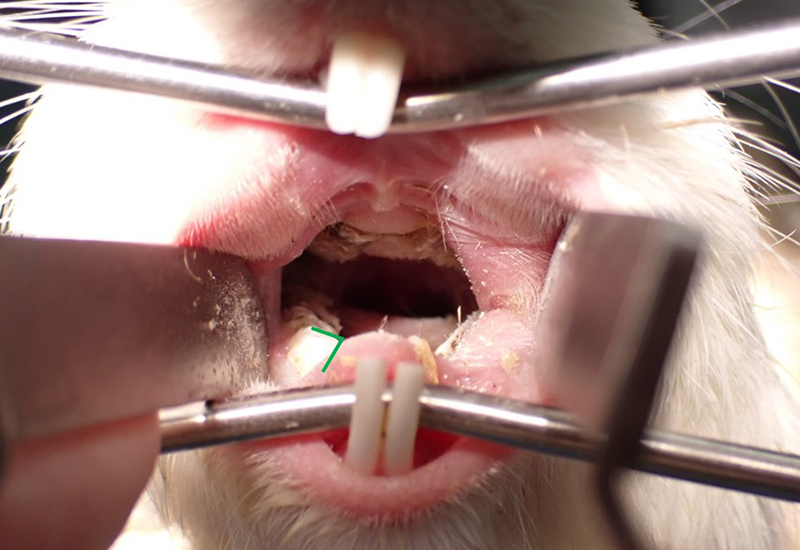
Guinea pig mouth after treatmentIt's a little hard to see, but can you spot that the part covering his tongue has shortened? Also, the angle of his teeth, which were previously flat, is now slightly angled. I was relieved to see him eating hay without any problems after waking up from the anesthesia.
Malocclusion, once it develops, is something that must be managed for life. However, we are constantly working to improve our methods, such as preventing its occurrence by improving feeding content in consultation with the animal care staff, exploring better treatment methods, and shortening anesthesia time.
[Kamakura, Animal Hospital Section, Animal Care and Exhibition Department, Tama Zoo]
◎Related articles
・
Treatment and prevention of urinary stones in guinea pigs (May 25, 2018)
(January 18, 2025)