The harsh winter is over, and the long-awaited spring has arrived. Although Tama Zoo is temporarily closed, spring has also arrived for the animals. The birds I am in charge of have also welcomed spring and entered their breeding season.
Inside the walk-in birdcage is a bird called Black-faced Spoonbill. As its name suggests, it is a distinctive bird with a black marking around its face and a beak that resembles a "spatula."
The Black-faced Spoonbill have also entered their breeding season. Despite the current circumstances, black-faced Black-faced Spoonbill breed in groups (I imagine that people are taking precautions to avoid crowded places). These groups are not without mates; several pairs build nests, and the nests are located next to each other.
Last year, we installed three nesting platforms for Black-faced Spoonbills in the walk-in Black-faced Spoonbill, each measuring 150cm long, 150cm wide, and 110cm high. Previously, we had spread a plastic net over a tree called Pittosporum tobira and allowed the birds to breed there, but the plant had been depleted, so we made new nesting platforms.
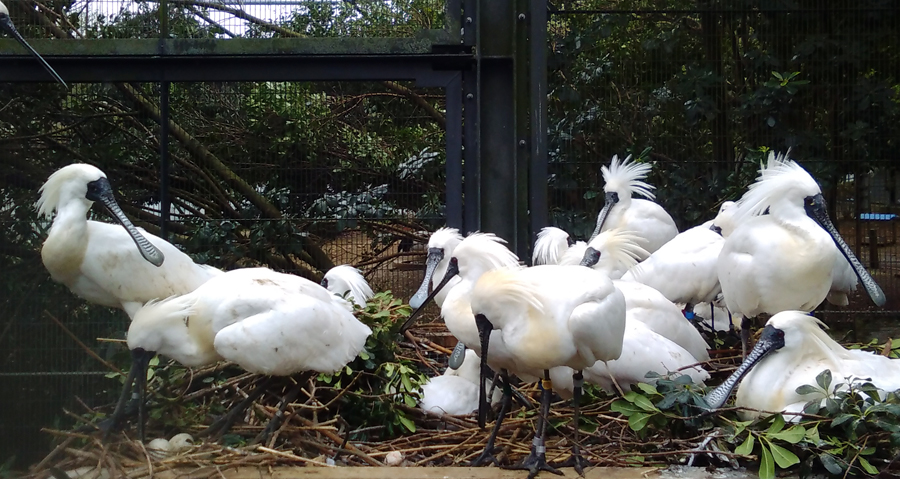
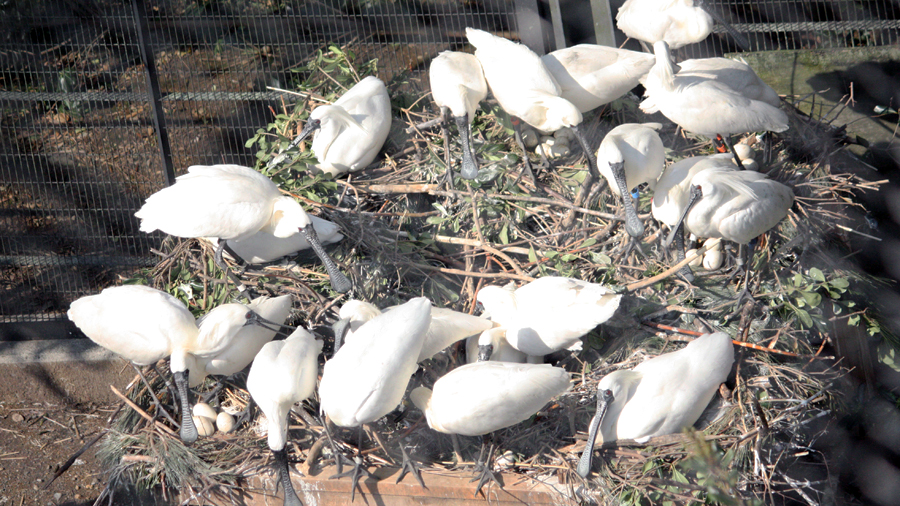
We placed three nesting platforms in different locations, allowing Black-faced Spoonbill to choose its favorite spot. It began using the platform near the one it had previously used. It seems to really like this spot, as it has used it for two consecutive years, last year and this year. As mentioned earlier, they breed in groups, so the platforms are densely packed with nests, and despite the cramped conditions, they never move to other platforms. Because the nests are close together, they sometimes take nesting material (branches and grass) from neighboring nests, causing neighborly disputes. However, their spoonbill-like beaks have no sharp edges, so pecking doesn't cause any serious harm.
Perhaps because their beaks are not very effective at attacking, when they want to intimidate someone, they forcefully clap their upper and lower beaks together, making a sound like castanets. This is how a pair of Black-faced Spoonbill works hard to protect their eggs and nest and ensure the survival of their offspring.
We are temporarily closed, so we are very sorry that you cannot see them in person. However, we hope that this news will allow you to think of Black-faced Spoonbill at Tama Zoo from the comfort of your home. Please support them as they enter their breeding season. For the animals, this is just another season in their daily lives, but let's overcome this crisis together with these animals who are striving to survive.
[Yosuke Taguchi Tama Zoo]
(April 24, 2020)