Tama Zoo also keeps Bar-headed Goose geese in its Greater One-horned Rhinoceros enclosure. Three Bar-headed Goose goose chicks hatched on June 9th, 2020, and one more hatched on June 13th.
We had observed egg-laying and incubation since early May, but the females didn't seem very enthusiastic about it. They would lay eggs and then leave them unattended, or abandon incubation almost immediately, so we thought there wouldn't be any breeding this year.
However, after about a week, it was as if a switch had been flipped, and about seven pairs suddenly began incubating their eggs at the nesting site. The location is on a hill to the right of the path used by visitors, in an area inaccessible to Greater One-horned Rhinoceros. As far as we could observe, they incubated the eggs all day long, and the parent birds were also seen cooperating to chase away wild crows that approached.
As is said to be the incubation period for Bar-headed Goose, which is 28 to 30 days, the eggs seem to have hatched about a month after they began nesting in groups in mid-May.
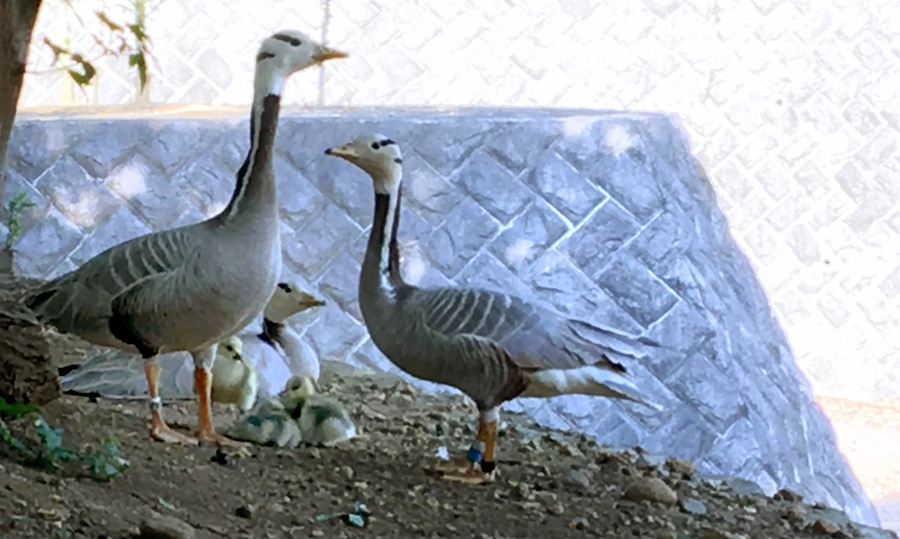
June 9, 2020, hatching dayThe three chicks born on June 9th have different parents. On the morning of hatching, two of the three were with the female "W-0040" and her male partner. The third chick was with a different adult in the morning, but by evening it was walking around with the other two chicks, protected by W-0040 and her partner.
One chick that hatched on June 13th was with its parents in the morning, but a day later it was spending time with W-0040 and its offspring. Since Bar-headed Goose are birds that live in flocks, perhaps it feels safer to be with W-0040 and its chick than with two parents and one chick alone. W-0040 and its pair were very attentive parents, protecting the chick from crows and other birds by staying in front of, behind, and to the sides of it.
Immediately after hatching, the chicks look rather helpless, but they grow very quickly, getting bigger day by day. Within a week, they are eating the exact same food as the adults. You can also see them swimming in the shallow parts of the pool.
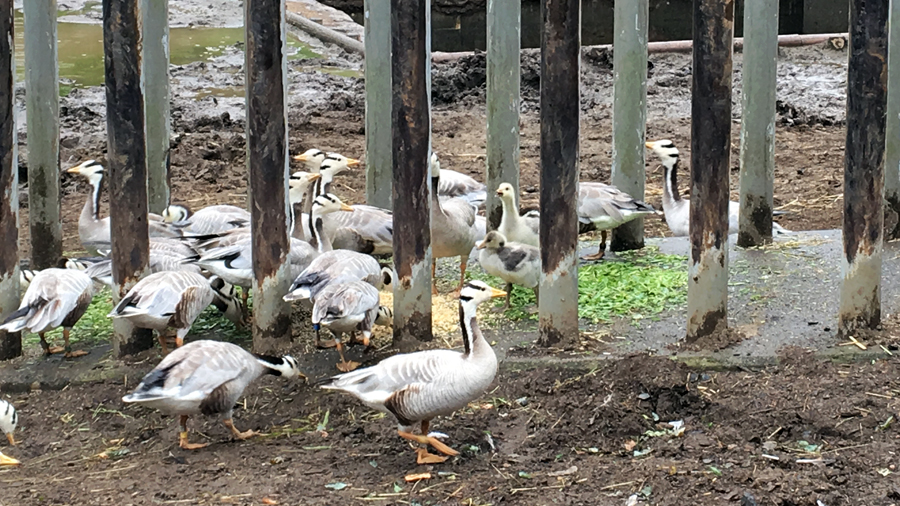
On July 3, 2020, a chick can be seen eating food alongside the adults.Sadly, two of the four chicks died shortly after, but the other two are growing up healthy and strong. As I write this article, it's been about three weeks since hatching, and the chicks have already ventured out of the nesting grounds, chasing away pigeons that come to eat, and joining the adult flock, showing signs of growth in their behavior. The yellow feathers that were a distinguishing feature of the chicks also seem to be fading.
When you visit Greater One-horned Rhinoceros enclosure, please pay attention not only to the rhinos but also to the growth of Bar-headed Goose.
[Ayana Arashida, Animal Care and Exhibition Staff, South Tama Zoo]
(July 10, 2020)