On September 3, 2024, Greater One-horned Rhinoceros "Dekopon" (female) was born. This marks the first successful breeding of Greater One-horned Rhinoceros at Tama Zoo in 50 years. This article will be published in two parts: the first part will cover the pairing of the father, "Vikram," and the mother, "Gopon" (the plan for them to live together for breeding), and the second part will cover Gopon's pregnancy and the efforts of the zookeepers. We also plan to publish an article summarizing Dekopon's first year around her first birthday, so please look forward to it.
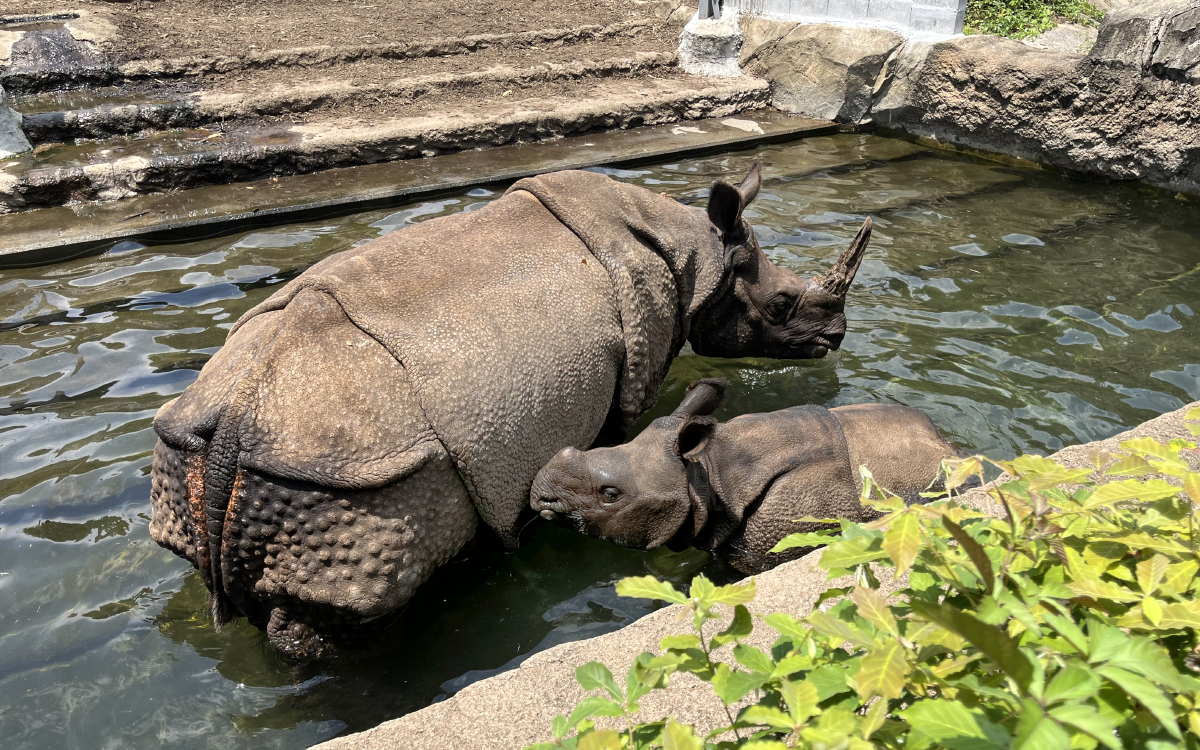
A recent photo of a parent and child (taken on July 22, 2025)The father, Vikram, arrived at Tama Zoo from the Kingdom of Nepal in 2002 at an estimated age of 12 months. Meanwhile, the mother, Gopon, arrived in December 2020 from Yokohama Municipal Kanazawa Zoo under a breeding loan agreement (
news from that time can be found here). Gopon must have been nervous in her new environment, but I remember that she was eating from the day she arrived.
Female Greater One-horned Rhinoceros rhinoceroses go into estrus on a 40-50 day cycle. During estrus, they emit a whistling call known as "whistle-like vocalizations," and exhibit characteristic behaviors such as frequent urination and decreased appetite. Males also become excited in response to the females' estrus. Gopon's first estrus was confirmed nine days after his arrival at the zoo, but due to Gopon not having fully adjusted to his new environment, animal keeper not fully understanding Gopon's personality, and insufficient preparation, cohabitation was postponed at that time.
The first time they lived together was on April 21, 2021. However, as soon as they started living together, Vikram ran away from Gopon at an incredible speed. Vikram had previously been paired with "Narayani" (female), who was moved to Kanazawa Zoo in exchange for Gopon. However, Vikram and Narayani are of similar size, while Gopon is about two sizes larger than Vikram. Therefore, he may have been surprised by the female who was larger than him. After that, they were put together every time Gopon went into estrus, and although Vikram became a little more proactive, he continued to run away even when Gopon approached him in an inviting manner. In the latter half of 2021, mounting was observed, but he would quickly dismount, and the path to breeding remained uncertain.
In 2022, we revised our pairing method. Previously, we would immediately house males with females as soon as estrus was confirmed. However, Greater One-horned Rhinoceros are solitary animals in the wild, and it is unlikely that a male and female in estrus would suddenly encounter each other. Therefore, even when Gopon showed signs of estrus, we did not immediately house them together, but instead tried a method of first allowing Vikram to sense only the signs of estrus. Specifically, we let Gopon out and then housed him, and then released Vikram into the same enclosure to allow him to sense the signs of the female in estrus. As a result, we observed "whispering" and intense excitement in Vikram, behaviors we had not seen in him before. We postponed housing them that day, and when we housed them the next day, we observed erection and mounting behavior in Vikram. Mating did not occur this time, but there was definitely progress. Subsequent estrus cycles were paired using the same method.
On May 8, 2023, Gopon was confirmed to be in heat. We decided against letting them live together that day, but when we did the next day, the 9th, Vikram followed Gopon from the start, and we finally confirmed that they mated. We were worried about whether they would be able to mate successfully due to the size difference between them. However, it seems that their previous mounting sessions had served as good practice, as they were able to assume a proper mating position. Mating in Greater One-horned Rhinoceros is said to take about an hour, but Vikram and Gopon's mating was completed in about 20 minutes, and afterwards, the two of them went into the pool and spent time peacefully together. Since Gopon's behaviors associated with estrus had also stopped, we decided that further cohabitation was unnecessary and returned them to their respective sleeping quarters in the evening.
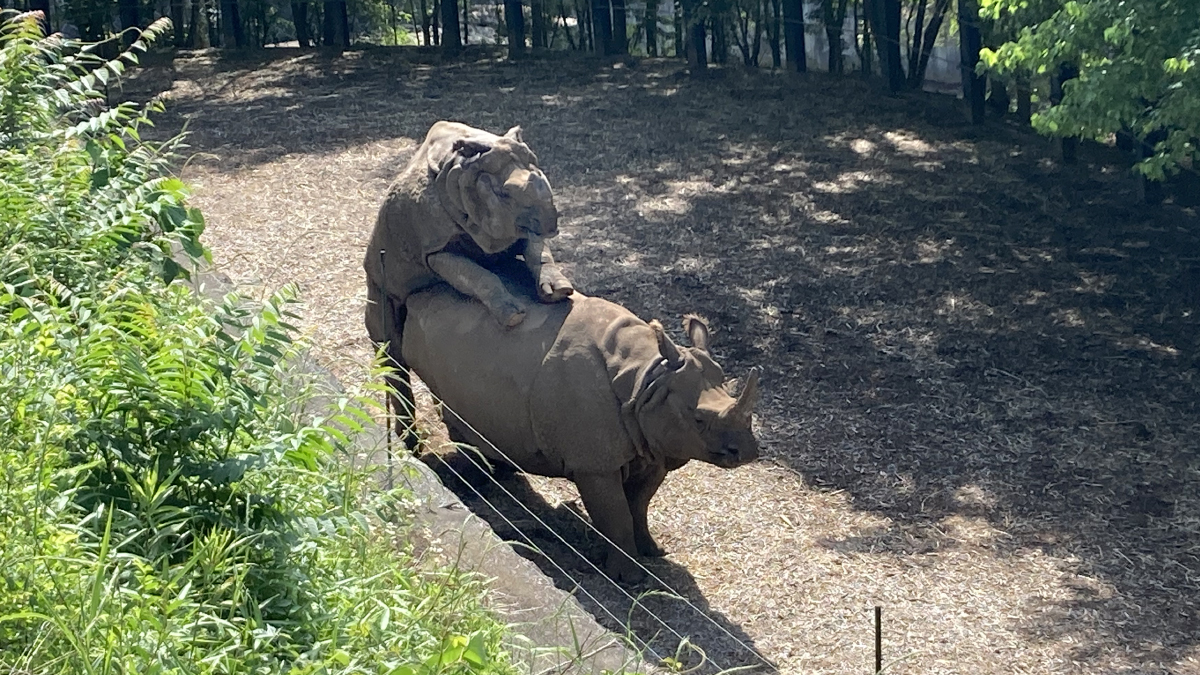
Mating finally confirmed (photographed on May 9, 2023)
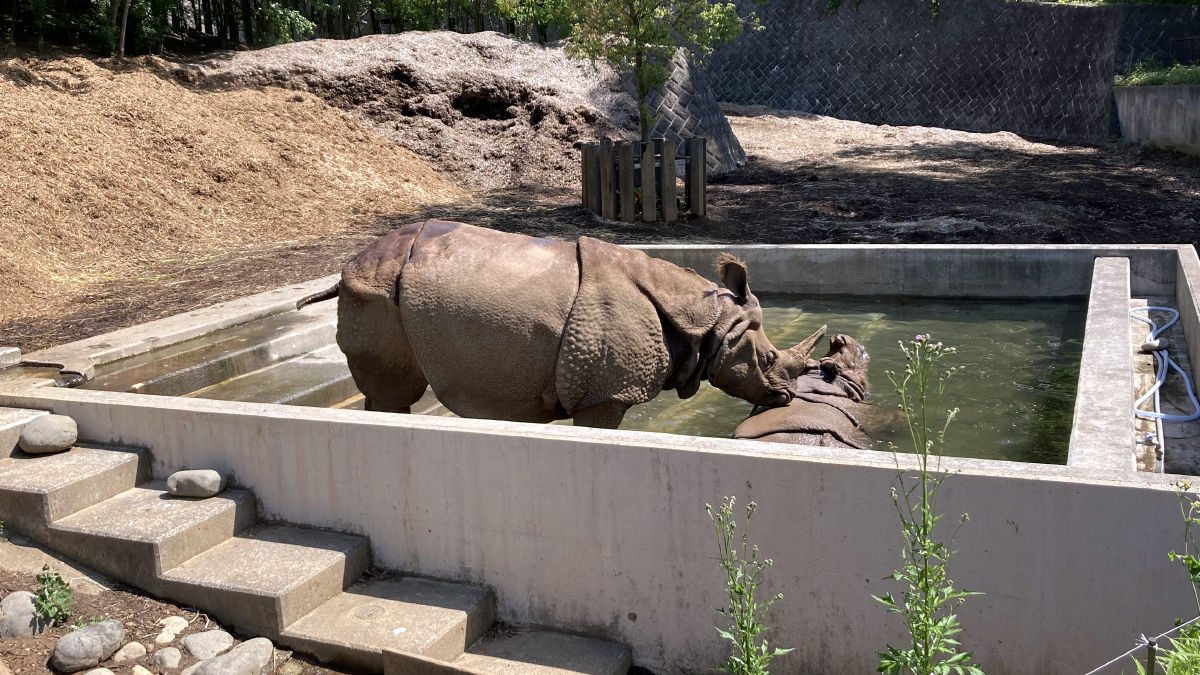
Gopon (left) and Vikram enter the pool together after mating (photographed on May 9, 2023).Approximately two years after Gopon arrived at the zoo, mating was successful, marking a major step towards the first successful breeding of Greater One-horned Rhinoceros in 50 years. In the second part of this article, we will provide more details about Gopon's gestation period.
[Arashida, Tama Zoo]
>>Click here for Part 2
◎Related articles
・
Aiming to breed Greater One-horned Rhinoceros: A report on the cohabitation situation of "Gopon" after his arrival at the zoo. (November 12, 2021)
・
Greater One-horned Rhinoceros "Gopon" may be pregnant – if she gives birth, it would be the first birth at Tama Zoo in 50 years, since 1973. (June 26, 2024)
・
Greater One-horned Rhinoceros has been born! This is the first birth at Tama Zoo in 50 years! (September 5, 2024)
(July 25, 2025)