On September 3, 2024, Greater One-horned Rhinoceros "Dekopon" (female) was born. This marks the first successful breeding of Greater One-horned Rhinoceros at Tama Zoo in 50 years. In
the first part, we reported on the process leading up to the mating of the father, "Vikram," and the mother, "Gopon." In the second part, we will report on the events leading up to the birth.
In May 2023, after Gopon and Vikram mating was confirmed, Gopon's regular estrus cycles stopped. It was unclear whether this was due to pregnancy, a disruption in her cycle, or age-related factors. The gestation period for Greater One-horned Rhinoceros is approximately 1 year and 4 months. Outward changes do not appear immediately. Therefore, our team carefully continued to observe Gopon, keeping the possibility of pregnancy in mind.
Gopon's fecal neutral hormone levels were regularly measured by the Department of Applied Biological Sciences at Gifu University, and in October 2023, hormonal changes similar to those observed during Gopon's previous pregnancies were confirmed. However, since similar changes can also be seen in uterine or ovarian diseases, pregnancy could not be confirmed. Ultrasound examinations were also attempted multiple times starting in February 2024, approximately nine months after mating, but pregnancy could not be determined due to the thick skin of Greater One-horned Rhinoceros.
Between May and July of 2024, Gopon's belly began to noticeably grow larger. We proceeded with preparations for the birth in Greater One-horned Rhinoceros enclosure, assuming she was pregnant.
First, the gaps in the fence inside Greater One-horned Rhinoceros enclosure were too large, allowing baby rhinos to escape, so all the gaps in the fence of the room used for birthing and raising the young were sealed. In addition, a fence was installed to prevent falls into the moat (a ditch designed to prevent escapes) in the exercise area. Furthermore, although Gopon was normally allowed to roam freely at night during the summer, she was brought indoors at night because there was a risk of her giving birth outdoors at night and the baby rhino falling into the pool, and it would be difficult to manage the baby afterward, such as not being able to bring it back inside. On the other hand, during the day, Gopon is allowed to move freely between the indoor area and the outdoor enclosure.
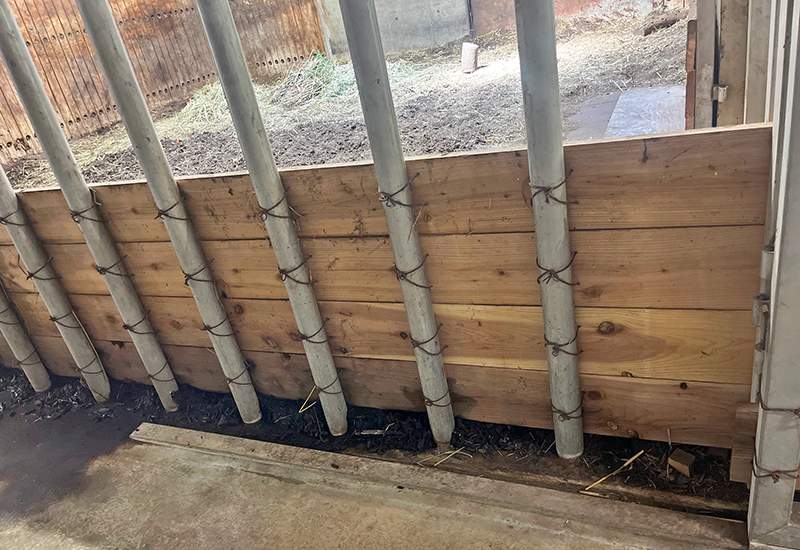
We attached boards to the fence to prevent the baby rhinos from getting out.After completing preparations for the birthing facility, Gopon soon began showing signs of labor. On September 2nd, during evening training, we noticed a clear fluid leaking from her nipples. Also, during indoor cleaning, we noticed her feces had a more sour smell than usual. The following day, September 3rd, Gopon rested lying down from the morning, but later showed aggressive behavior in response to calls for training. Judging from this behavior that birth was imminent, we decided to keep Gopon in the indoor exhibit room all day. At that time, we confirmed that white milk was leaking from her nipples. Since birth often occurs within a few days of milk leakage, we carefully monitored her condition.
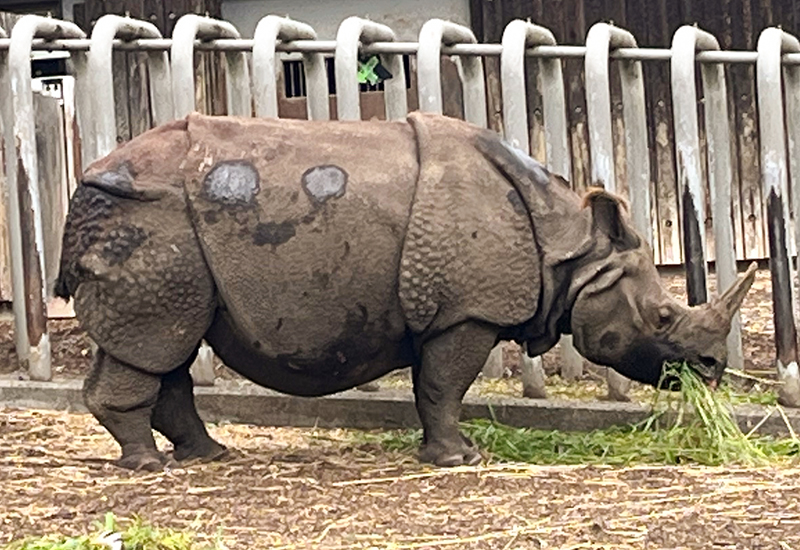 | 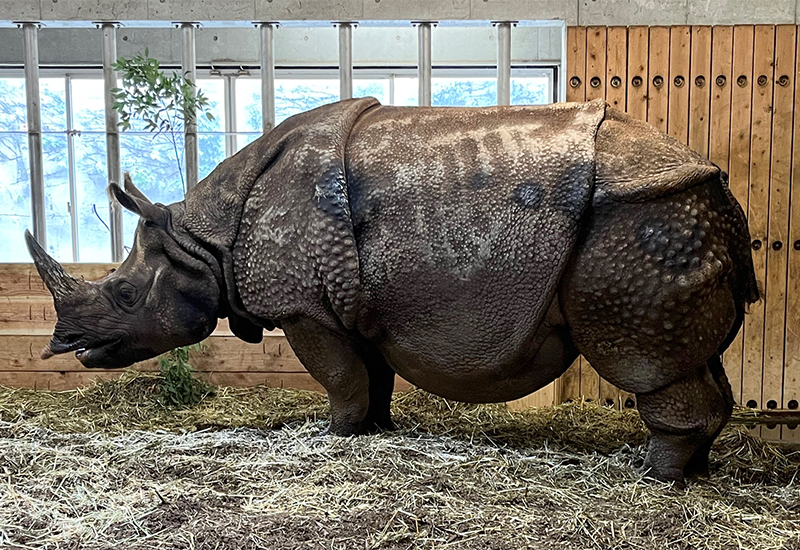 |
| Taken on August 6, 2023 | Photo taken 3 days before giving birth (August 31, 2024)
Her stomach is very swollen. |
Around noon that same day, a brown liquid was discharged from Gopon's genitals, indicating that her water had broken. Then, at 1:20 PM, Gopon gave birth. At that time, I was doing other work inside Greater One-horned Rhinoceros enclosure, but I heard an unusual noise and went to check on her, discovering that a baby rhino, still encased in amniotic sac, was emerging from Gopon's genitals. During childbirth, mothers can panic and sometimes harm their offspring, so I quietly left the area to avoid disturbing Gopon and continued to observe her using the surveillance camera.
Immediately after giving birth, Gopon briefly separated from her baby rhino, but soon began caring for it. The baby rhino fell several times but got up after about 20 minutes, and nursing was confirmed two hours later. Gopon also calmed down and resumed foraging around 3 PM. The afterbirth was expelled later that day, and both mother and calf were confirmed to be in good condition. The gestation period was 484 days.
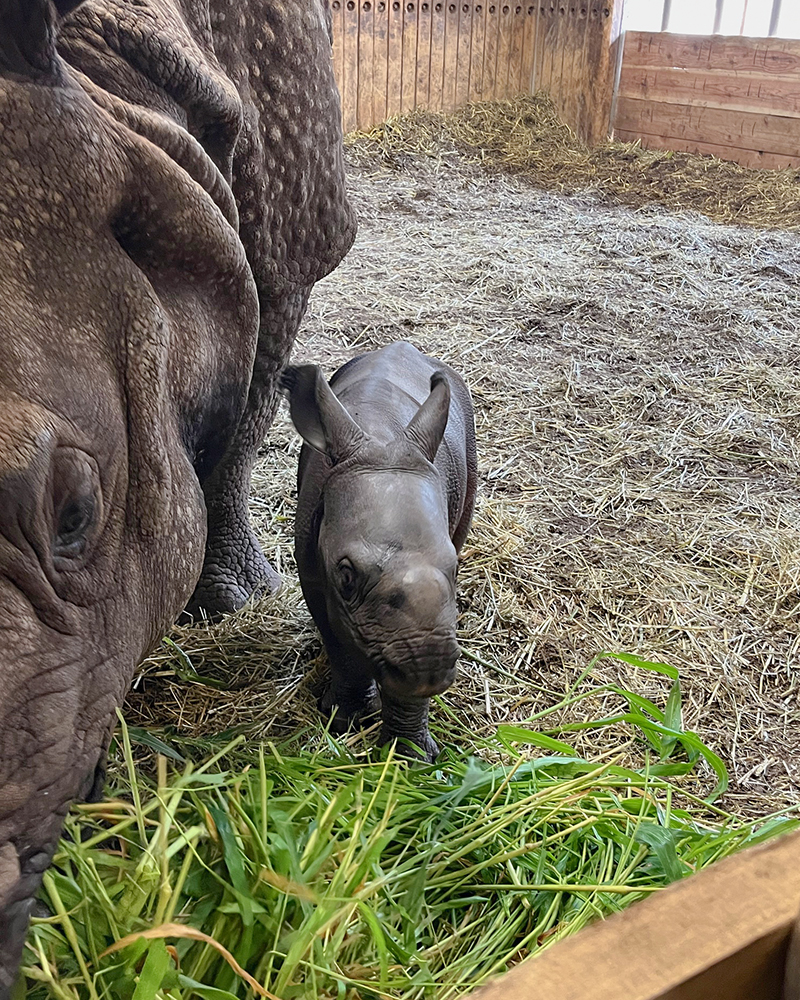
She was born safely! Photo taken on the morning of her second day of life (September 4, 2024).And so, Greater One-horned Rhinoceros was born at Tama Zoo for the first time in 50 years. It wasn't all smooth sailing, with difficulties in mating and preparations for giving birth proceeding without confirming whether she was truly pregnant, but the baby, "Dekopon," was born safely, and seeing Gopon calmly raising her offspring made me realize once again how wonderful Greater One-horned Rhinoceros are.
We will utilize the knowledge gained from this breeding project to contribute to improving Greater One-horned Rhinoceros rearing techniques. We would appreciate your continued warm support as Dekopon grows.
[Arashida, Tama Zoo]
◎Related articles
・
Aiming to breed Greater One-horned Rhinoceros: A report on the cohabitation situation of "Gopon" after his arrival at the zoo. (November 12, 2021)
・
Greater One-horned Rhinoceros "Gopon" may be pregnant – if she gives birth, it would be the first birth at Tama Zoo in 50 years, since 1973. (June 26, 2024)
・
Greater One-horned Rhinoceros has been born! This is the first birth at Tama Zoo in 50 years! (September 5, 2024)
(September 3, 2025)