We would like to share the results of Tama Zoo 's research into the breeding ecology of shrews.
1. Long-clawed Shrew Tama Zoo!
Four Long-clawed Shrew were born at our zoo on July 22, 2021. This marks the first successful breeding of large-footed shrews in a zoo in Japan.
Long-clawed ShrewBirthday July 22, 2021 (Thursday/Holiday)
Number of individuals: 4 (1 is currently surviving)
Gender unknown
Both parents were collected on September 21, 2020, on Kenbokki Island.
Visited Tama Zoo on September 26, 2020.
ProgressOur zoo entered into a partnership agreement with Hamanaka Town, Akkeshi District, Hokkaido in 2007, and has been working on breeding Long-clawed Shrew and Eurasian Least Shrew which were collected on Kenbokujima Island in the town. Furthermore, since 2019, we have entered into a joint research agreement with Mr. Jun Kawahara, who has been conducting flora and fauna surveys on Kenbokujima Island in Hokkaido since 1999, with the aim of "elucidating the breeding ecology of shrews."
Thanks to the cooperation of Mr. Long-clawed Shrew in Hamanaka Town, four shrews were born on July 22nd of this year from a pair that had overwintered in captivity. Subsequently, one died by August 8th, another on September 12th, and another on September 18th, but one is currently growing.
*Regarding the partnership agreement
In 2007, Hamanaka Town and Tama Zoo concluded this agreement with the aim of clarifying the physiological ecology of valuable wild animals and plants inhabiting Hamanaka Town, and protecting and promoting their habitats.
Regarding the release scheduleIt is yet to be determined. Information regarding the exhibition will be announced on the website.
Please note that the "Mole House," which houses Long-clawed Shrew is temporarily closed for facility maintenance.
Current status of animal care at our zoo (as of October 14, 2021)5 individuals (2 males, 2 females, 1 unknown) *This includes the offspring born this time.
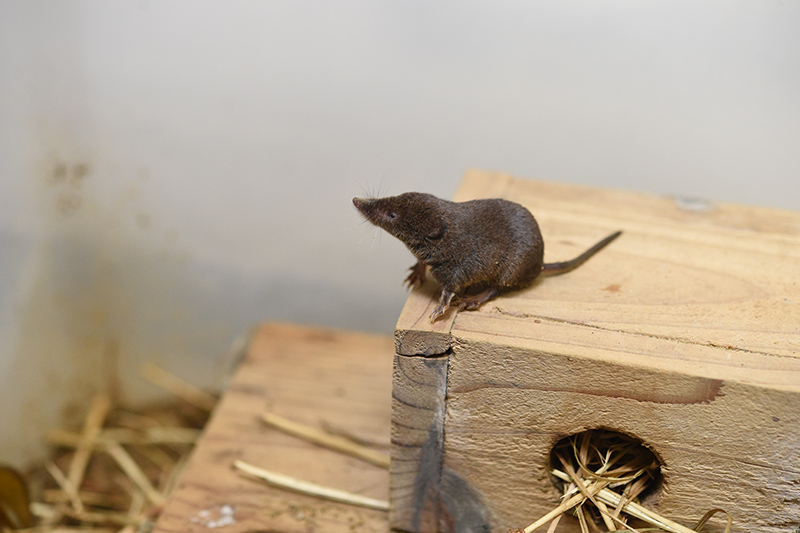
Long-clawed Shrew
(Date of photo: September 15, 2021)
2. The first Eurasian Least Shrew has been born in captivity!
Our zoo is collaborating with Jun Kawahara, who conducts research on shrews, to "elucidate the reproductive ecology of shrews." As a result of this work, three Eurasian Least Shrew that we collected have given birth in captivity. This is the first reported case of shrew births in captivity in Japan.
A newly born Eurasian Least Shrew(1) Birthday August 1, 2021 (Sunday)
Number of animals: 7 (2 are still alive today)
Gender unknown
Parents: Mother: Collected on July 28, 2021, in Shiranuka-cho, Shiranuka-gun, Hokkaido.
Father: Unknown (wild individual)
Breeding location: Breeding facility in Shiranuka Town
(2) Birthday August 4, 2021 (Wednesday)
Number of animals: 5 (1 is still alive today)
Gender unknown
Parents: Mother: Collected in Shiranuka Town on July 28, 2021
Father: Unknown (wild individual)
Breeding location: Breeding facility in Ebetsu City, Hokkaido
(3) Birthday: Friday, August 13, 2021
Number of individuals: 2 (no individuals have survived to date)
Gender unknown
Parents: Mother: Collected in Shiranuka Town on July 30, 2021
Father: Unknown (wild individual)
Breeding location: Breeding facility in Ebetsu City
ProgressOur zoo has entered into a joint research agreement with Mr. Jun Kawahara, who has been conducting flora and fauna surveys on Kenbokki Island in Hamanaka Town, Akkeshi District, Hokkaido since 1999, with the aim of "elucidating the reproductive ecology of shrews" since 2019. As part of this joint research, we conducted a capture survey in Shiranuka Town from July 28th to 30th this year. Subsequently, one of the collected shrews gave birth to seven pups on August 1st at a breeding facility in Shiranuka Town, and two other shrews gave birth to five pups on August 4th and two pups on August 13th at breeding facilities in Ebetsu City.
There have been no previous reports of Eurasian Least Shrew giving birth in captivity, and this is the first time that a pregnant shrew has been captured and given birth in captivity. Three shrews are currently being raised at a breeding facility in Ebetsu City. Mr. Haruhiro Rokuda also cooperated with the on-site capture survey and rearing.
Regarding the release scheduleThere are no plans to make it public. Information regarding the child's development will be posted on the website.
Current status of animal care at our zoo (as of October 14, 2021)2 females
*The baby born this time is being raised in Hokkaido and there are no plans to keep it at our zoo.
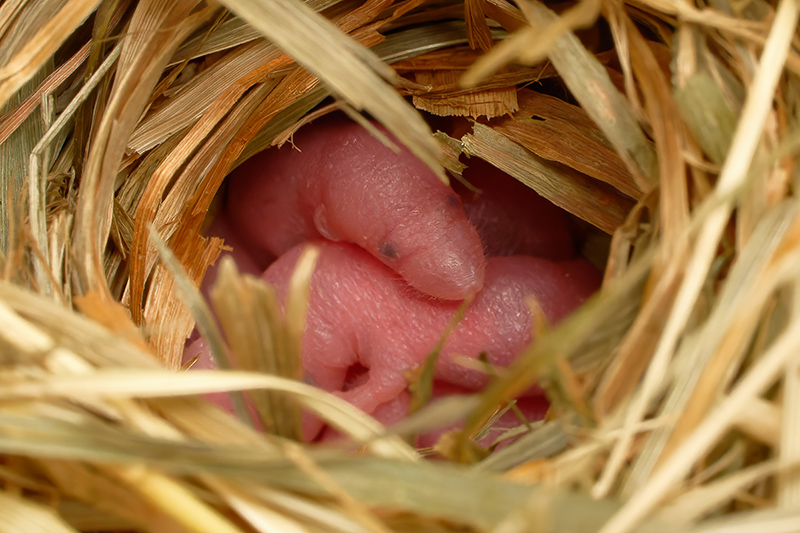
Eurasian Least Shrew three days after giving birth
(Photo taken on August 4, 2021; Photo courtesy of Haruhiro Rokuda)(October 14, 2021)