In August 2021, I was able to witness the birth of three Eurasian Least Shrew the world's smallest mammal, which is found only in Hokkaido within Japan—a first in the world.
The mother shrews, starting with a head-body length of approximately 4 cm and a weight of around 2.0 g, increased in weight to about 1.8 to 2.1 times their initial weight. Between early and mid-August, the three adult shrews gave birth to newborns in the order of 7, 5, and 2 pups respectively. Two days after birth, the newborns weighed 0.25 g and had a head-body length of approximately 22 mm. They generally began to vocalize around the 4th day, their fur grew in completely by the 16th day, their eyes opened on the 18th day, and they reached almost the same head-body length and weight as their mothers. Weaning began on the 24th day, and they became independent on the 30th day. The gestation period was about 15 days, which is about 10 days shorter than the known gestation period of shrews, and the parenting period was found to be almost the same.
[Video] Growth record of a newborn Eurasian Least ShrewIt seems simple when summarized like this, but in reality, it took 19 years to finally experience this childbirth. There were many hurdles to overcome before this encounter.
Eurasian Least Shrew was first discovered in Japan in 1903, but until 2001, it was such a rare species that it was said that only accidental captures had occurred, with only 46 individuals captured at 11 locations. During that time, only one shrew was ever captured alive. After I discovered a coastal environment suitable for capturing this species in 2002, it was around 2005 that we were able to establish the technology to capture them alive and keep them in captivity. From that year, our joint research with Tama Zoo began. Actually, that's when the real challenges began.
We encountered a difficult reality for breeding this species: "Kenbokki Island is the only place where we can reliably capture specimens every year," "We can hardly capture any during the breeding season from June to August," and "About 80% of those captured are males." Furthermore, because it is a small island, we had to take the utmost care to prevent the species from becoming extinct. Therefore, from 2008, we aimed to capture specimens once a year in September, when the number of individuals to be captured is highest, and breed them in captivity the following year. However, high tides and tsunamis struck Kenbokki Island, severely impacting the species' habitat, and making it difficult to secure captive individuals for a prolonged period.
A turning point came in 2018 with the discovery of a new capture site other than Kenbokki Island. This removed various limitations imposed by the island, allowing us to increase the number of individuals we could capture. And that's when our 213th, 214th, and 215th captured individuals gave birth.
However, there are still many mysterious phenomena, and in fact, we have only just begun to unravel the mysteries of this species' ecology. The real challenge begins now.
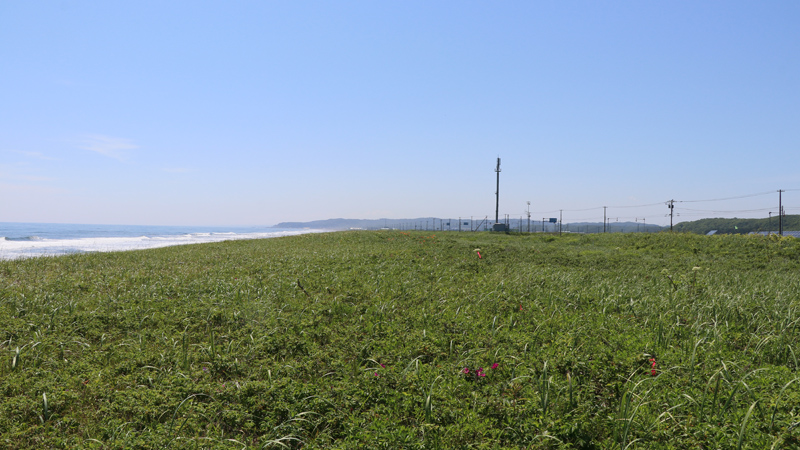
Capture location environment[Jun Kawahara, Conservation Promotion Officer for Rare Wild Animals and Plants, Ministry of the Environment]
◎Related News
・
Results of efforts to elucidate the reproductive ecology of shrews (October 14, 2021)
(January 4, 2022)