Red-headed Wood Pigeon is a rare species of Japanese Wood Pigeon found only in the Ogasawara Islands. Its body is black, but it has a beautiful, glossy reddish-purple to green gradient that extends from its head to its chest.
In the Ogasawara Islands, the population of the Ogasawara wood pigeon had been declining due to feral cats, rats, and accidents. Therefore, since 2000, Tokyo Zoological Park Society has been working with the national government, the Tokyo Metropolitan Government, Ogasawara Village, and NPOs to protect and increase the population of Red-headed Wood Pigeon. As part of this effort Tama Zoo accepts injured individuals, such as those with wing fractures, that are difficult to return to the wild, and after treatment, provides care and breeding services.
In mid-April 2021, two Red-headed Wood Pigeon with fractured wings were brought to an animal hospital from the Ogasawara Islands. Birds need to keep their bodies light in order to fly, and their bones have many tiny cavities. While this allows them to be lightweight, it also makes them animals that are prone to fractures when strong force is applied.
The two birds were brought to the animal hospital and treatment for their fractures began immediately. Both birds had fractures in the radius and ulna of their forearms. Therefore, under anesthesia, pins were inserted into the bones to straighten them, and they were hospitalized until the bones healed.
One of the injured birds was a young bird, and because the time between discovery and treatment was short, the bone healed in about a month, the pins could be removed, and it was discharged in June. On the other hand, the other bird was an adult, and its recovery was slower than the young bird's. Because time had passed between discovery and treatment, the bone did not heal easily. Ultimately, the bone and skin tissue at the tip of the toe at the fracture site began to die, so we had no choice but to perform surgery to amputate the wing from the elbow joint. After the surgery, it recovered smoothly and was discharged in August.
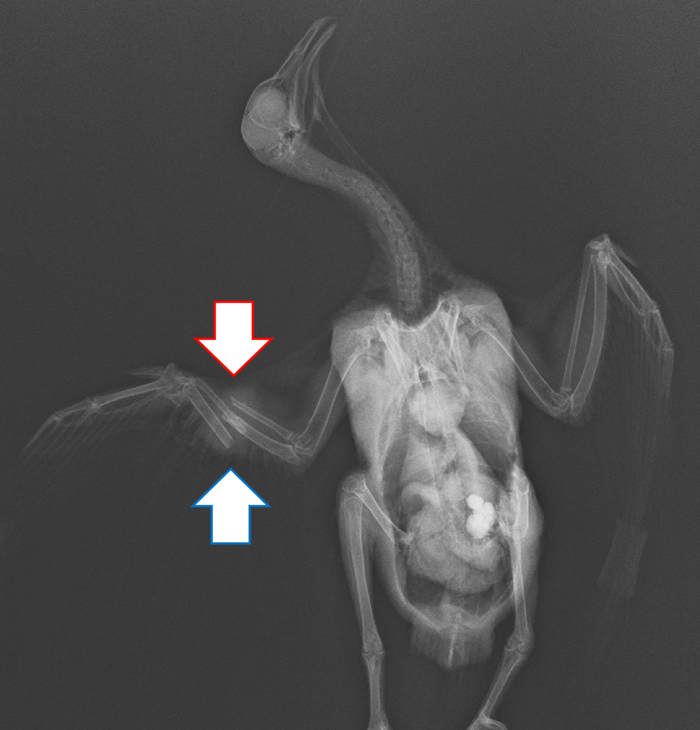 | 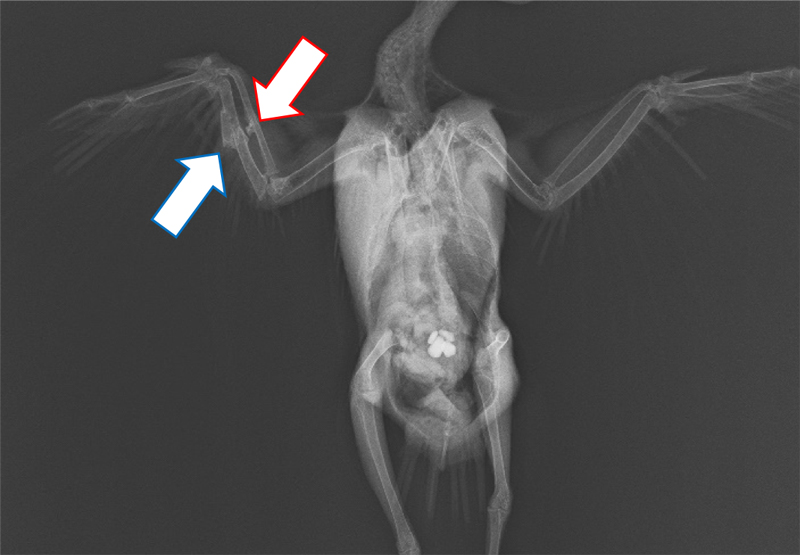 |
X-ray image of a young bird upon arrival.
The bone is broken and dislocated.
(Red arrow: RadiusBlue arrow:ulna) | X-ray of a young bird before its discharge from the hospital.
The bones are firmly fused together.
(Red arrow: RadiusBlue arrow:ulna) |
Furthermore, since the two birds had been moved to the zoo from outside, we also carried out quarantine procedures in parallel with treating their fractures. During their hospitalization, we faced various difficulties, such as initially worrying because they wouldn't eat, and finding parasites during quarantine, which took a long time to disappear even after deworming.
One thing I noticed while taking care of them was that they seemed to have their own preferences for food from time to time. For example, one day they would mainly eat live food, but a few days later they would eat a lot of commercial feed and leave the live food behind, or even within the commercial feed, they would only eat certain beans. I found it interesting that they were so selective about what they ate.
The two chicks that were discharged from the hospital are currently being raised in the brooding house, and we hope that they will eventually play an active role in breeding at Tama Zoo.
This time, we introduced some of the conservation activities for rare species being undertaken at Tama Zoo. In the future, we would like to share information about other rare species initiatives from a veterinarian's perspective.
[Tama Zoo]
(January 28, 2022)