African Bush Elephant kept at Tama Zoo
Tomu This is the third article in our series on our challenge with Tomu (male). In the previous articles (
Part 1,
Part 2), we reported that our new approach has increased Tomu's exploratory behavior and range of movement, and that he has become more independent in his actions. This time, we would like to introduce some of our new feeding methods.
Many wild animals, including elephants, spend the majority of their time foraging and eating. However, in captivity, these activities are confined to an environment provided by humans, inevitably shortening the time they spend foraging. Furthermore, the unique behaviors that each species exhibits when obtaining or foraging for food (for example, elephants extending their trunks to break off branches) that are seen in the wild become less frequent. Prolonged exposure to such conditions can lead to a decline in the animals' physical and mental health. Large African Bush Elephant are no exception, and changing feeding methods is unavoidable for their long-term health maintenance.
Therefore, as a challenge for Tomu, we animal keeper have been thinking about and installing various food containers (feeders). When installing them, we set the behaviors and goals we wanted to express, and proceeded only after considering safe equipment and methods for both the elephant and the people. This time, we will introduce some of them.
Throw-in feeder
I give him food when I add more or when Tomu seems bored. Also, the difficulty of getting the food out varies slightly depending on the type of feeder. Furthermore, by sometimes feeding him and sometimes not, and by changing the feeding time, I can stimulate Tomu without letting him predict when he will be fed.
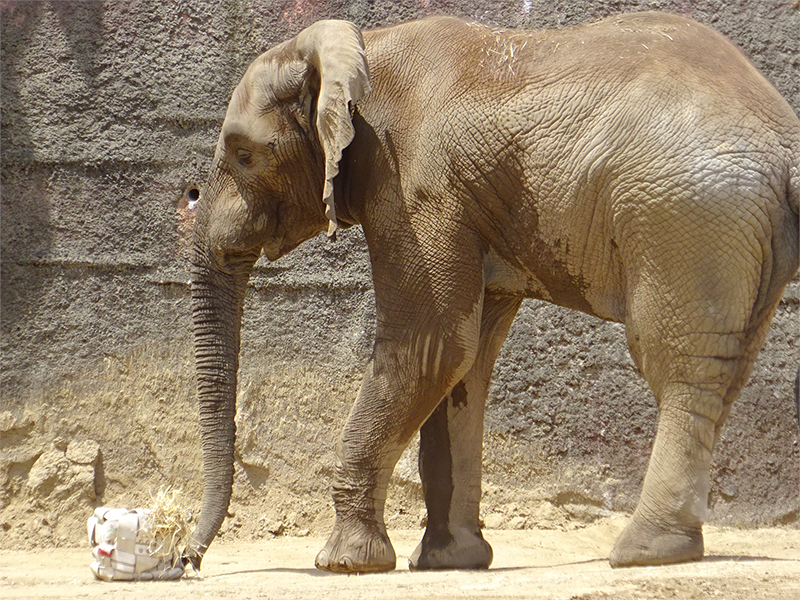
Tomu takes hay from a feeder made from a fire hose.
V-feeder
These buoys are used to hold small amounts of food such as root vegetables, pellets, and hay cubes (dice-shaped hay). Depending on the buoy, the method of use may differ, such as shaking to retrieve the food or rotating it. It seems that Tomu uses each buoy with a different method of retrieval in mind.
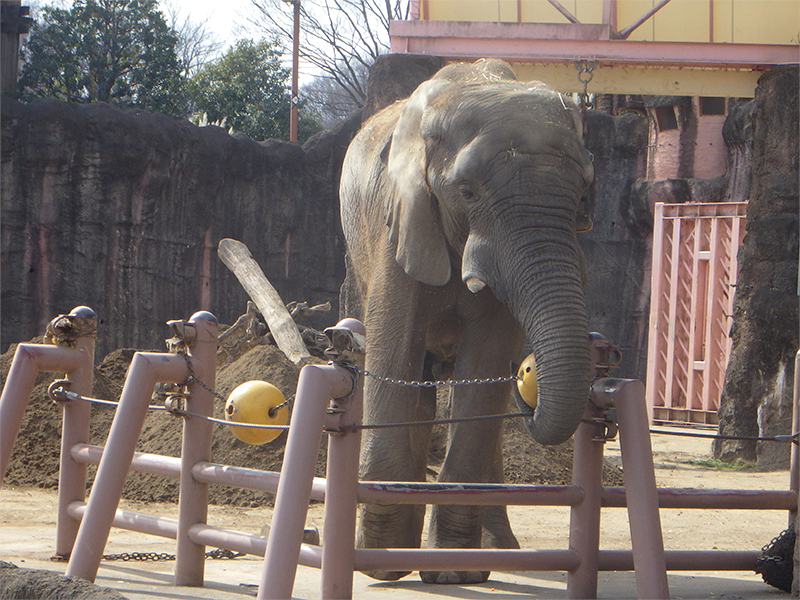
Tomu using a buoy
Edayama
As the name suggests, it's a pile of branches. Giraffe and Chimpanzee reuse the branches they've left behind. By hiding food amongst them, the animals have to move the branches aside to search for it. Elephants also munch on these branches.
Tomu eating branches from the mountain of branches
Haynett
The nets are filled with a mixture of fresh grass and hay, and the elephants pull them out. Wild African Bush Elephant are adept at eating branches and leaves from high places, and it is very important to replicate this behavior in captivity for their health. This is because they have to lift their heavy trunks and heads to get food from the hay nets, which helps to strengthen the shoulder and neck muscles that are essential for maintaining a healthy physique.

Tomu using Haynet
Haynet is about 6 meters above the ground.These feeding efforts have allowed us to increase the time Tomu spends foraging. Furthermore, this approach seems to have had an impact on Tomu's personality. At first, Tomu would give up if he found it even slightly difficult to get food from the feeder. Lately, however, he has been seen thinking about and experimenting with different ways to get food, and we believe this has increased his assertiveness and curiosity.
I believe that Tomu's increased exploratory behavior and his ability to think and act independently are significant improvements. Going forward, I will continue to consider and implement initiatives that encourage proactive behavior in order to help Tomu live a healthy life.
The four feeders introduced here are only a part of the whole. If you're curious about other feeders or new features, please come visit African Bush Elephant enclosure and carefully observe whether there are any feeders there on that day and how Tomu actually uses them. You might make some interesting new discoveries.
(March 3, 2023)