As of January 2023, there are 61 Japanese Japanese Macaque (28 males and 33 females) living in the monkey enclosure at Tama Zoo. The monkeys do not understand what their own names are, but the staff have given names to the members of the group so they can distinguish them, and they also record individual histories such as birth dates, weight, births, and illnesses.
Listing some of the members' names in order from oldest to youngest by birth year, we get: Nishikitake Sakuratake (1996), Konohagaeru (1998), Keri (2000), Mimiika Suboya (2001), Hasu (2002), Tsubaki Konara (2004), Ai Kon (2005), Renge Hakobe Keshi (2006), Lemon Olive (2010), Ocarina Echo (2012) ), Balloon, Clematis, Otedama (2013), Viola, Oboe, Flute (2015), Loofah, Okra, Corn, Chives (2016), Shallot, Salmon Roe, Mentaiko, Aonori, Furikake (2017), Besi, Vikke, Osomatsu, Zenigata, Ashitaka, Mogutan, Hemuhem, Nodame (2018), Dvořák (2020), Watao, Tokkaebi (2022).
If you look closely, you'll see that each year of birth has a designated naming theme, allowing you to identify individuals of the same age from their names. The themes are as follows: 1996: "Mushrooms", 1998: "Frogs", 2000: "Birds", 2001: "Marine Invertebrates", 2002: "Fish", 2004: "Woody Plants", 2005: "Colors", 2006: "Herbaceous Plants", 2010: "Fruits", 2012: "Musical Terms", 2013: "Children's Games", 2015: "Musical Instruments", 2016: "Vegetables", 2017: "Accompaniments to Rice", 2018: "Anime and Other Characters", 2020: "Musicians", and 2022: "Titles of Korean Llama".
| Year of birth | Individual name | Naming theme |
|---|
| 1996年 | Nishikitake, Sakuratake | Mushrooms | | 1998年 | Leaf frog | Frogs | | 2000年 | Keri | birds | | 2001年 | Bighead squid, sea squirt | Marine invertebrates | | 2002年 | Lotus | fish | | 2004年 | Camellia, Quercus serrata | Woody species | | 2005年 | icon | color | | 2006年 | Chinese milk vetch, chickweed, poppy | herbs | | 2010年 | Lemon, Olive | fruit | | 2012年 | Ocarina, Echo | Musical terminology | | 2013年 | Balloons, clematis, beanbags | Children's play | | 2015年 | Viola, oboe, flute | musical instrument | | 2016年 | Loofah, okra, corn, chives | vegetables | | 2017年 | Pickled shallots, salmon roe, mentaiko (spicy cod roe), dried seaweed, furikake (rice seasoning) | Side dishes for rice | | 2018年 | Beshi, Vikke, Osomatsu, Zenigata, Ashitaka, Mogutan, Hemuhem, Nodame | Anime and other characters | | 2020年 | Dvořák | musician | | 2022年 | Watao, Goblin | Korean Llama titles |
In wild Japanese Macaque, males typically leave their birth group and move to other groups. Furthermore, since only females raise their young, identifying the father through observation is difficult. Therefore, the monkey family tree at Tama Zoo is created using a matriarchal population structure.
The naming convention also incorporates a mechanism for distinguishing kinship. Children from the same mother share the same initial letter, so we know that Hechima and Hemuhem are children of Echo and are siblings. Furthermore, all individuals in the group originate from five females (Maki, Ayame, Fushi, Ste, and Ocho) that came from Shodoshima in 1968. The descendants of these five women are assigned the vowels a, i, u, e, and o in the initial letter of their names, in that order, so we know that Hechima, Hemuhem, and Echo (he/he/e) are descendants of Ste.
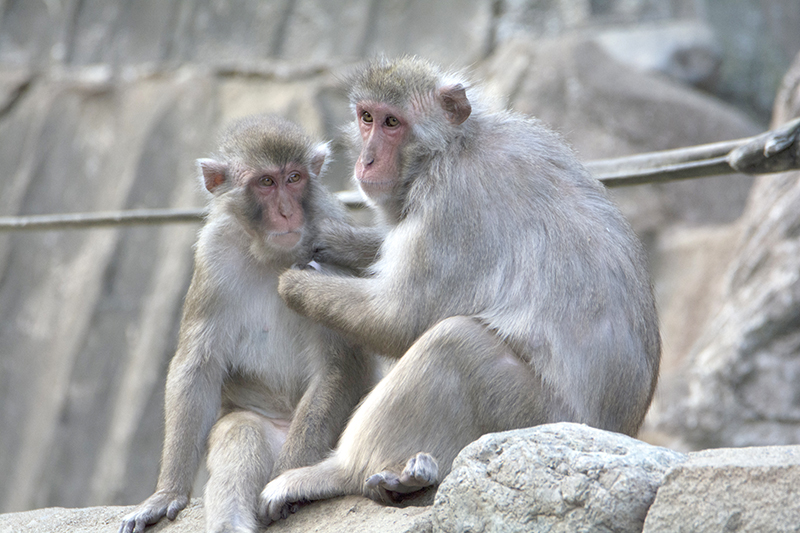
Hem-Hem (left) and his mother Echo (right)[Tama Zoo Tama Zoological Park]
◎Related News ・ Tama Zoo 's monkey mountain celebrates its 50th anniversary. (January 13, 2018)
(March 10, 2023)
|