Wild elephants spend long periods of the day searching for and foraging for food by walking, stretching their trunks, digging, and so on.
At Asian Elephant enclosure in Tama Zoo, various measures are taken during feeding to allow the elephants to utilize their trunks and legs, thereby improving their health management and the quality of the exhibit.
This time, we will introduce the work we do as Asian Elephant caretakers and how elephants forage for food.
To reach out to high places
Asian Elephant enclosure at Tama Zoo is designed so that feeders containing food can be suspended at a high position. This encourages the elephants to raise their trunks to reach food, which is their natural movement and helps them maintain a healthy physique by strengthening their neck and shoulder muscles. Because the feeders are suspended a little higher, making it difficult for the elephants to reach the food with their trunks, they use nearby logs or gas pipes as stepping stones to get their food.
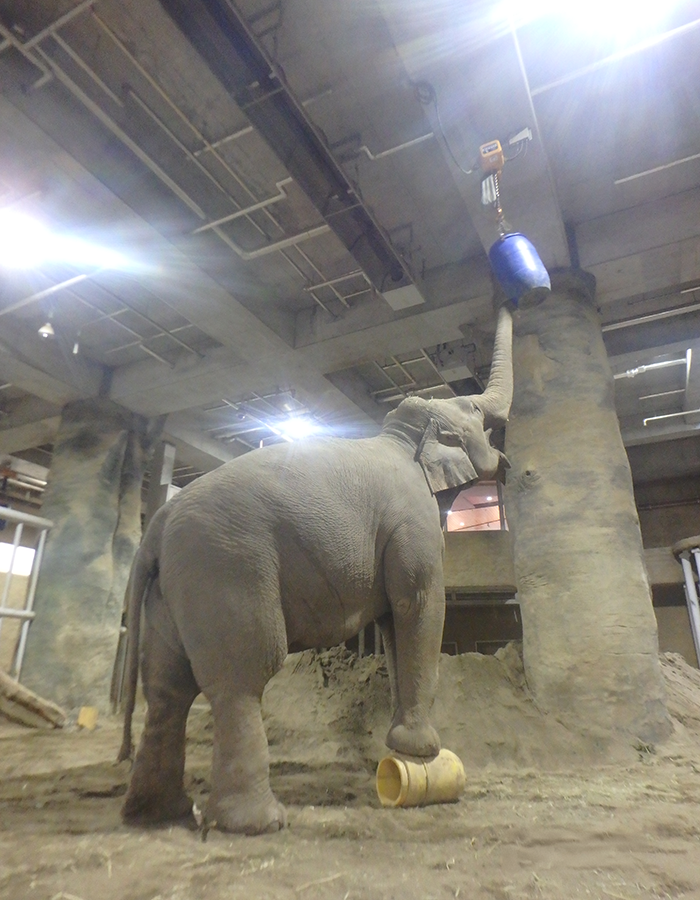
Amara (female) uses a gas pipe as a stepping stool to reach food in high places.
Dig in the ground
Another distinctive feature of Asian Elephant enclosure is that almost the entire facility is covered with soil or sand. The indoor sand area is about 2 meters deep, allowing the elephants to take sand baths, reducing strain on their limbs, creating an undulating terrain to increase their exercise, and providing various other benefits for elephant care and management.
By burying food in this sandy area, elephants can be encouraged to use their sense of smell to search for food, dig holes, and use their trunks to retrieve and eat the food from the ground.
Amara, Asian Elephant, digs in the sand with her front legs to eat buried food (time-lapse footage shot at 0.5-second intervals, played back at the same 0.5-second intervals).
They fold their front legs to grab food.
In sandy areas, you can bury not only food but also feeders. If you bury a long gas pipe into a sand mound and put food inside, the elephants will extend their trunks to reach the back to get the food. When they do this, they can bend their front legs to reach even further back. These movements of the elephants, including their gait, are one of the things we animal keeper use to judge the condition of the elephants' legs.
Amara bends her left foreleg to reach the food deep inside the gas pipe buried in the sand mound.
Roll the feeder to get the food out.
To diversify their foraging behavior, Asian Elephant enclosure has a variety of feeders, including some that the elephants can roll with their trunks or feet, causing the food inside to fall out through a downward-facing hole. Similar to the feeders we've introduced so far, this makes it take the elephants longer to find their food, which helps reduce their boredom.
Anura (male) feeds by rolling a feeder.Our important job animal keeper is to increase opportunities for the elephants living in the zoo to showcase their abilities and to ensure they have a rich and fulfilling time. We also hope that our efforts will be conveyed to visitors through the animals, making their time at the zoo enjoyable and rewarding.
[Tama Zoo Tama Zoological Park]
◎Related articles
・
Asian Elephant "Vidura" is released into the wild at night for the first time since moving. (June 10, 2022)
・
The ingenuity animal keeper (February 17, 2023)
・
Vehicles working in the "Valley where Asian Elephant Live" (November 10, 2023)
・
Making a bed in the sand—creating a sleeping place for African Bush Elephant (October 25, 2024)
(May 2, 2025)